
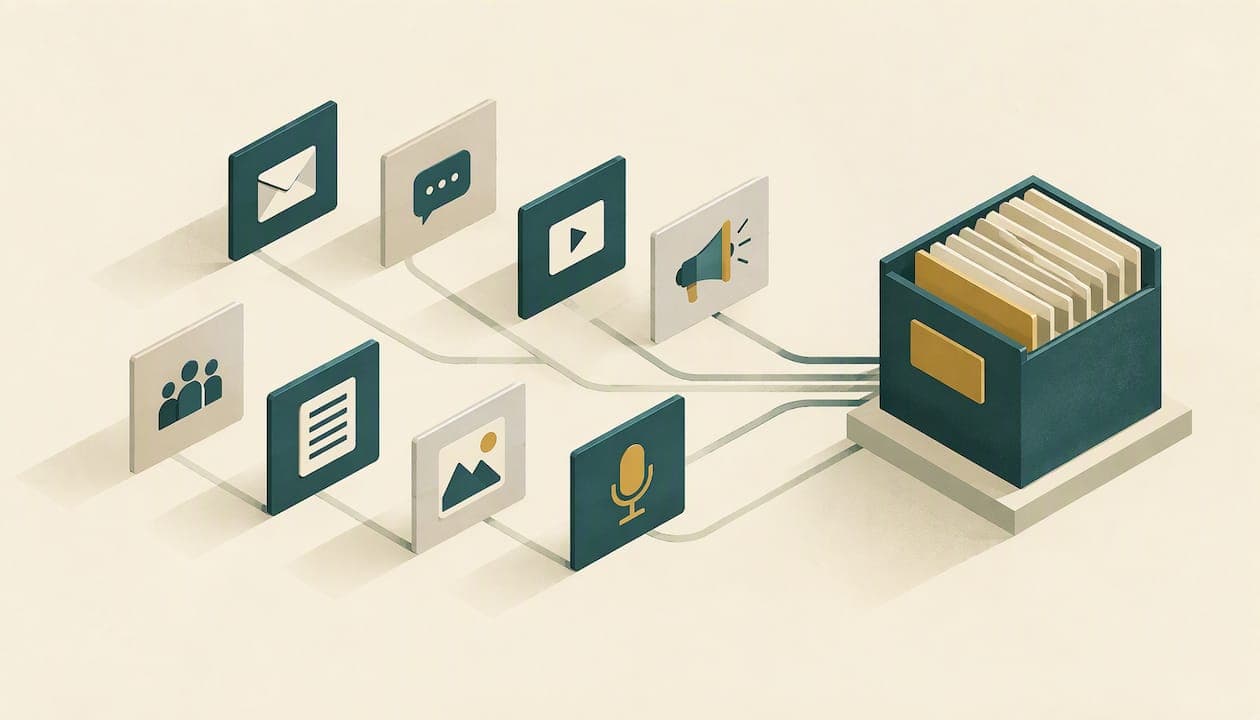
Advisor marketing archiving is the firmwide system that captures and preserves every marketing communication your firm publishes or sends, and relevant business communications should be captured and retrievable under applicable SEC and FINRA recordkeeping rules. Your first move is a capture inventory: list every channel your team uses, then confirm that each one, including messaging apps used for business, is actually being saved.
TL;DR:
- The general retention period is five years, with the first two years readily accessible in an appropriate office; confirm the exact period by record type.
- Retention follows content, not the device: capture business messages in any app, including personal social accounts used for work, or prohibit those accounts.
- A registered principal should approve static content before publication, while firms can review interactive threads after use through documented sampling on a fixed schedule.
- Index dated versions, approval records, send details, and calculation worksheets, then test retrieval with a campaign so examiners can trace claims to supporting evidence.
Table of Contents
- Why does archiving matter for U.S. advisors?
- What marketing content should you archive?
- Where and how should you store archives?
- How long must you keep records, and what will examiners ask for?
- What operational controls keep archiving running daily?
- What can you do this week to become audit ready?
- Why does treating archiving as a capability help marketing scale?
- How do we help you build compliant archiving and marketing operations?
- FAQ
- Sources
Why does archiving matter for U.S. advisors?
Two layers of rules sit behind this work. The SEC's marketing rule modernized advertising and solicitation requirements and amended the books-and-records obligations that support them. Rule 204-2 then requires advisers to keep true, accurate and current records, including communications relating to the advisory business.
Enforcement attention has followed. SEC exams have shifted toward off-channel communications, meaning unmonitored messaging apps, and firms face fines for failing to supervise and archive them. Examiners also look hard at performance claims and the substantiation behind them, so your archive has to show not just what you published but why you could say it.
Examiners now scrutinize the substantiation behind performance claims and material facts, not only the final published piece. That means your records should connect each claim to its support. FINRA's Regulatory Notice 17-18 adds that content, not device type, decides what must be retained.

What marketing content should you archive?
Start from the channels, not the rulebook. If your firm uses it to reach a prospect or client, it belongs in the inventory:
- Website pages, landing pages and dated snapshots of each
- Paid ads and their creative versions
- Email templates and every campaign send
- Social posts, plus the comment threads attached to them
- Webinar recordings, slides and handouts
- Seminar invitations and attendance lists
- SMS and text messages
- Any messaging app used for business conversations
Treat static and interactive content differently. Static content, such as a posted article, is typically reviewed by a registered principal before use, while interactive threads are handled through post-use review and sampling.
The items most often missed are business posts made from personal accounts, ephemeral app chats, and third-party content your firm shares or links. For worked examples of what examiners ask to see, read our guide to advertising records to archive for SEC exams.
Where and how should you store archives?
The standard to design for is "readily accessible." Acceptable approaches include dedicated archival platforms, email archivers and versioned cloud object stores. What matters is not the brand of tool but whether you can find a specific record efficiently, which depends on indexing.
Capture metadata with every item:
- Date and time of publication or send
- Author and approver
- Channel and campaign
- Approval records and any edits
- Export format, so records can leave the system intact
Route everything through one ingestion point, keep immutable snapshots and audit logs, and test retrieval on a schedule rather than waiting for an exam letter. Email deserves its own controls; our pre-send email compliance guide covers them.
Text search also pays off here. Archived pages and transcripts that are machine-readable are far easier to retrieve, and a tool like BabyLoveGrowth's content optimization audit can show how searchable your published content is.
Pro Tip: Run retrieval drills regularly: pick a campaign and time how long it takes to produce the copy, approval and send record.
How long must you keep records, and what will examiners ask for?
Under 17 CFR 275.204-2, the baseline is five years, with the first two years kept in an appropriate office where the records are readily accessible. Treat that as the floor and confirm the details for each record type against the rule text or with counsel.
Rule 204-2 generally requires five years of retention, with the first two years in an appropriate office and readily accessible.
Exam requests tend to be specific: all ads from a date range, every version of a web page, or the support behind a performance figure. A workable response process starts with an index lookup, pulls archived copies and approval logs, and ends with an organized package for the examiner.
Have these ready to present:
- The index of archived items
- Approval logs with names and dates
- Archived copies of each communication
- Calculation worksheets behind any performance claim
For more on what to keep and why, see our walkthrough of the SEC marketing rule compliance steps.
What operational controls keep archiving running daily?
Archiving fails when it lives outside the marketing workflow. FINRA Rule 3110 calls for a supervisory system reasonably designed for compliance, and that supervision should be risk-based, not one-size-fits-all. Personal accounts are the sharpest edge: under Regulatory Notice 11-39, business posts on personal social media fall under supervision and recordkeeping, so firms should either prohibit them or capture them technically.
A practical control set:
- Name a registered principal who approves static content before it goes live.
- Write an approval workflow and require that every approval is logged.
- Decide how personal devices and messaging apps are handled: technical capture, a secure portal, or an explicit ban.
- Sample interactive content on a fixed schedule and document the review.
- Train staff on what counts as business communication, and keep attendance records.
Our five-stage compliance workflow shows how these steps fit together.
What can you do this week to become audit ready?
Work through this list in order:
- Inventory every marketing channel and content type
- Mark each channel as captured, partly captured or not captured
- Turn on capture for the gaps, starting with messaging apps
- Index the archive and test retrieval against a real campaign
- Store approval names, dates and training logs beside the content
- Keep performance calculation worksheets with the ads they support
We built our services around this kind of work. Mastermind Advisor Marketing was founded and is staffed by practicing financial advisors, and our compliance-friendly content library, webinars and seminars are designed with regulatory review in mind. For a deeper version of this list, see our compliance marketing checklist.
Pro Tip: Save each approval as a dated record attached to the content itself, not in a separate inbox where it can be lost.
Why does treating archiving as a capability help marketing scale?
Most firms see the archive as a cost. I see it as the thing that lets marketing move faster. When every webinar, email and post is captured, indexed and approved on the record, you can test new campaigns without fearing an exam letter, and a lead generation program built on clean records is one you can safely repeat. Make a change: pick the channel you trust least and put capture on it.
— Josh
How do we help you build compliant archiving and marketing operations?
We run marketing for independent advisors, and compliant records are part of how we do it. Our services include a compliance-friendly content library, fully produced webinars and seminars, email marketing automation, social media, websites and growth strategy, supported by CRM and email integrations. Current pricing details are on our website.
The outcome we aim for is centralized capture, audit-ready workflows and less friction between your marketing team and your compliance process. Review our services page or ask us for an implementation audit, and we will map your current channels against the checklist above.

This article is general information, not a substitute for advice from a qualified financial advisor. Consult a qualified financial professional about your own circumstances before acting on anything here.
FAQ
How long do advisors have to keep marketing records?
The general baseline under 17 CFR 275.204-2 is five years, with the first two years in an appropriate office. Confirm the exact period for each record type with counsel.
Do texts and messaging apps need to be archived?
Yes, when they relate to your advisory business. FINRA's Regulatory Notice 17-18 says content, not the device or platform, determines the retention duty, so business messages in any app need capture.
Are personal social media posts covered?
If an advisor uses a personal account for business, that content falls under firm supervision and recordkeeping. Firms should either prohibit the practice or set up technical capture.
What should I show an examiner first?
Start with your index, then the archived copies, approval logs and any performance calculation worksheets. A searchable index can help you answer a request more efficiently.
Sources
- SEC rules RIAs need to keep in mind in 2025 - InvestmentNews
- eCFR :: 17 CFR 275.204-2 -- Books and records to be maintained by investment advisers.
- Final Rule: Investment Adviser Marketing
- FINRA Rule 3110 and Social Media Supervision: A 2026 Overview