

A complete advisor marketing system generates leads on a schedule, nurtures them automatically, and hands warm prospects to a calendar link, with compliance checks built into every step, not bolted on afterward. If you have limited hours to build this yourself, run a single pilot webinar or lead offer through a turnkey provider like Mastermind Advisor Marketing to see whether the demand exists before committing more budget. Track one number in the first 60 days: cost per lead or meetings booked, whichever tells you faster whether the pilot deserves a second round.
TL;DR:
- Building a marketing system involves integrating lead offers, landing pages, CRM, automation, and compliance checks, with gaps often found in tracking and governance.
- A phased approach with measurable pilots, such as one offer, build, and test period, ensures steady progress and reduces the risk of stalled development.
- The fastest channels for advisors are webinars and seminars, while content, paid media, direct mail, and referrals require different timelines and tracking strategies.
- Key KPIs include cost per lead, appointment, and client, along with conversion and show rates, all of which need attribution built into the CRM.
- Compliance must be embedded in workflows using pre-approval steps, recordkeeping, oversight, and vendor diligence to avoid regulatory flagged deficiencies.
Table of Contents
- What Does It Mean to Build an Advisor Marketing System?
- How Do You Build an Advisor Marketing System Step by Step?
- Which Channels Should an Advisor Test First?
- What KPIs Prove a Marketing System Is Actually Working?
- What Compliance Rules Apply to Advisor Marketing Systems?
- How Does a Turnkey Marketing System Work in Practice?
- The One Habit That Actually Makes a Marketing System Stick
- Ready to Build This Without Doing It Alone?
- Sources
- FAQ
What Does It Mean to Build an Advisor Marketing System?
An advisor marketing system is not a bigger version of "post more on social media and hope." It is a defined set of parts that work together: a lead offer that attracts the right prospect, a landing page that converts them, a CRM that tracks them, automated follow-up that nurtures them, and a compliance layer that keeps the whole thing defensible. Miss one part and the rest degrades. A brilliant webinar with no CRM follow-up loses half its leads to a full inbox. A tight follow-up sequence with no lead offer has nothing to nurture.
Run this checklist against your current setup before you build anything new. Most independent advisors already have two or three of these pieces; the gaps are usually predictable.
- Lead offers. Webinars, downloadable guides (a retirement income checklist, a tax-loss harvesting primer), and in-person seminars remain the highest-converting entry points because they let a prospect self-select into a topic they already care about.
- Landing pages and tracking. Every offer needs its own page with clean UTM parameters, a load time under three seconds, a mobile-first form with no more than four fields, and a conversion pixel tied back to the campaign that drove the click.
- CRM and automation. One system holds every lead record as the single source of truth, scores leads by engagement, and fires an automated follow-up sequence the moment someone converts. This is also where your speed-to-lead service standard lives, and it should be measured in hours, not days.
- Content library. A reusable bank of email sequences, recorded webinars, social post bundles, and seminar decks means you are never starting from a blank page when a new campaign launches.
- Nurture and handoff. A defined appointment-setting process, a discovery-call standard, and specific tactics for lifting show rates (text reminders, calendar holds, a short pre-webinar engagement email) turn interest into booked meetings.
- Measurement and governance. Named KPIs, a dashboard someone actually checks weekly, and a compliance sign-off step before anything goes live.
The last item is where most independent shops fall down, not because compliance is complicated but because nobody owns it. A compliance checklist built for independent advisors works only if someone has the job of running it every single time, not just when a campaign feels risky.
Notice what is missing from that list: a big-budget rebrand, a flashy new website by itself, or a social media influencer strategy. Those things can support a system. They are not the system. The system is the plumbing that turns a stranger into a scheduled meeting on a predictable timeline, and that plumbing is what most advisor marketing failures actually trace back to.
How Do You Build an Advisor Marketing System Step by Step?
Treat this as a project with phases, not a single launch date. Advisors who try to build everything at once almost always stall in month two because they are debugging five new systems simultaneously with no way to tell which one is broken. A scalable advisor marketing engine gets built as a portfolio of small, measurable pilots, not one big overhaul.
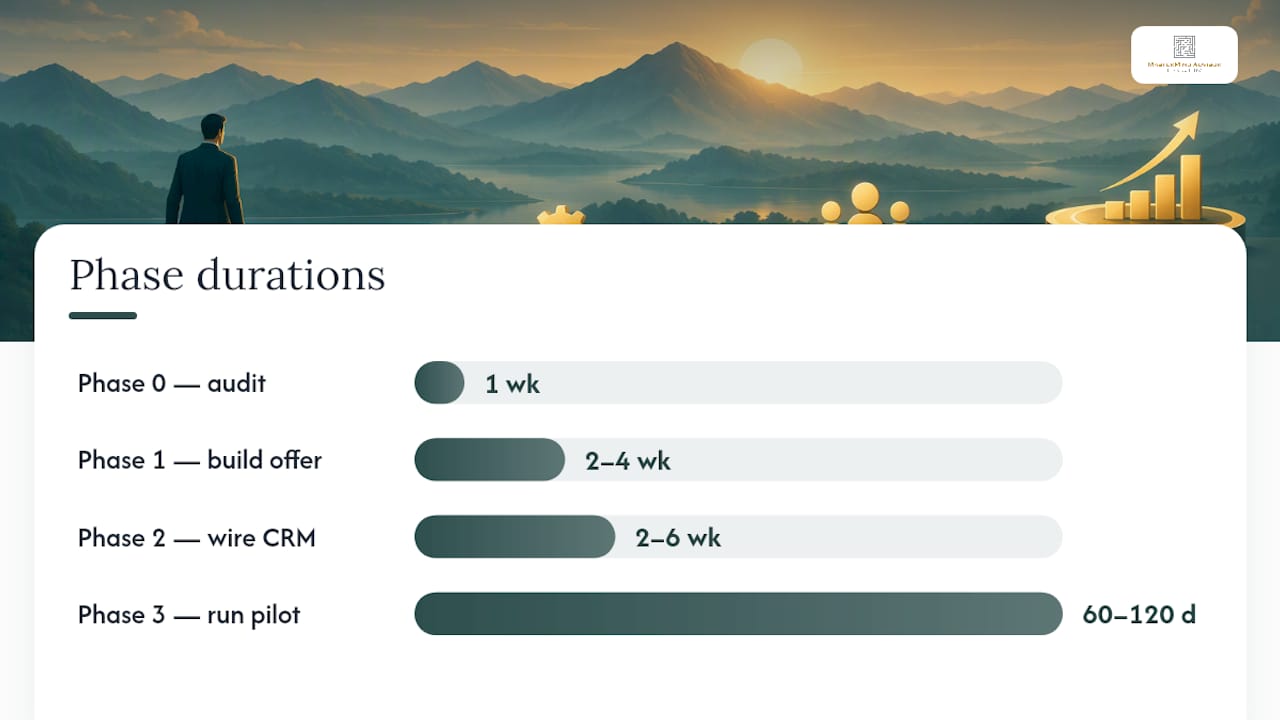
- Phase 0, the audit (one week). Pull your current lead sources into one spreadsheet, run the components checklist above against what you actually have, and pick a single pilot offer. Do not pick three. Pick one.
- Phase 1, build the offer (two to four weeks). Define the audience for that one offer, build a single landing page, and write the email sequence that follows a conversion. Keep the page to one call to action.
- Phase 2, wire the CRM (two to six weeks, can overlap with Phase 1). Map the lead source into your CRM with a tag that triggers automated follow-up, and set a written service standard for how fast a live person contacts a new lead, ideally 24 to 48 hours.
- Phase 3, run the pilot (60 to 120 days). Launch the channel, whether that is a webinar series or a small paid search budget, with a fixed spending cap and acceptance criteria decided in advance: a target cost per lead and a target show rate for anyone who registers.
- Phase 4, scale what worked. Document the process as a repeatable standard operating procedure, then add the staffing or vendor support the volume now justifies, whether that is an inside-sales hire or a content calendar service.
Resourcing does not require a marketing department. A small practice can run this with a marketing lead who owns strategy and vendor coordination, a compliance reviewer who signs off before anything publishes, an operations person who owns the CRM and automation, and someone doing inside sales or discovery calls. In many independent shops, one person wears two of those hats. What breaks the system is when nobody owns compliance sign-off, because that is the piece that gets skipped under deadline pressure.
Pro Tip: Set your speed-to-lead standard before you launch the pilot, not after you see the first batch of leads come in cold. Firms that contact a new lead within 24 to 48 hours see materially higher meeting rates than those that let leads sit in an inbox for a few days.
The timeline matters more than it looks. A four-month build to full pilot data sounds slow next to "just start posting on LinkedIn," but the phased version produces a number you can actually act on: a real cost per lead, a real show rate, a real conversion percentage from meeting to client. The fast, unstructured version produces activity with no way to know if it worked.
Which Channels Should an Advisor Test First?
The right first channel depends on your capacity and your ideal client's asset level, not on what is trending. Each channel below has a different setup cost, timeline to results, and audience fit.
Webinars and seminars remain the strongest lead offer for advisors because they let a prospect self-qualify by topic interest before they ever talk to you. Frame the offer around a specific problem (Social Security timing, Roth conversion windows, a market-volatility briefing) rather than "learn about our firm." Build the registration flow to capture the fields your CRM actually needs, follow up with a reminder sequence the day before and the morning of, and send a recorded version to no-shows within 24 hours. Show-rate levers matter as much as registration volume: a two-touch reminder sequence with a calendar hold typically outperforms a single confirmation email by a wide margin. A resource on hosting seminars that actually convert covers venue selection and follow-up timing in more depth.
Content and SEO work as a compounding asset rather than a quick win. Pick narrow, high-intent topics (not "retirement planning" but "when to start Social Security if you retire at 62 with a pension") and repurpose each piece into a weekly email and two or three social posts. Treat content engagement, time on page, email opens, click-throughs, as an early signal of lead quality even before someone converts. A content strategy built for advisors turns this from a one-off blog post habit into a repeatable content calendar.
Paid media splits by audience. Search campaigns capture people already looking for an advisor in your area. Performance Max campaigns can extend reach across Google's network for a similar intent signal. LinkedIn ads work best for niche B2B segments, business owners, executives approaching a liquidity event, where the targeting precision justifies the higher cost per click. Budget in phases, not all at once, and treat the first month as calibration.
Direct mail still earns its place for higher-AUM targets who respond better to a physical piece than a digital ad. Pair it with a personalized landing page (a PURL tied to the mail piece) so you can track response digitally even though the outreach was analog. Expect a longer runway to results than digital, usually measured in weeks rather than days.
Referrals and centers of influence deserve a structured process, not a hope. A direct, specific referral ask ("Do you know anyone else weighing a Roth conversion this year?") outperforms a vague one. COI events with CPAs or estate attorneys work best with a dedicated partnership landing page so you can track which relationships actually produce leads.
- Webinars and seminars work fastest for advisors targeting mass-affluent to near-retiree prospects.
- Content and SEO compound over months and reduce paid-lead dependency over time.
- Paid search and LinkedIn fit narrow, well-defined audience segments with clear intent.
- Direct mail fits higher-AUM targets who respond to a physical, personalized touch.
- Referrals and COI relationships need tracking infrastructure, not just good intentions.
What KPIs Prove a Marketing System Is Actually Working?
Cost per lead tells you almost nothing on its own. What separates a working system from an expensive hobby is the full chain: cost per lead, cost per appointment, cost per client, and the conversion rate at each step between them. Track these five:
- Cost per lead (CPL): total spend divided by leads generated.
- Cost per appointment: spend divided by booked, kept meetings.
- Cost per client: total acquisition spend divided by new clients signed.
- Lead-to-client conversion: the percentage of leads that eventually become clients.
- Show rate: the percentage of registrants or scheduled meetings that actually happen.
- Media efficiency ratio: revenue or AUM generated relative to media spend, used by firms running a portfolio of channels rather than a single campaign.
Benchmarks vary sharply by target client. For mass-affluent campaigns, expect a CPL in the $80 to $300 range; for high-net-worth targeting, CPL often runs $300 to $1,500 or more given the narrower, higher-value audience. Lead-to-client conversion typically lands between 2% and 10% for cold leads and 10% to 25% for warm or referral leads, a gap wide enough that blending the two into one "conversion rate" number will mislead you every time.
| Metric | Definition | Typical range |
|---|---|---|
| Mass-affluent CPL | Spend per lead, broad retirement/investing audience | $80–$300 |
| HNW CPL | Spend per lead, high-net-worth targeting | $300–$1,500+ |
| Cold lead conversion | Lead to client, no prior relationship | 2–10% |
| Warm/referral conversion | Lead to client, referred or engaged prospect | 10–25% |
Practitioner firms often accept a higher cost per client than a simple CPL number suggests, because the lifetime value of a client relationship justifies it. Firms running a marketing "portfolio" across several channels routinely accept a higher per-client acquisition cost when the resulting AUM and multi-year retention support it. Set your payback window up front, most independent practices target break-even within 12 to 24 months of acquisition spend, and decide your scale-up threshold before the pilot ends, not after.
Attribution has to be built into the CRM from day one: UTM parameters on every campaign link, a lead-source field that never gets left blank, and a conversion window (30, 60, or 90 days depending on your sales cycle) that determines when a lead officially counts as converted. Review channel performance weekly and full return on marketing investment monthly.
When a pilot underperforms, the fix is usually specific rather than a wholesale restart. Low show rate points to weak reminder sequences or a scheduling process with too much friction. High CPL points to targeting that is too broad or an offer that is not compelling enough to the audience you are reaching. Diagnose before you scrap the channel.
What Compliance Rules Apply to Advisor Marketing Systems?
Every piece of your marketing system has to survive regulatory scrutiny, and that means building compliance into the workflow rather than reviewing it after launch. Three frameworks govern most of what an independent advisor does in marketing.
The SEC Marketing Rule permits testimonials and endorsements, but only under specific disclosure, oversight, and disqualification conditions, and it generally requires a written agreement with a promoter unless compensation is de minimis. A 2025–2026 Risk Alert from the SEC's Division of Examinations flagged disclosure gaps, weak oversight, and insufficient diligence on third-party ratings as the most common deficiencies examiners are finding right now. If your system uses client testimonials or a "top advisor" badge anywhere, that oversight requirement applies to you directly, and the three conditions RIAs must meet to use testimonials compliantly are worth reviewing before your next campaign launches.
CAN-SPAM governs every commercial email your automation sends. The FTC's compliance guide requires a clear disclosure that the message is an advertisement, a valid physical postal address in the footer, and a conspicuous, easy-to-use opt-out mechanism. Opt-out requests must be honored within 10 business days, no exceptions, which means your email platform needs an automated suppression list, not a manual one someone updates when they remember.
FINRA guidance extends supervision requirements into digital communications, including oversight of any AI tools used to draft content. Regulatory notices in 2026 emphasize that firms need a reasonable supervisory system for AI-generated content, meaning every AI-drafted email, social post, or webinar script gets tested and vetted by a human before it goes live, not published on the assumption the tool got it right.
Build these controls into your workflow, not into a binder nobody opens:
- A pre-approval step where compliance signs off before any content publishes, including AI-drafted material.
- A retention schedule that keeps records of every published piece and every edit made to it.
- An audit trail showing who approved what and when.
- A named compliance role in every campaign's sign-off chain, not an afterthought review.
- A vendor due-diligence checklist for any outside marketing partner touching client-facing content.
The gap between advisors who pass an exam cleanly and those who get flagged usually is not the marketing tactic itself. It is whether disclosure, oversight, and recordkeeping were built into the process before the campaign launched, or patched in after a client complaint or an exam letter arrived.
A four-step compliance framework for RIAs built around the Marketing Rule gives you a starting checklist if you are building this function in-house for the first time.
How Does a Turnkey Marketing System Work in Practice?
The turnkey marketing system is designed to map directly onto the checklist above rather than replace it with something generic. Webinars and seminars serve as the primary lead offer, produced and staffed rather than left to an advisor's spare hours. A content library covers the reusable email sequences, social bundles, and recorded sessions that keep every new campaign from starting at zero. CRM automation handles the lead scoring and follow-up sequencing, and email marketing runs the nurture cadence between first contact and booked meeting.
Compliance sits inside that workflow rather than beside it: content moves through an approval step built for the regulatory realities of financial services before anything reaches a prospect's inbox, which matters given how many Marketing Rule deficiencies trace back to skipped oversight rather than bad intent.
The decision to build in-house versus bring in a turnkey partner usually comes down to three signals. Capacity: do you or your team have the hours to build and maintain landing pages, email automation, and a content calendar every month? Timeline: can you afford a slow, in-house build over several quarters, or do you need a working pilot in weeks? Budget: does a retainer model make more sense than hiring and training an in-house marketing coordinator who may leave in a year?
- Advisors with no existing marketing infrastructure often see the fastest path to a working pilot through a turnkey system rather than a ground-up build.
- Practices with an in-house marketing hire may only need specific pieces, like webinar production or a compliance-ready content library, rather than the full system.
- Firms already running a marketing engine can still benefit from an outside compliance workflow review to catch gaps an internal team has stopped noticing.
The One Habit That Actually Makes a Marketing System Stick
Most independent advisors do not fail at marketing because they lack ideas. They fail because the whole operation runs through one person's ad-hoc energy, a rainmaker who does a great job networking until they get busy with client work and the pipeline goes quiet for two months. That is not a marketing system. That is a hobby that happens to produce clients sometimes.
The advisors who actually build something durable stop trying to design the "perfect" campaign before launch and start running small, measured pilots instead. A four-month plan with a fixed budget and a defined acceptance number beats a six-month strategy deck that never leaves the drafting stage.
If you take one thing from this article, make it this: set a 48-hour speed-to-lead service standard today, and watch it for 90 days. Do not skip it because your CRM setup feels unfinished. Speed-to-lead is the cheapest, fastest lever you have, and it will tell you more about your system's health than any dashboard you build later.
— Josh
Ready to Build This Without Doing It Alone?
If you have read this far and the phased build plan sounds right but the hours to execute it do not exist in your week, that is exactly the gap a turnkey marketing system can close: a system designed specifically for the challenges of advisor marketing and compliance, rather than a generic agency approach.
The services lineup covers webinar and seminar production, a compliance-friendly content library, CRM and email automation, social content, and advisor websites, built as one connected system rather than separate vendors you have to stitch together yourself. It fits independent advisors who want a turnkey path to measurable lead flow without spending the next two quarters building landing pages and automation sequences from scratch. Seminar planning specifically benefits from a structured calendar approach that ties event timing to your actual pipeline needs rather than a random quarterly schedule.
If you want to see where your current setup has gaps, request an audit or scope a pilot webinar through the Mastermind Advisor Marketing growth strategy team and get a straight answer on what a working system would cost and how fast it could launch.
Sources
For deeper reading on the rules and benchmarks in this article: the SEC's Marketing Rule risk alert, the FTC's CAN-SPAM compliance guide, CFP Board's 2026 findings on advisor trust and outcomes, and Select Advisors Institute's wealth management benchmarks.
This article is general information, not a substitute for advice from a qualified financial advisor. Consult a qualified financial professional about your own circumstances before acting on anything here.
- CAN-SPAM Act: A compliance guide for business
- Investment Advisers: Additional Observations Regarding Advisers’ Compliance with the Advisers Act Marketing Rule
- Wealth management marketing benchmarks — Select Advisors Institute
FAQ
How Long Does It Take to Build an Advisor Marketing System?
A working pilot typically takes several weeks from audit to launch, followed by 60 to 120 days of measured testing before you decide to scale. A turnkey provider like Mastermind Advisor Marketing can compress the setup phase significantly since the infrastructure already exists.
What Is a Good Cost Per Lead for Financial Advisor Marketing?
Cost per lead depends heavily on your target client. Mass-affluent campaigns typically run $80 to $300 per lead, while high-net-worth targeting often costs $300 to $1,500 or more given the narrower audience.
Do I Need a CRM Before I Start Marketing?
Yes. Without a CRM, leads scatter across inboxes and spreadsheets and you lose the ability to track speed-to-lead, conversion, or attribution. Set up CRM mapping and automation before or alongside your first campaign, not after.
How Much Does Mastermind Advisor Marketing Cost?
Pricing for services like webinar production, seminars, and CRM automation is not published and depends on the scope of the engagement. Current rates and packages are available directly through the Mastermind Advisor Marketing team on request.
What's the Biggest Compliance Risk in Advisor Marketing?
The most common deficiency examiners flag involves testimonials and third-party ratings used without proper disclosure, oversight, or written agreements under the SEC Marketing Rule. Build a pre-approval and recordkeeping workflow before publishing any content that features client feedback.