

Advisor public relations is defined as the specialized practice of managing communications, media relationships, and thought leadership for individual financial advisors to build trust, generate qualified leads, and establish lasting authority. Unlike general corporate PR, advisor PR focuses on the person behind the practice. It shapes how prospects, clients, and even AI-powered search tools perceive a specific advisor's expertise. Regulatory and compliance considerations are built into every tactic, making this discipline distinct from standard marketing. Understanding what is advisor pr explained correctly means recognizing it as a long-term reputation investment, not a one-time campaign.
What is advisor PR explained: core definition and purpose
Advisor PR is the structured practice of earning third-party media coverage, building a thought leadership presence, and managing public narratives for individual financial advisors. The industry term for this discipline is "financial advisor public relations," and it sits at the intersection of media relations, content strategy, and personal branding. Many advisors mistakenly view PR as only crisis management or press releases. That misunderstanding costs them years of compounding reputation value.
The core purpose of advisor public relations is to create verifiable, third-party proof of expertise. A prospect who finds an advisor quoted in Barron's, featured on a financial podcast, or cited in a MarketWatch article arrives with a level of trust that no paid advertisement can manufacture. That trust shortens sales cycles and improves the quality of inbound leads. Compliance-aligned messaging is woven into every tactic from the start, so advisors never have to choose between visibility and regulatory safety.

What does a typical advisor PR program look like?
A well-structured advisor PR program follows a clear sequence. The first phase runs 6–8 weeks and covers foundational work: auditing the advisor's website schema markup, building a media page, aligning compliance workflows, and developing a core narrative. Without this foundational preparation, media wins fail to boost organic authority or capture leads. Skipping this phase is the single most common reason advisor PR programs underdeliver.
The ongoing execution phase typically spans 12–18 months on a monthly retainer. During this period, the program targets 5–10 trade publication quotes and 3–6 podcast appearances as benchmarks. Those placements build a recognizable digital footprint that both human prospects and AI tools use to vet credibility. A structured 90-day foundational plan leads to pipeline impact within 6–12 months, with measurable inbound leads and shortened sales cycles as the primary signals of success.
Key performance indicators for advisor PR programs include:
- Share of voice — how often the advisor appears in media relative to peers in the same niche or geography
- Inbound lead volume — direct inquiries that cite a media appearance or article as the first touchpoint
- Sales cycle length — the time from first contact to signed agreement, which typically shortens as media credibility grows
- Digital footprint depth — the number of distinct, authoritative publications where the advisor is quoted or featured
- Referral confidence — the ease with which existing clients refer others, supported by shareable media assets
Pro Tip: Track inbound leads by source from day one. Ask every new prospect how they found you. Media-sourced leads close faster and require less education, so isolating them proves PR's return on investment to your own practice.
How does advisor PR differ from general financial PR?
General financial PR serves institutions: asset managers, banks, and publicly traded firms. Advisor PR serves the individual. That distinction changes everything about strategy, tone, and execution. The goal is not to protect a firm's stock price or manage an earnings announcement. The goal is to make one advisor the recognized expert in a specific niche, whether that is retirement income planning for federal employees or tax-efficient wealth transfer for business owners.
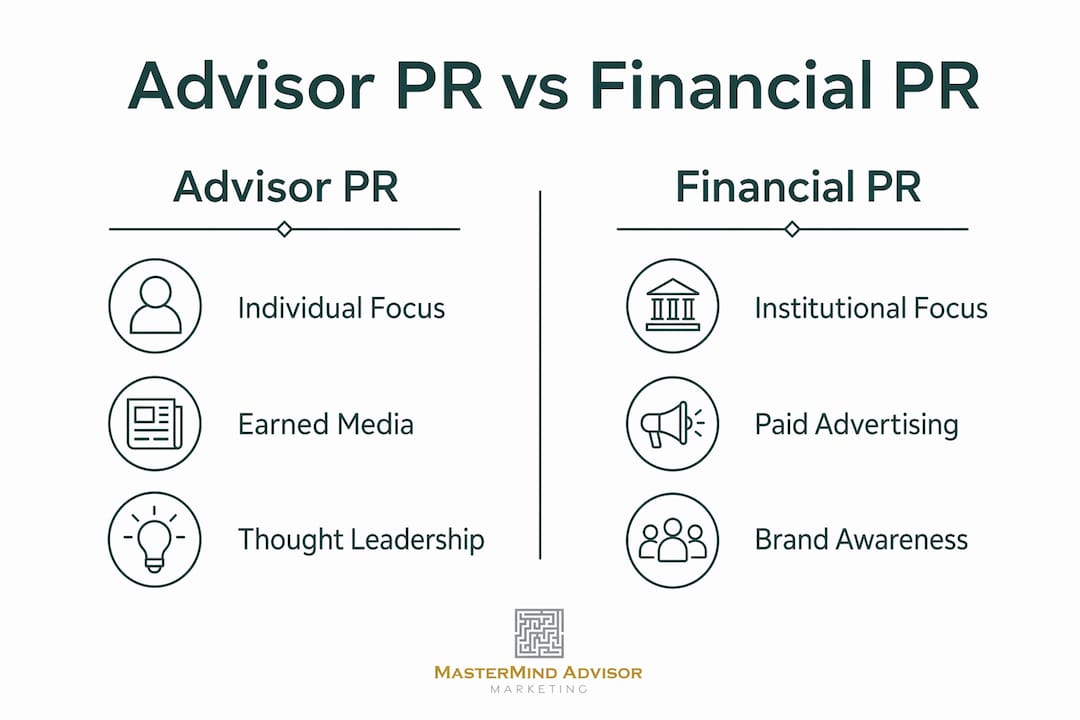
Narrative ownership is the defining concept in advisor PR. An advisor who owns a specific story arc, connecting personal expertise to a recurring market theme, becomes the go-to source for journalists covering that theme. Advisor PR requires owning narrative arcs that connect expertise to market trends. A generic advisor who comments on everything owns nothing. A specific advisor who consistently explains one complex topic simply becomes the expert journalists call first.
Key elements that separate advisor PR from general financial PR include:
- Individual thought leadership focus — the advisor's name and face, not the firm's logo, carry the brand
- Citation-rich digital footprint — building a body of third-party references that AI models treat as expert validation
- Compliance integration — every message is pre-cleared through regulatory workflows before pitching
- Media readiness training — advisors learn to speak in quotable, jargon-free language on short notice
- Personal narrative development — the advisor's background, values, and specialty are woven into a consistent story
"Earned media creates a 'trust dividend' that compounds over time, protecting reputation during market volatility and building goodwill with journalists and stakeholders who remember who showed up consistently."
This compounding effect is what separates advisor PR from paid advertising. A media placement from 18 months ago still appears in search results today. A paid ad disappears the moment the budget stops.
What role does media engagement and content creation play?
Media engagement is the engine of advisor public relations. The biggest media mistake advisors make is not being quickly and clearly quotable. Journalists covering a market event need a credible voice within hours, not days. Advisors who respond fast, speak plainly, and avoid jargon get quoted. Those who send lengthy, compliance-heavy responses get ignored.
Content creation supports media engagement by giving advisors a body of published thinking to reference. A LinkedIn article explaining a tax law change, a short podcast appearance on sequence-of-returns risk, or a contributed column in a trade publication all serve as proof of expertise. Financial advisors who consistently publish transparent, expert content build trust that no marketing claim can replicate. That published body of work also gives journalists a reason to call.
Practical media engagement tactics that work include:
- Rapid response to reporter queries — services like HARO (Help a Reporter Out) and Qwoted connect advisors with journalists who need expert sources today
- Compliance-safe thought leadership content — short, specific, and pre-approved articles that address real client questions
- Earned media amplification — sharing every placement on LinkedIn, in email newsletters, and on the advisor's website to extend its reach
- Podcast guest appearances — a 30-minute conversation builds more trust than a dozen social media posts
- Long-term journalist relationships — following reporters who cover your niche and offering genuine insight before you need a favor
Pro Tip: Build a "media kit" page on your website with a professional headshot, a one-paragraph bio, your areas of expertise, and links to past media appearances. Journalists check these pages before deciding whether to reach out.
How does advisor PR impact digital visibility and AI search in 2026?
The most significant shift in advisor public relations over the past two years is the influence of AI-powered search. When a prospect asks ChatGPT, Perplexity, or Claude to recommend a financial advisor specializing in small business retirement plans, the AI pulls from sources it treats as authoritative. AI assistants prioritize third-party corroboration, and advisor media placements directly influence those AI-generated answers. An advisor quoted in 5–10 publications over 18 months builds the kind of verifiable digital authority that AI models recognize as expert validation.
This dynamic changes the return-on-investment calculation for advisor PR. A media placement is no longer just a credibility signal for human readers. It is a data point that AI systems use to decide whose name appears in a prospect's answer. Consistent media presence also builds a Google Knowledge Panel, which signals to both search engines and AI tools that an advisor is a recognized public figure in their field. Advisors who understand this connection treat every media placement as a long-term digital footprint asset rather than a one-time win.
| PR Activity | Human Benefit | AI Search Benefit |
|---|---|---|
| Trade publication quotes | Builds credibility with prospects | Creates indexed citations AI models reference |
| Podcast appearances | Deepens trust through conversation | Generates transcripts and show notes AI can read |
| Contributed articles | Demonstrates expertise in writing | Adds authoritative backlinks to advisor's digital profile |
| LinkedIn thought leadership | Engages existing network | Signals active professional presence to search algorithms |
| Media page on website | Gives journalists a resource | Provides structured data for AI and search engine indexing |
The integration of advisor PR with SEO and personal branding is no longer optional. An advisor's thought leadership content and media placements feed each other. Each article or quote generates backlinks. Each backlink improves search ranking. Each improved ranking increases the probability that an AI tool surfaces the advisor's name. The advisors who build this cycle early gain a compounding advantage that is very difficult for late movers to close.
Key Takeaways
Advisor public relations builds trust, digital authority, and qualified lead flow through earned media, thought leadership, and consistent narrative ownership over a 12–18 month horizon.
| Point | Details |
|---|---|
| Define your narrative first | Own a specific story arc connecting your expertise to a recurring market theme before pitching any media. |
| Build the foundation before pitching | Complete the 6–8 week audit of your website, media page, and compliance workflows before any outreach. |
| Measure the right metrics | Track share of voice, inbound lead source, and sales cycle length to prove PR's return on investment. |
| Treat media placements as assets | Every quote and appearance compounds over time, building AI-recognized authority and referral confidence. |
| Speed and clarity win media | Respond to journalist queries fast and in plain language to earn consistent coverage over competitors. |
Why most advisors underestimate what PR actually does
Most advisors I work with come in thinking PR means getting their name in a newspaper once or twice a year. That framing sets them up for disappointment and causes them to quit before the compounding effect kicks in.
The advisors who see the biggest results treat PR the way a long-term investor treats a portfolio. They show up consistently, they stay patient through the early months when placements are sparse, and they reinvest every win by amplifying coverage across every channel they own. The advisors who treat PR as a short-term campaign almost always abandon it right before the pipeline starts moving.
The compliance fear is real, and I understand it. But most advisors are held back by compliance fears that dissolve once they sit down with their compliance officer and clarify what they can actually say. The answer is almost always more than they expected. Jargon-free explanations of market concepts, personal stories about client outcomes (without identifying details), and commentary on broad economic trends are almost universally compliant. The advisors who do this work upfront gain a massive advantage over peers who stay silent.
The other underestimated benefit is referral confidence. When a client refers a friend and that friend Googles the advisor's name, what they find either confirms or undermines the referral. A page of media appearances, articles, and podcast interviews confirms it immediately. An empty search result creates doubt. PR fills that gap in a way no amount of paid advertising can.
— Josh
How Mastermindadvisormarketing supports your advisor PR program
Building a PR program from scratch takes time, structure, and a clear understanding of what financial advisors specifically need. Mastermindadvisormarketing offers a turnkey marketing system built exclusively for independent financial advisors, with PR strategy development integrated alongside content marketing, webinars, and automated client engagement tools.
Mastermindadvisormarketing combines compliance-aligned messaging workflows with media training and personal branding support, so advisors can pursue earned media without second-guessing every word. The platform's advisor marketing solutions connect PR activity directly to lead generation, giving advisors a clear line from media placement to new client conversation. For advisors ready to build a reputation that compounds, Mastermindadvisormarketing provides the structure and support to make it happen efficiently.
FAQ
What does advisor PR mean for independent financial advisors?
Advisor PR is the practice of earning third-party media coverage and building thought leadership to establish trust and generate qualified leads for individual financial advisors. It differs from firm-level PR by focusing on the advisor's personal expertise and narrative.
How long does it take for advisor PR to produce results?
A structured advisor PR program typically produces measurable pipeline impact within 6–12 months, following a 6–8 week foundational phase. Inbound leads and shortened sales cycles are the primary indicators that the program is working.
How does advisor PR affect AI-powered search results?
AI tools like ChatGPT and Perplexity prioritize third-party corroboration when generating answers. Advisors quoted in 5–10 publications over 18 months build the kind of verifiable digital authority that AI models treat as expert validation, increasing the likelihood of appearing in AI-generated recommendations.
What is the difference between advisor PR and paid advertising?
Advisor PR earns credibility through third-party media coverage, which compounds over time and remains searchable long after publication. Paid advertising stops generating results the moment the budget ends, and it carries less trust weight with prospects than earned media.
How does an advisor get started with a PR program?
The first step is a 6–8 week foundational audit covering website infrastructure, a media page, compliance workflows, and a core narrative. For a detailed independent advisor PR strategy, advisors should align their digital presence before pitching any media outlet.