
A compliant dinner seminar invitation avoids unsubstantiated performance claims, discloses any testimonial or compensation arrangement, moves through your firm's principal pre-approval process before it goes out, and gets archived the moment it's finalized. Every one of those requirements traces back to the SEC's marketing rule and FINRA Rule 2210, and skipping any of them is how a routine invitation turns into a supervisory finding.
Before you send anything, run this five-point check:
- Claims: No specific performance numbers or guarantees without substantiation on file.
- Testimonials: Any client quote or endorsement carries the required disclosures.
- Approval: A principal has signed off on the exact final version, not a draft.
- Archival: The invitation, RSVP flow, and any recordings are saved somewhere retrievable.
- Hospitality: Food and drink costs are logged per person, not lumped into a general marketing budget.
Keep the Independent Advisor Compliance Marketing Checklist next to your invitation template. It catches the items marketing teams miss most often, and it takes less time to run through than most firms assume.
Key Takeaways
A compliant dinner seminar invitation succeeds when it pairs substantiated claims and proper disclosures with principal pre-approval, tracked hospitality costs, and complete archival records.
| Point | Details |
|---|---|
| Pre-approval is the gate | Any invitation reaching more than 25 retail investors needs principal sign-off under FINRA Rule 2210 before it goes out. |
| Testimonials need disclosures | Client quotes and endorsements require the specific disclosures set out in the SEC marketing rule, not a generic disclaimer. |
| Hospitality needs documentation | Log meal and venue costs per attendee to prove business entertainment stayed reasonable and wasn't a disguised incentive. |
| Follow-up stays in the workflow | Confirmations, reminders, and post-event emails need the same approval and archival path as the original invitation. |
| Mastermind Advisor Marketing streamlines the system | Its turnkey templates, CRM integration, and built-in approval workflow map directly onto this compliance checklist. |
Table of Contents
- Dinner Seminar Invitations: Wording, Disclosures, and Red Flags
- How Should You Handle RSVP and Registration Compliantly?
- What's a Compliant Follow-Up Sequence After a Dinner Seminar?
- What Will Compliance Check Before Your Campaign Goes Live?
- Sample Compliant Language for Invitations, RSVPs, and Follow-Ups
- Protecting the Personal Data You Collect at Registration
- Business Entertainment, Gift Limits, and Documenting Your Dinner Costs
- Strategies for Effective Post-Seminar Follow-Up
- Common Compliance Mistakes in Seminar Marketing
- Author Perspective: Why Compliance-First Invitations Actually Win
- How Mastermind Advisor Marketing Builds Your Invitation and Follow-Up System
- Sources
Dinner Seminar Invitations: Wording, Disclosures, and Red Flags
Under FINRA Rule 2210, a seminar invitation is a communication the moment it leaves your firm, and if it reaches more than 25 retail investors it becomes a retail communication that requires prior principal approval before distribution, per FINRA's Rule 2210 FAQ. That threshold matters more than most marketing teams realize. A mailing list of 40 prospects means your invitation needs sign-off before a single envelope goes out; a list of 20 might not, depending on your firm's internal policy, but the safer play is to treat every seminar invitation as retail communication regardless of headcount.
The SEC's marketing rule adds a second layer. If your invitation includes a client quote, a "why clients choose us" line, or any third-party endorsement, it triggers specific disclosure and oversight requirements under Rule 206(4)-1. That doesn't mean testimonials are off the table. It means you need the disclosures that go with them, and you need to know whether the person quoted was compensated. The Role of Client Testimonials for Financial Advisors breaks down exactly which disclosure language applies to which scenario.
Performance claims are where invitations get pulled in review most often. If your speaker plans to reference historical returns during the dinner, that claim needs a substantiation packet and a standardized presentation format compliance has already blessed, not a number pulled from memory the week of the event.
Copy review checklist before submission:
- Strip any language implying guaranteed outcomes ("secure your retirement," "guaranteed income").
- Confirm every statistic or performance figure has a backup source on file.
- Add required disclosure language wherever a testimonial or endorsement appears.
- Verify the invitation doesn't imply FINRA or SEC endorsement of the firm.
- Route the final draft, not an earlier version, to your principal for sign-off.
Pro Tip: Treat every seminar invitation as if it will land in an examiner's file someday, because it might. Write it clean the first time instead of hoping compliance waves it through.
Industry compliance commentary consistently flags one mistake above the rest: treating invitations as informal, plug-and-play templates rather than reviewing each one for its specific audience and claims. A template that passed review in March doesn't automatically pass in October if the guest list, speaker, or content changed.
How Should You Handle RSVP and Registration Compliantly?
Your RSVP form is doing double duty. It's a logistics tool and, in the eyes of regulators, part of your communications trail. Keep registration fields simple: name, contact information, guest count, and a clear opt-in checkbox for future marketing emails. Skip fields that fish for account balances or investable assets at the registration stage. That data belongs in a later, direct conversation, not a public form.

Confirmation emails and reminder texts aren't casual afterthoughts. They follow the same approval and archival path as the original invitation because they're still communications under FINRA's framework. If your confirmation email restates seminar details or adds a call to action, run it through the same review your invitation went through.
For capacity limits, keep the language neutral: "Seating is limited; RSVPs are confirmed on a first-come basis" works better than anything implying scarcity as a sales tactic. Waitlist communications should follow suit; no urgency language, just plain status updates.
- Use a CRM that time-stamps every automated send.
- Confirm your CRM triggers route through the same approval workflow as manual emails.
- Retain RSVP records for as long as your firm's books-and-records policy requires.
- Document any virtual event refreshment costs the moment they're incurred, not after the fact.
The Financial Advisor Email Campaign Setup: 2026 Guide walks through building that CRM workflow so automation doesn't quietly bypass your review process.
What's a Compliant Follow-Up Sequence After a Dinner Seminar?
A tight three-touch follow-up sequence tends to outperform a scattershot approach, and each touch has its own compliance boundary.
- Thank-you note (within 24 hours): Keep it purely relational. Thank the attendee for coming, mention nothing about products or performance, and skip any call to action beyond a warm closing line.
- Replay or materials share (2 to 4 days out): If you send a recording or slide deck, label it clearly as previously reviewed material, not a fresh communication. Any recording used with more than 25 retail investors still counts as a retail communication requiring the same prior approval as the live event.
- Soft consultation invite (5 to 7 days out): This is where a call-to-action belongs. "Would a 20-minute call make sense to talk through your specific situation?" is safe. "Let's build your winning retirement plan" edges toward a promise your firm can't back up.
Pro Tip: Don't reuse the seminar's promotional language in your follow-up emails. A phrase that was fine live, in context, can read very differently in writing, especially if compliance never saw the exact wording land in an inbox.
Every follow-up message, including automated CRM sequences, needs a home in your approval workflow. If a template gets reused across a dozen campaigns, that template needs periodic re-approval, not a one-time sign-off from two years ago. The Generate Leads with Financial Webinars: 2026 Guide has more detail on structuring replay distribution so it doesn't create an approval gap.
What Will Compliance Check Before Your Campaign Goes Live?
Principal pre-approval is required any time your invitation, script, or slide deck qualifies as a retail communication, which in practice means almost every seminar you run. Filing obligations kick in for certain communication types, so check your firm's specific filing calendar rather than assuming none apply.
Speaker scripts and slides need the same supervisory attention as the invitation itself. If your advisor plans to speak from notes rather than a fixed script, compliance should still review the outline in advance, and recordings should get a prompt post-event review to confirm nothing off-script created a new disclosure gap.
Recordkeeping applies to the entire trail: the invitation, RSVP data, slides, recordings, approval sign-offs, and hospitality receipts. Industry guidance on event compliance recommends attaching a short "approval snapshot" to every campaign record, listing the approver's name, the date, the version number, and which checklist items were verified. That single document is often the first thing an examiner asks for.
- Confirm principal approval on the final version before sending.
- Attach the approval snapshot to the campaign file immediately.
- Store slides, scripts, and recordings together, not scattered across individual inboxes.
- Log hospitality costs per attendee the same week the event happens.
Sample Compliant Language for Invitations, RSVPs, and Follow-Ups
These snippets are starting points, not finished copy. Every firm's disclosure requirements differ slightly, so run each one through your own review process before it reaches a prospect.
Subject lines that stay safe:
- "You're Invited: An Evening on Retirement Income Planning"
- "Join Us for Dinner and a Conversation About Your Financial Future"
Neither implies a guaranteed outcome or a specific return, which keeps them clear of substantiation requirements.
RSVP confirmation, in-person: "You're confirmed for [event name] on [date]. We collect your name and contact information solely to manage seating and follow-up; you can opt out of future communications at any time."
RSVP confirmation, virtual: "Your spot is reserved for [event name]. You'll receive a secure link 24 hours before the event. Attendance data is used only for event logistics."
Follow-up CTA, replay: "Here's the recording from Tuesday's session, previously reviewed by our compliance team. Reply if you'd like a copy of the slides."
Follow-up CTA, consult: "Would a brief call help answer any questions from the seminar? No obligation, just a conversation."
Protecting the Personal Data You Collect at Registration
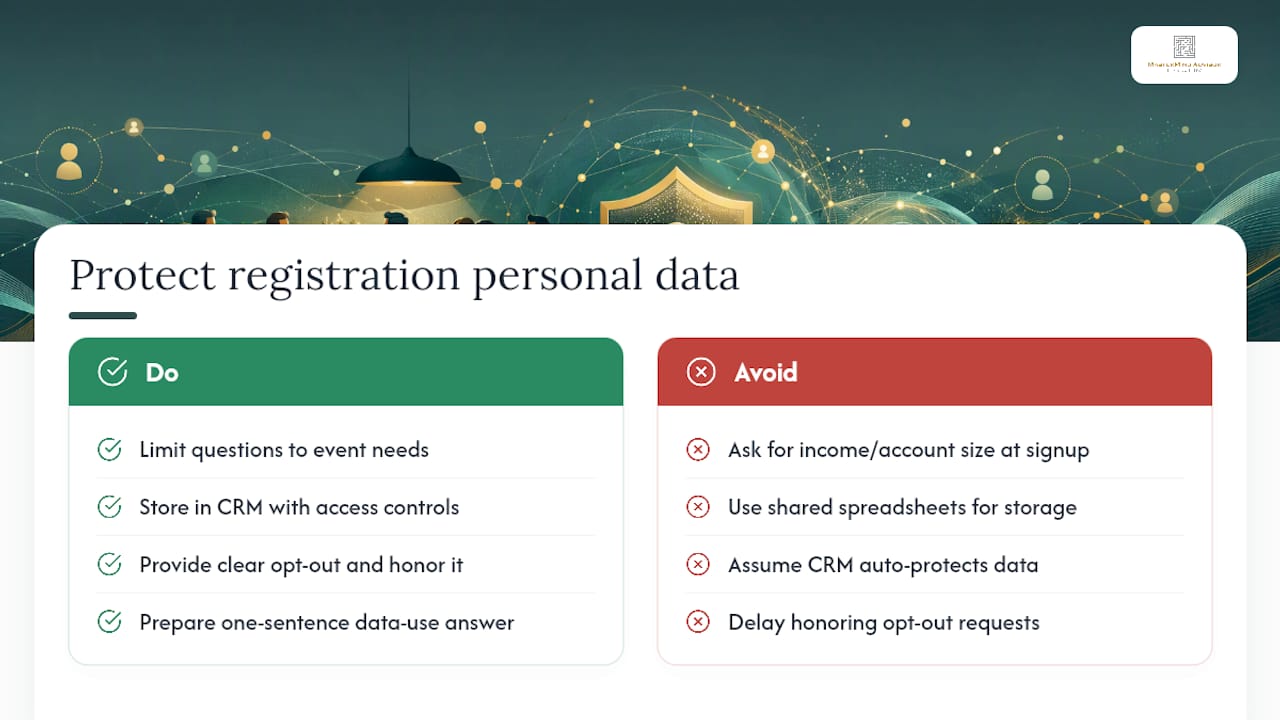
Every RSVP form collects personal information, and that data carries its own handling obligations separate from your marketing compliance requirements. Names, emails, phone numbers, and any notes a prospect volunteers during registration all need a documented storage and access policy, not an assumption that your CRM handles it automatically.
Limit what you ask for at the registration stage. A form asking for household income or account size before someone has even attended the dinner creates both a compliance flag and a data-security liability if that information sits unprotected in a spreadsheet. Collect only what you need to manage the event: name, contact details, and attendance preference.
Store registration data in the same system that handles your other client records, ideally one with access controls and an audit trail, rather than a shared spreadsheet passed between staff. If your CRM integrates directly with your email platform, confirm the integration doesn't quietly export attendee data somewhere outside your firm's oversight.
Give attendees a clear opt-out path for future marketing communications, and honor it immediately, not at the next quarterly list cleanup. If a prospect asks what happens to their information after the event, you should have a one-sentence answer ready, and that answer should be true. Retention timelines should match your firm's broader recordkeeping policy so RSVP data doesn't get deleted before your books-and-records obligations are satisfied, or kept indefinitely with no purpose.
Business Entertainment, Gift Limits, and Documenting Your Dinner Costs
A seminar dinner is business entertainment, not a gift, but the line between the two is about documentation as much as intent. FINRA's non-cash compensation guidance allows reasonable business entertainment, including the meal itself, as long as it isn't excessive and isn't preconditioned on a sale, according to FINRA's gifts and entertainment FAQ. The word "reasonable" is doing a lot of work there, and the way you prove it is by tracking cost per attendee, not a lump-sum event budget.
Log the per-person cost of the meal, venue, and any incidentals, then keep a running frequency log if you host the same prospects at multiple events across a year. That log is what lets your compliance team demonstrate the entertainment wasn't a disguised incentive tied to opening an account.
Virtual dinner seminars complicate this slightly. If you're mailing a meal delivery credit or a gift card for attendees to order dinner during a virtual event, FINRA guidance expects the host to control participation and stay present throughout, which is what distinguishes business entertainment from an unrestricted gift. Document the value of that credit the same way you'd document an in-person meal.
Keep receipts, guest lists, and cost breakdowns in the same file as your invitation and approval records. When these numbers live in three different places, three months apart, they're much harder to reconstruct if compliance asks for them.
Strategies for Effective Post-Seminar Follow-Up
The cadence matters, but so does the mix of channels. Email carries the bulk of your follow-up sequence, but a phone call from the advisor within a few days of the dinner often converts better than a fourth email, especially for the attendees who asked questions live at the table. Segment your follow-up by engagement level: attendees who stayed for the full Q&A get a different message than those who left early.
Smaller guest lists tend to make this easier. Dinners running 8 to 20 people convert better than large ballroom-style events partly because follow-up can be personalized rather than templated, and personalization is what compliance reviews the fastest since there's less room for stray promotional language to sneak in.
Track which attendees requested materials versus which simply RSVP'd and showed up. That distinction should shape your next message: someone who asked for the slide deck is signaling more interest than someone who attended and left, and your CRM should flag that difference automatically. The Advisor Seminars That Win Clients and Fill Pipelines guide covers qualification tactics that make this segmentation practical rather than theoretical.
Common Compliance Mistakes in Seminar Marketing
The most frequent error is treating a successful invitation template as permanently approved. A version that cleared review in January can fail in June if the speaker changed, the guest list grew past the retail communication threshold, or a new performance statistic got added without anyone flagging it for re-approval.
The second is informal follow-up language that drifts from what compliance actually reviewed. An advisor who ad-libs a warmer, more promising line in a personal email after the event has created an unreviewed communication, even if the original invitation was clean.
The third is hospitality tracking that exists only in someone's memory. Without a documented per-person cost log, there's no way to demonstrate that dinner seminar entertainment stayed within reasonable, non-preconditioned limits if a regulator asks.
The fourth is automation outrunning approval. A CRM sequence set up once and left running for a year can quietly send outdated or unapproved language long after the version compliance signed off on has changed.
Author Perspective: Why Compliance-First Invitations Actually Win
Here's what I've noticed reviewing how advisors run these campaigns: firms that build compliance into the invitation from the first draft move faster, not slower. The rework cycle on a template built without disclosures in mind eats more time than the upfront review ever would. Mastermind Advisor Marketing's own seminar campaigns are built with that sequencing baked in, which is exactly why the approval step stops being a bottleneck.
— Josh
How Mastermind Advisor Marketing Builds Your Invitation and Follow-Up System
Mastermind Advisor Marketing is the alternative to piecing together invitations, RSVP tracking, and follow-up sequences from scratch: you get a turnkey system built specifically for the approval and archival requirements independent advisors already have to meet.
The service maps directly onto the checklist above. Pre-built invitation and follow-up templates come structured for principal review from the start, so your compliance team isn't rewriting copy line by line. CRM integration keeps RSVP data, confirmations, and reminders inside one approved workflow instead of scattered across separate tools, and every campaign gets archived automatically, so nothing disappears if an examiner asks for it eighteen months later. Advisors working with this system report faster approval turnaround and higher qualified RSVP rates, because the copy arrives already built to pass review the first time.
Visit the Mastermind Advisor service page to see how the seminar and webinar system fits your firm's current campaign calendar, or request a walkthrough to map your next dinner seminar against your compliance requirements before you send a single invitation.