
Speaking engagements are the most efficient authority-building tool available to financial advisors, and the role of speaking engagements for advisors goes well beyond name recognition. When paired with a conversion system, a single well-structured talk generates a stream of pre-qualified, warm inbound leads who already trust you before the first meeting. The core roles are specific: credibility signaling through third-party stage endorsement, prospect pre-qualification by event self-selection, content asset generation from recordings and handouts, and network amplification through organizer and attendee relationships. FINRA Rule 2210 sets the compliance frame for all public communications, including live appearances. The expected outcome is not on-stage sales. It is a steady flow of qualified conversation requests from people who already see you as the expert.
- Speaking builds third-party authority faster than most digital channels
- Events pre-qualify attendees by topic interest before you say a word
- Recordings and repurposed content extend reach long after the event ends
- Compliance guardrails (FINRA Rule 2210) apply from the first slide to post-event follow-up
Table of Contents
- What roles do speaking engagements play for financial advisors?
- How do you choose which speaking opportunities to accept?
- How should you structure a presentation that builds trust without pitching?
- How do you convert attendees into strategy calls after the event?
- What does a speaking program actually cost, and what should you measure?
- What compliance rules apply to public appearances under FINRA Rule 2210?
- What do research and real-world examples show about speaking outcomes?
- Key Takeaways
- Why most advisors waste their best speaking opportunities
- Mastermindadvisormarketing runs the system so you can focus on the talk
- Useful sources and further reading
What roles do speaking engagements play for financial advisors?
The most underappreciated benefit is the implicit endorsement. When an event organizer selects you to speak, that selection itself signals credibility to every person in the room. Being chosen to speak functions as third-party validation that makes audience trust easier to earn than any cold outreach campaign.
Beyond the endorsement effect, speaking serves five distinct business functions:
- Authority and credibility: The stage positions you as the expert before you say a word. Attendees arrive with a baseline of trust that a LinkedIn post cannot replicate.
- Pre-qualified pipeline: People who register for a retirement income workshop are already interested in retirement income planning. The event does your targeting for you.
- Lead generation vs. relationship building: Short-term, a single seminar can fill your calendar with discovery calls. Long-term, recorded talks and social proof assets compound into a brand that attracts referrals for years.
- Referral and retention: Clients who attend your events have a concrete, shareable reason to refer friends. "My advisor did a great talk on Social Security timing" is a referral trigger.
- Content multipliers: One 45-minute talk becomes a YouTube video, three LinkedIn posts, a blog article, and an email newsletter. That content repurposing for digital marketing multiplies reach without multiplying effort.
Common formats that deliver these benefits include local dinner seminars, virtual webinars, conference panel appearances, podcast guesting, and continuing education workshops for CPAs or attorneys.
Pro Tip: Place a gated resource (a checklist, worksheet, or short diagnostic) at the back of the room or on a QR-code landing page. Anyone who downloads it hands you their contact information and self-identifies as a warm prospect, converting anonymous attendees into tagged CRM leads before you leave the venue.

How do you choose which speaking opportunities to accept?
Most advisors say yes to too many events and wonder why the ROI is thin. The fix is a short decision framework applied before every invitation.
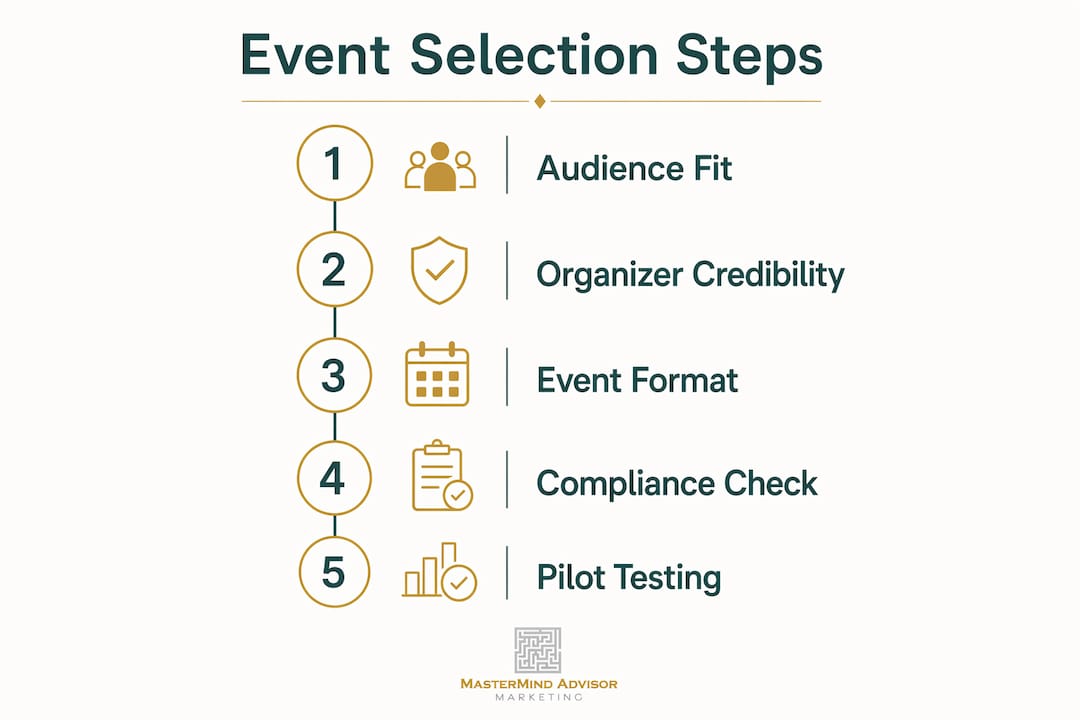
Defining your intention for each speaking effort changes everything, because the metrics and tactics that matter shift depending on whether the goal is social proof, lead generation, or referral building. A keynote at a national conference builds brand awareness but rarely fills your local pipeline. A dinner seminar for 30 pre-retirees in your zip code does the opposite.
Checklist: factors to evaluate before accepting an invitation
- Audience fit: Do the demographics and financial situation match your ideal client profile?
- Event format: Workshop (high engagement, smaller audience) vs. keynote (broad reach, lower conversion)?
- Organizer credibility: Does the host have a track record of filling rooms with the right people?
- Audience size vs. quality: A smaller, engaged audience of pre-retirees consistently outperforms a larger, general group.
- Sponsorship or paid options: Are you paying to speak, or are you being paid? Both can work, but the math changes.
- Location or virtual reach: Does the geography or platform match where your ideal clients live?
- Cost vs. benefit: Add up time, travel, production, and any sponsorship fees against your realistic lead-capture rate.
When to say no: misaligned audiences, organizers with no track record, or any event that pressures you to pitch products from the stage.
Pro Tip: Before committing to a new event category, run one low-cost pilot. Track three metrics in the first 90 days: number of leads captured, contact-to-meeting conversion rate, and cost per lead. Those three numbers tell you whether to repeat the event or redirect the budget.

How should you structure a presentation that builds trust without pitching?
Financial Planning reports that presenters who lead with audience problems rather than credentials generate better engagement and higher conversion. That finding points to a simple structural principle: the talk is for them, not about you.
Presentation template (five parts):
- Open with the audience's problem (3–5 minutes): name the specific fear or gap your audience faces. "Most people within five years of retirement don't know their actual income gap." That sentence earns attention immediately.
- Three insight-driven segments (25–30 minutes): each segment teaches one concrete idea the audience can use, regardless of whether they ever hire you. Generosity here is the conversion mechanism.
- Evidence and examples (woven throughout): use anonymized case scenarios, not performance claims. "A client in a similar situation found that…" is compliant and persuasive.
- Short interactive element (5 minutes): a show-of-hands question, a quick worksheet, or a live poll. Interaction breaks passive listening and increases retention.
- Non-sales closing (3–5 minutes): invite a next conversation, not a sale. Offer a free diagnostic, a checklist download, or an appointment slot sign-up.
Dos and don'ts:
- Do teach generously. The more value you give away, the more trust you build.
- Do keep your credential slide to 30 seconds or less.
- Don't make pricing or product claims from the stage.
- Don't use "limited time" language. It reads as pressure and triggers compliance risk.
- Don't compare your products to competitors' offerings in real time.
Compliant CTA options include offering a downloadable retirement readiness checklist, a Social Security timing worksheet, or a link to schedule a 20-minute discovery call. All three are educational, not transactional.
For Q&A, prepare a standard deferral line: "That's a great question and the answer really depends on your specific situation. I'd rather give you a complete answer in a one-on-one conversation than oversimplify it here." That language is compliant, honest, and moves the conversation toward a meeting.
Pro Tip: Build a two-slide personal branding block: one slide with your credentials (CFP®, years of experience, firm name) and one "why I do this" slide with a brief client-outcome story. Keep both slides combined under two minutes. That format satisfies firm review requirements while keeping the talk audience-focused.
How do you convert attendees into strategy calls after the event?
Public speaking creates warm prospects, not closed clients. The conversion happens in the follow-up, and most advisors leave that work undone.
Follow-up sequence (five steps):
- Same day: Send a thank-you email with the promised resource attached or linked. This email has one job: deliver the value you promised and confirm the next step.
- Day 3: Send a short value-add email (one insight from the talk, expanded). No ask.
- Week 2: Share a relevant article or tool. Still no direct ask.
- Week 3–4: Send a soft invitation to a discovery meeting. Frame it around their situation, not your services.
- Week 5–6: Final check-in. If no response, move to a lower-frequency nurture track.
Lead capture mechanics to set up before the event:
- Signup sheets at the door with a clear value exchange ("Sign up for the retirement checklist")
- QR-code landing pages on your slides and handouts
- Gated resource downloads that require a name and email
- On-site appointment scheduling (a tablet with a calendar link works fine)
CRM tagging recommendations: tag every lead with talk source, event ID, topic interest, engagement level (attended vs. downloaded vs. booked), and follow-up owner. Those tags let you segment follow-up by intent and measure which events actually produce clients.
Pro Tip: Assign a unique UTM parameter and a dedicated landing page to every event. That single step lets you attribute downstream revenue to a specific talk, which makes your ROI calculation precise instead of estimated.
| KPI | What it measures |
|---|---|
| Attendance rate | Registered vs. showed up (signals event quality and promotion) |
| Lead capture rate | Attendees who gave contact info (target: a substantial portion) |
| Contact-to-meeting conversion | Leads who booked a discovery call (target: 20–25%) |
| Meeting-to-client conversion | Discovery calls that became clients (target: 20–30%) |
| Average client LTV | Revenue per seminar-acquired client over the relationship |
What does a speaking program actually cost, and what should you measure?
Realistic budgeting prevents the most common mistake: abandoning a program after one event because the numbers looked thin.
Typical cost ranges per event:
- Local dinner seminar: $1,500–$4,000 (venue, food, printed materials, promotion)
- Sponsored conference talk: $500–$5,000 in sponsorship fees, plus travel
- Webinar: $200–$800 (platform, promotion, landing page)
- Podcast guesting: minimal direct cost, but 3–5 hours of prep time
A simple ROI formula: (new client revenue attributable to the event) ÷ (total event cost including staff time) = event ROI. A local seminar that costs $3,000 and produces two clients with a combined first-year revenue of $12,000 returns 4x before accounting for referrals or LTV.
Suggested program timeline:
- Months 1–3 (pilot): Run 1–3 events in different formats. Track lead capture rate and cost per lead. Do not optimize yet; gather data.
- Months 3–9 (optimization): Double down on the format with the best lead-capture rate. Refine the talk structure and follow-up sequence. Expect lead rates to improve as you iterate.
- Months 9–18 (scale): Add frequency or geographic reach. Consider advisor webinar programs to run parallel virtual events alongside in-person seminars.
Pro Tip: Track the lifetime value of seminar-acquired clients in a separate CRM segment. Advisors who do this consistently find that seminar clients refer at higher rates and stay longer than clients from other channels, which changes the ROI calculation significantly.
What compliance rules apply to public appearances under FINRA Rule 2210?
FINRA Rule 2210 requires firms to supervise public appearances and maintain written supervisory procedures for all public communications. The primary control is not pre-approval of every slide. It is a documented process of training, guardrails, and post-event review.
Compliance checklist for every speaking engagement:
- Complete an intake form before the event (topic, audience, format, estimated size)
- Submit slides and handouts for capture (not necessarily pre-approval, but documentation)
- Know your firm's recording policy and follow it
- Use approved deferral language for Q&A (see the template in the designing_the_talk section above)
- Complete a post-event attestation confirming no unapproved claims were made
Higher-risk appearances — media appearances, large audiences, product-specific talks — require stricter controls: recording capture, a pre-brief with compliance, and a post-event review. Know which tier your event falls into before you walk on stage.
How to handle testimonials, performance claims, and product comparisons:
- Testimonials require written consent and specific disclosures under current SEC marketing rules.
- Performance claims must include appropriate context and disclosures; avoid them entirely in live settings where you cannot control the record.
- Off-the-cuff product comparisons are a compliance trap. Prepare a pivot line: "I'm not in a position to compare specific products here, but I'm happy to walk through that in a private conversation."
Pro Tip: Run a 20-minute scenario training session with your team before any new event type. Practice the three most likely off-script Q&A moments and script the deferral response for each. Require every speaker to complete a one-page event attestation within 24 hours of the event.
What do research and real-world examples show about speaking outcomes?
The research points to three practices that separate advisors who build real pipelines from those who collect business cards:
- Teach first, always. Audience-centric education consistently outperforms credential recitation for both engagement and conversion.
- Niche focus accelerates authority. Starting local and building credibility through podcast guesting and community events builds a recognizable name faster than chasing large national stages.
- Systematic follow-up is the actual conversion engine. Gated, value-rich resources that require contact information seed a nurture sequence that converts at a higher meeting rate than any cold outreach.
Compact case example: An advisor specializing in pre-retirees ran a local dinner seminar for 40 attendees on the topic "Five Social Security Mistakes That Cost Retirees Thousands." The talk followed the five-part template above. A QR code on the final slide linked to a gated Social Security timing checklist. Twenty-two attendees downloaded the checklist (55% lead capture rate). The advisor's team ran the five-step follow-up sequence. Eight attendees booked discovery calls. Three became clients within 90 days. The event cost approximately $2,800 all-in.
Process flow: speaker selection → talk architecture (teach-first) → lead capture (QR + gated resource) → CRM tagging → five-step nurture sequence → discovery call invitation → client onboarding.
For A/B testing, vary one element per event cycle: CTA type (checklist vs. worksheet vs. appointment link), follow-up email subject lines ("Your Social Security checklist is inside" vs. "One thing most pre-retirees miss"), or follow-up timing. Six months of iteration produces a measurably better conversion rate.
Speaking is a demonstration of how you think, not a pitch for what you sell. The advisors who fill their calendars from the stage are the ones who give away their best ideas freely and trust that the right people will want more.
Pro Tip: Use a marketing funnel framework to map each speaking engagement to a specific funnel stage. Awareness events (large conferences) feed the top; conversion events (local seminars, webinars) feed the middle. Mixing them without distinction makes attribution impossible.
Key Takeaways
Speaking engagements build authority and generate warm leads only when paired with a structured conversion system that captures contacts, tags them by intent, and follows up with value before making any ask.
| Point | Details |
|---|---|
| Choose events by audience fit | Accept only invitations where the audience matches your ideal client profile and the format fits your goal. |
| Teach first, never pitch | Structure every talk around audience problems; keep credentials under 30 seconds and close with a non-sales invitation. |
| Capture leads before you leave | Use a QR-code landing page or gated resource to convert anonymous attendees into tagged CRM contacts at the event. |
| Follow up in five steps | Send value-first touches over 4–6 weeks before inviting a discovery meeting; cold asks after warm events waste the trust you built. |
| Mastermindadvisormarketing | Mastermindadvisormarketing's turnkey system handles event setup, landing pages, CRM tagging, and automated follow-up so advisors can focus on the talk. |
Why most advisors waste their best speaking opportunities
The single most common mistake is spending the first ten minutes of a talk on credentials. By the time the advisor gets to the actual content, half the room has mentally checked out. The stage is not a résumé reading. It is a live demonstration of how you think about problems your audience actually has.
Corrective steps are simple but require discipline. Reduce your credential time to 30 seconds: name, firm, one sentence on who you help. Then go straight to the audience's problem. That shift alone changes the energy in the room.
The deeper mindset correction is this: speaking is a conversion demonstration, not a closer. You are not trying to get a client in the room. You are trying to give the right people enough confidence to raise their hand afterward. The close happens in the follow-up, not on stage. Advisors who internalize that distinction stop feeling pressure to sell during the talk, which paradoxically makes them more persuasive.
Practical drill: run your talk in front of a colleague before the first live event. Time the credential slide with a stopwatch. Script your three most likely Q&A deferrals and say them out loud until they sound natural. Those three steps take 90 minutes and prevent the most expensive mistakes.
Mastermindadvisormarketing runs the system so you can focus on the talk
Independent advisors who want to build a speaking program face a real operational problem: the talk is the easy part. The landing pages, CRM tagging, automated follow-up sequences, and event logistics are where most programs stall.
Mastermindadvisormarketing is built specifically for this gap. The platform delivers a turnkey seminar and webinar system that handles event sourcing, custom landing pages, CRM integration, and automated follow-up, so every lead you capture at a speaking event enters a structured nurture sequence without manual work. Unlike generic marketing platforms, Mastermindadvisormarketing is designed exclusively for independent financial advisors, which means the compliance-aware templates, the CRM tagging logic, and the follow-up cadences are built around how advisor practices actually work. Advisors using the system report stronger lead capture rates and shorter time-to-meeting cycles compared to managing follow-up manually. If you are ready to turn your next seminar or webinar into a measurable pipeline, visit Mastermindadvisormarketing to see how the system works and schedule a walkthrough.
Useful sources and further reading
- FINRA Public Appearances and Seminar Standards (via Daydream): Detailed summary of FINRA Rule 2210 supervisory requirements for public appearances, including tiered controls and documentation standards.
- Financial Planning: How to Do Effective Financial Advisor Seminars: Reporting on what separates high-converting seminar presenters from those who generate low engagement.
- Financial Planning: Public Speaking Tips for Financial Advisors: Opinion piece on gated resources and structured follow-up as the primary conversion mechanism after live events.
- Michael Kitces: Building Local Brand Leverage, Media & PR: Framework for setting speaking intentions and aligning metrics to objectives (social proof, lead gen, referrals).
- HighTicketHQ: How to Use Public Speaking to Get High-Ticket Clients: Explains the endorsement effect of the stage and the teach-first conversion model.
- Select Advisors Institute: Financial Advisor Speaking Engagements & PR: Guidance on niche focus, local credibility building, and podcast guesting as scalable authority channels.
- Mastermindadvisormarketing: Advisor Seminars That Win Clients and Fill Pipelines: Practical playbook for seminar design, lead capture, and conversion tactics for independent advisors.
- Mastermindadvisormarketing: Marketing Funnel for Advisors: Explains how speaking events fit into a broader advisor marketing funnel and how to nurture prospects from stage to signed client.
This article is general information for educational purposes. Compliance requirements, supervisory procedures, and marketing rules vary by firm and registration type. Confirm current FINRA and SEC requirements with your compliance department or a qualified professional before implementing any speaking program.