

A financial advisor marketing plan is a written document that ties your growth goal to one audience, a few channels, a budget and the numbers you will check. It matters because practices that write it down grow faster, and because the work of building and running it is where most independent advisors stall. We built our turnkey system, with webinars, seminars, a compliance-friendly content library, email automation and websites, so advisors can run the plan instead of drafting it and abandoning it.
This guide gives you the plan itself: the goal, the niche, the channels, the compliance guardrails, the budget and the scorecard.
TL;DR
- Firms with a written marketing plan, a documented ideal client persona and a defined client offering brought in 87% more new clients and 127% more new client assets in 2025 than firms without them, per Schwab's 2026 RIA Benchmarking Study.
- Start with one measurable goal, one niche audience and one primary channel, then add channels as the first one produces conversations.
- Every channel needs to pass the SEC Marketing Rule: testimonial disclosures, net performance beside gross, and five years of records.
- Track the pipeline from lead to consultation to client, and judge spend by net new assets from right-fit clients, not clicks.
Table of Contents
- Why a written plan changes growth
- Step 1: Set one goal you can count
- Step 2: Choose a niche and write your value proposition
- Step 3: Pick channels that fit a long buying cycle
- Step 4: Build compliance into every channel
- Step 5: Set a budget
- Step 6: Measure the pipeline, not the clicks
- A 90-day starting calendar
- Where our system fits
- Our perspective
- FAQ
- Sources
Why a written plan changes growth
Most advisors market in bursts: a seminar here, a few posts there, a website refresh when someone has time. A plan replaces that with decisions made once and reused.
The evidence is consistent. Schwab's study covered 1,236 firms with over $2.5 trillion in assets under management (AUM) and found the gap above between firms that had the plan, persona and offering defined and firms that did not. Lisa Salvi of Schwab Advisor Services described the combination as a filter for every business decision, from communication to service offerings, according to FA Magazine's coverage. A plan tells you what to say yes and no to.
There is also an arithmetic reason. Capital Group reports that firms average 4.3% of AUM in outflows and 3.3% in inflows from existing clients, so without new clients a practice shrinks by about 1% of AUM a year. Growing a financial planning practice means replacing that gap first, then adding to it.
Step 1: Set one goal you can count
"Grow the practice" cannot be marketed against. A goal needs a number, an audience and a time frame. Examples:
- 12 consultation requests from business owners over six months.
- Five new households with $2 million or more in investable assets in 12 months.
- A 1 point increase in organic growth rate, from 7% to 8%.
That last one is worth working through. Schwab's study illustrates that a median firm with $712 million in assets lifting its organic growth rate from 7% to 8% could add more than $5 million in enterprise value over five years (FA Magazine). One point of growth is a modest target with a large payoff, which makes it a sensible way to size your own goal.
Work backward from the goal. If an average new client brings $1.5 million and one in three consultations converts, five clients need about 15 consultations. Your plan then has a concrete job: produce 15 qualified conversations.
Step 2: Choose a niche and write your value proposition
The single most useful decision in the plan is who you are not marketing to. The Financial Planning Association's December 2024 journal cites a 2023 Kitces study in which niche advisers reported an average client growth rate of 58% versus 26% for non-niche firms. Its author, Kristine McManus, notes that generic messages do not get read, and that a niche is especially useful for virtual practices because prospects can find a specialist from anywhere.
A niche is specific enough that a prospect recognizes themselves in one sentence. WealthManagement.com gives examples: business owners preparing for liquidity events, corporate executives approaching retirement, physicians in private practice, or widowed spouses.
To pick one, check three things:
- Experience. Where have you already solved the problem for real clients?
- Economics. Can this group pay your fee and bring assets you can serve profitably?
- Reach. Can you name where these people gather, online and offline, and who advises them (CPAs, attorneys, other professionals)?
We cover this in more depth in our guides to financial advisor niche selection and the independent advisor target market.
Then write the value proposition in two sentences: who you serve, the problem you solve, and how the relationship works. Kitces' October 2026 survey roundup found prospects at a minimum look for firm fees including minimums, proof of the advisor's expertise, the firm's investment philosophy, and how the planning process and client service work. Your website and every piece of content should answer those four things plainly.
Step 3: Pick channels that fit a long buying cycle
Financial services prospects rarely decide after one touch. They read, attend something, wait, and come back. That favors channels that let you build trust over weeks. The practical menu for an independent RIA:
| Channel | What it does | Best for |
|---|---|---|
| Webinars | Lets prospects hear you teach a specific topic from home | Niche audiences with a clear question (for example, stock options or Medicare timing) |
| Seminars, in person or virtual | Puts you in a room with qualified prospects and invites a next step | Pre-retirees, business owners, local markets |
| Website and content library | Answers fee, process and expertise questions before the first call | Every plan; it supports all other channels |
| Email drip campaigns | Keeps you in front of prospects until they are ready | Leads who attended an event or downloaded a guide |
| Social media | Shows consistent expertise to people who already know your name | Building familiarity and recognition |
| Client and professional referrals | Brings introductions from people who already trust you | Every firm, when documented |
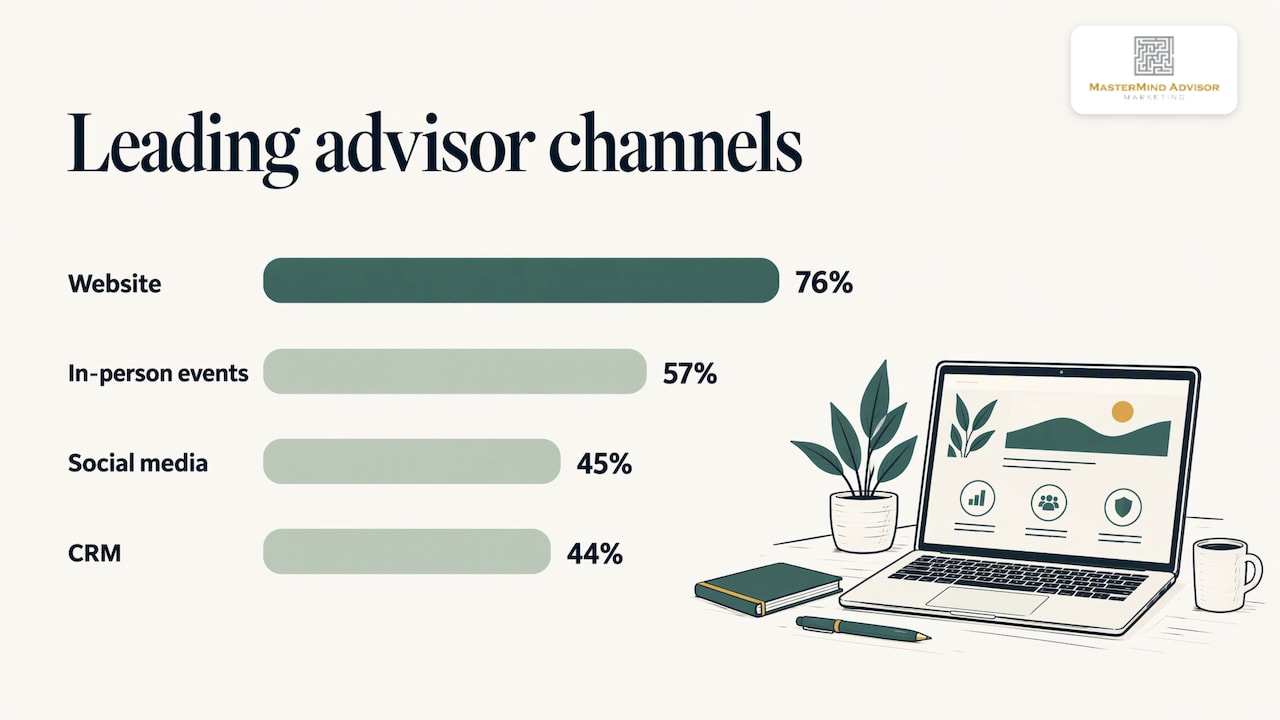
Broadridge's 2019 survey of 406 advisors found the website (76%), in-person events (57%), social media (45%) and CRM (44%) were the leading channels, and that advisors who described themselves as innovators converted leads in 3.4 months versus 4.3 months for laggards. The survey is older, but it shows the shape of an advisor's mix and why a follow-up system matters.
Search visibility belongs in the mix too, because prospects check you online whatever the source of the introduction. If you want a primer on SEO for financial advisors, it explains how keyword and content planning fit into a firm's channel choices.
Start with one primary channel, as the LPL guide also advises, then layer on a second only when the first produces appointments.
Do not skip referrals
Referrals are still the largest source of new business. Capital Group cites a 2023 study of more than 1,500 advisors in which referrals accounted for 87% of new business. Schwab found firms with a documented referral plan for existing clients generated 1.5 times more new clients and 1.6 times more new client assets from those referrals, and firms with a documented business-partner referral plan saw 1.6 times more clients and 1.7 times more assets, yet fewer than half of firms have either one (FA Magazine).
Write down when you ask, who you ask and what you send afterward. Referrals and marketing work together: a referred prospect still checks your website, and a webinar gives your best clients something specific to forward.
Step 4: Build compliance into every channel
For an RIA, compliance is not a final review stage. It is part of how each asset is designed. The SEC's final Investment Adviser Marketing Rule (Release IA-5653) permits testimonials and endorsements in advertisements, subject to disclosures, adviser oversight and, for certain promoters, written agreements. It also requires net performance whenever gross performance is shown, over 1-, 5- and 10-year periods, and sets conditions on hypothetical, extracted and predecessor performance.
The Utah Division of Securities' Marketing Rule Examination Guide is a useful view of what examiners look for. It says firms must clearly and prominently disclose whether a testimonial comes from a client or non-client, any compensation paid, and material conflicts. Performance ads must give gross and net returns equal prominence, and records of advertisements distributed to 10 or more persons, testimonial disclosures and performance substantiation must be kept for five years.
In practice, put these into the plan:
- A review step before anything publishes, with a named person who signs off.
- A standard disclosure block for testimonials and endorsements. See our breakdown of what the SEC Marketing Rule requires for testimonials.
- An archive of every ad, with the date it ran. We list the five items to archive for SEC exams.
- A rule for AI-drafted content: treat it as a draft, verify facts and sources, keep disclosures and archive the final version. Our AI marketing roadmap walks through it.
For the full rule in four steps, read our SEC Marketing Rule compliance guide. Questions about how the rule applies to your specific firm belong with your chief compliance officer or securities counsel.
Step 5: Set a budget
Benchmarks give you a starting range, not a verdict. Kitces notes that industry benchmarking shows most firms spend only 1% to 2% of revenue on marketing, and that most advisors rely on referrals largely because little else is invested in lead generation. Broadridge's 2019 survey found an average of 3.3% of revenue and an average cost of $929 per new client.
A workable method:
- Take your goal (say, five new clients).
- Estimate what one client is worth in annual revenue, and how long they typically stay.
- Decide what you would pay to acquire that client, then multiply by the clients you need.
- Split the total across your primary channel, the website and content that supports it, and follow-up automation.
SEI's marketing plan builder illustrates a plan that aims at $20 million in new assets from five new clients, largely through referrals, with a budget up to 2% of revenue or $20,000 and a 1:10 return on marketing spend. Treat it as an example of the structure, then use your own fee schedule and close rates.
Step 6: Measure the pipeline, not the clicks
Megan Carpenter of FiComm Partners told Financial Planning that RIAs should aim for right-fit leads rather than clickthrough rates, likes and visitors, because what a firm wants is more net new assets from right-fit clients. Build your scorecard on that idea.
Track each stage in a single CRM:
- Leads: new contacts, by source.
- Qualified leads: contacts who match your niche and asset minimum.
- Consultations held.
- Clients signed, and assets brought in.
- Cost per acquisition and sales cycle length. WealthManagement.com suggests evolving toward these, plus client lifetime value and event ROI.
The same article argues marketing and business development should work from the same CRM, since proactive follow-up calls raise appointment rates compared with waiting for prospects to self-schedule. Schwab's 2021 study found firms tracking lead conversion closed 75% of leads versus 60% for all other firms, and that top-performing firms were more likely to have a documented marketing plan and track metrics toward new client growth.
Review the scorecard monthly and the plan quarterly. Cut the channel with the weakest cost per qualified consultation, and put its budget behind the strongest.
A 90-day starting calendar
| Weeks | Focus | Output |
|---|---|---|
| 1 to 2 | Goal, niche, value proposition | One-page plan, ideal client persona |
| 3 to 4 | Website and compliance workflow | Pages that cover fees, process, expertise; review and archive routine |
| 5 to 8 | First event or webinar and email sequence | Registrations, attendees, follow-up emails |
| 9 to 12 | Referral asks and scorecard review | Documented referral plan, first pipeline report |
The schedule is deliberately small. A plan you finish and run beats an ambitious one that sits in a folder.
Where our system fits
We offer a turnkey marketing system for independent financial advisors. The services page lists webinars, seminars, a content library, email marketing, social media and websites, and our growth strategy maps them to your goal and audience. It is built for the regulatory requirements and long buying cycles of financial services, with a custom CRM and automated email follow-up connecting the channels above.
If you want to turn the plan above into a running program, see our services or start with a growth strategy.
Our perspective
Most advisors we talk to do not lack ideas. They lack the hours. Marketing a practice is a second job on top of serving clients, and it falls to whoever has a free evening.
We founded Mastermind Advisor Marketing as practicing advisors who have grown real advisory practices, and our playbook is built around that experience. It is a $25M/year playbook, designed for the way financial services actually sells: long buying cycles, regulatory scrutiny and prospects who want to see your expertise before they call.
That is why we do not treat webinars, seminars, content, email, social media and websites as separate purchases. They are one system pointed at one niche, with compliance-friendly content and automated follow-up so a lead who attends in March still hears from you in June. A generic agency has to learn your regulatory world first. Ours is the only world we work in.
The plan on this page is the thinking. Our job is to take the production and follow-up off your desk so you spend your time on the conversations that become clients.
Josh
FAQ
How much should a financial advisor spend on marketing?
Benchmarks run from 1% to 2% of revenue in Kitces' summary of industry studies to an average of 3.3% in Broadridge's 2019 survey. Set your number from your goal: the clients you need, what each is worth, and what you are willing to pay to acquire one.
What should an RIA marketing plan include?
A specific goal, a defined audience and value proposition, a primary channel with a few supporting ones, a content and event calendar, a compliance review and archive process, a budget, and a scorecard. Prospects also look for fees, evidence of expertise, your investment philosophy and your client experience, so cover those on your site.
How long before marketing produces new clients?
It depends on the channel and the size of the household. Broadridge's survey found innovators converted leads to clients in about 3.4 months and laggards in 4.3, so plan for a quarter or more between first contact and signed agreement, and review results quarterly.
Can I use client testimonials in my marketing?
Yes, under the SEC Marketing Rule, with required disclosures, adviser oversight and recordkeeping. A testimonial must clearly state whether it is from a client or non-client, plus any compensation and conflicts. Confirm your exact process with your compliance officer.
Sources
- Gap between top RIAs and the rest widens, Schwab study finds (FA Magazine)
- How to get the right referrals from clients and COIs (Capital Group)
- Grow Your Practice by Finding Your Niche (Financial Planning Association)
- How RIAs Can Create Holistic Marketing Plans That Work (WealthManagement.com)
- What Information Prospects Seek When Choosing An Advisor (Kitces)
- Sample Niche Marketing Plan Template For Financial Advisors (Kitces)
- Broadridge survey on how high-growth advisors gain clients
- SEC Release IA-5653, Final Rule: Investment Adviser Marketing
- Marketing Rule Examination Guide (Utah Division of Securities)
- Schwab RIA Benchmarking Study 2021
- How should an RIA create a marketing plan? (Financial Planning)
- SEO for Financial Advisors