
Yes. Used correctly, a LinkedIn newsletter is a high-value, compliance-safe channel for financial advisors who want repeat visibility with prospects and referral partners. It works best as an educational channel, never a place to tout returns.
Before you publish anything, do three things:
- Pick one narrow topic (retirement income, tax planning for business owners, whatever you're known for)
- Set a cadence you can actually sustain through compliance review, monthly or biweekly
- Confirm your archive vendor and pre-send checklist under FINRA's social media guidance before your first issue goes out
Key Takeaways
A LinkedIn newsletter works for advisors when it pairs a narrow, educational topic with a sustainable cadence and a compliance workflow built before the first issue publishes.
| Point | Details |
|---|---|
| Pick one narrow topic | Choose a single recurring theme instead of general market commentary to build authority faster. |
| Match cadence to review capacity | Monthly or biweekly issues work better than weekly if compliance can't keep pace. |
| Run a pre-send checklist every issue | Check for performance claims, guarantees, testimonials, and PII before publishing. |
| Archive with a third-party vendor | Retain issues for three years with metadata and an audit trail, not LinkedIn's native history. |
| Repurpose approved content | Turn each newsletter issue into shorter posts to build cadence without new compliance review. |
Table of Contents
- Why a LinkedIn Newsletter for Advisors Beats a Regular Post
- How Do You Set Up a LinkedIn Newsletter?
- What Should Advisors Actually Write About?
- What Compliance Rules Apply to LinkedIn Newsletters?
- How Do You Grow Subscribers Without Breaking Compliance?
- Which Metrics Actually Matter for a LinkedIn Newsletter?
- How Mastermind Advisor Marketing Supports a Compliant Newsletter Program
- What Most Advisors Get Wrong About This Channel
- Sources
Why a LinkedIn Newsletter for Advisors Beats a Regular Post
A regular LinkedIn post has one shot at the feed. A newsletter for advisors works differently: every subscriber gets a notification when you publish, and that notification often outperforms organic reach by a wide margin because it lands directly in someone's alerts instead of competing with the algorithm.
That mechanism matters more for advisors than for almost any other profession. Your buying cycle is long, referrals matter more than clicks, and a newsletter creates a sustained, low-pressure touchpoint with prospects and centers of influence who aren't ready to call you yet.
- Notifications create repeat visibility a one-off post can't match
- Referral partners see your name consistently without you emailing them
- A niche topic builds a reputation faster than generic market commentary
Statistic Callout: According to Forbes, a tightly focused, useful weekly newsletter can grow visibility quickly, but only when frequency matches what your team can produce and get through compliance review.
Choose a newsletter over more frequent posting when you have deep, recurring expertise on one theme and a compliance process that can handle a predictable batch of content rather than a stream of ad hoc posts.

How Do You Set Up a LinkedIn Newsletter?
Setting one up takes fifteen minutes. Getting it right takes a little more planning.
- Confirm creator mode or newsletter access. Newsletters publish from your personal profile, so make sure your bio, headline, and featured section already reflect your actual practice. If your profile still reads like a generic résumé, fix that first with a profile optimization pass.
- Go to your profile and select "Write article," then "Create a newsletter."
- Name it around a benefit, not your firm. "The Retirement Ready Brief" beats "Smith Wealth Updates" every time.
- Write a two-sentence description that tells a prospect exactly what they'll learn and how often.
- Set cadence (weekly, biweekly, or monthly) and pick something your compliance reviewer can actually keep pace with.
- Publish your first issue with a clear subscriber CTA at the end, something like "subscribe for one idea a month on tax-smart retirement withdrawals."
- Build a simple editorial calendar with three months of topics already blocked out.
- Run a pre-send QA pass before that first issue goes live, and every one after it.
Pro Tip: Draft your first three issues before you publish issue one. Compliance review moves faster when it's reviewing a batch instead of reacting to a single deadline every two weeks.
What Should Advisors Actually Write About?
Stick to four content buckets that keep you safe and useful:
- Education — how annuities work, what a Roth conversion actually does, how sequence-of-returns risk plays out
- Trigger events — job changes, inheritance, a new tax law, a business sale
- Process — how you actually build a plan, what a first meeting looks like, how you vet investments
- Human stories — anonymized, composite scenarios that illustrate a planning concept without naming a client
Educational, process-focused content is consistently the safest high-performing category for regulated advisors, according to PostInstantly's guidance on advisor LinkedIn content.
Formats worth rotating through:
- Short commentary on a recent trigger event
- A simple Q&A pulled from real client questions (anonymized)
- A checklist readers can act on immediately
- A resource roundup with one or two outside links
Two calendar options work well. A monthly deep issue lets you go long on one topic with real substance. A biweekly short issue keeps you visible more often with less production lift each time. Either way, submit a quarter's worth of topics to compliance at once and repurpose approved issues into shorter posts, which Content Marketing for Advisors covers in more depth for building out a full calendar.
What Compliance Rules Apply to LinkedIn Newsletters?
LinkedIn newsletters count as retail communications, not casual social posts. That single fact should shape everything about how you write and publish them. Under FINRA Rule 2210 and the SEC Marketing Rule, your content must be fair, balanced, and free of unsubstantiated performance claims, and it has to be retained per recordkeeping rules just like any other firm communication.
Before you hit publish, run every issue through a short checklist. The 12-point pre-send checklist from LinkedInsider covers the points that trip up most advisors:
- No specific performance claims or implied guarantees
- No superlatives ("best," "top-rated") without substantiation
- No client testimonials without the required disclosures
- No personally identifiable client information, even anonymized poorly
- Required disclosures included where relevant
- Firm-specific policy sign-off documented
A short, repeatable pre-send review, run in under a minute once it's a habit, catches the majority of compliance issues before they become a problem. Pairing that habit with a small library of pre-approved templates is what makes weekly or biweekly cadence sustainable instead of exhausting.
Don't rely on LinkedIn's native archive. Third-party vendors like Smarsh or Global Relay capture the metadata, timestamps, and tamper-evident logs your firm actually needs, retained for three years, with an audit trail showing who approved what and when. That export is what saves you during an exam, not a screenshot.
For a firm-level version of this workflow, the Independent Advisor Compliance Marketing Checklist walks through building your own.
How Do You Grow Subscribers Without Breaking Compliance?
Growth on LinkedIn newsletters runs almost entirely on notifications, so your subject line and first line have to earn the open in about two seconds. Lead with the benefit, not your firm name, and never use urgency language that implies a limited-time recommendation.
Your CTAs should stay educational rather than advisory: "download the checklist," "reply with your question," "request the guide." Save any actual recommendation-driven language for a one-on-one conversation, not the newsletter itself.
- Ask employees and team members to engage and reshare within the first hour of publishing
- Repurpose each issue into two or three shorter posts over the following weeks, since approved newsletter content already cleared compliance once
- Cross-promote to your existing email list to seed your first hundred subscribers
Pro Tip: Mention your newsletter topic in your LinkedIn headline for a month after launch. It's free real estate that funnels profile visitors straight into a subscribe click.
For deeper tactical guidance on building audience momentum beyond the newsletter itself, this B2B LinkedIn engagement guide breaks down subject-line and timing tests worth adapting for an advisor audience.
Which Metrics Actually Matter for a LinkedIn Newsletter?
Skip vanity metrics and track five things: subscriber count, impressions per issue, reactions and comments, requested resources or DMs, and booked calls that trace back to the newsletter.
Use UTM-tagged links and a dedicated landing page for every "download the checklist" CTA so a resource request is traceable, not anecdotal, an approach covered in more detail in this guide to advisor email campaign setup.
- Subscriber growth month over month
- Impressions and view-through rate per issue
- Reactions, comments, and shares
- Downloaded resources or inbound DMs
- Calls booked with a newsletter source tag
Run a 90-day test at your chosen cadence before judging results. Three or four issues rarely tell you anything; twelve issues will.
How Mastermind Advisor Marketing Supports a Compliant Newsletter Program
Building and maintaining this whole system solo, content library, compliance sign-off, archiving, cadence discipline, is a real operational lift for a small practice. Mastermind Advisor Marketing built its system specifically around that gap for independent advisors.
- A pre-approved content library that removes the "what do I write" bottleneck issue by issue
- Custom CRM integration that connects newsletter subscribers to your actual pipeline instead of a disconnected spreadsheet
- Third-party archival workflows built for the same recordkeeping standards FINRA requires
- Batch-review templates that speed up compliance sign-off instead of slowing it down
The advisors who stick with a newsletter past month three are almost always the ones who built the compliance workflow before they built the content calendar, not after.
If you'd rather hand the editorial calendar, compliance coordination, and archiving to a team that's already built for it, Mastermind Advisor runs that entire system for independent advisory practices.
What Most Advisors Get Wrong About This Channel
Most advice on advisor newsletters treats compliance as a final step, something you check after the content is written. That order is backward, and it's why so many advisor newsletters die after two or three issues: the writer hits a compliance snag, loses momentum, and never restarts.
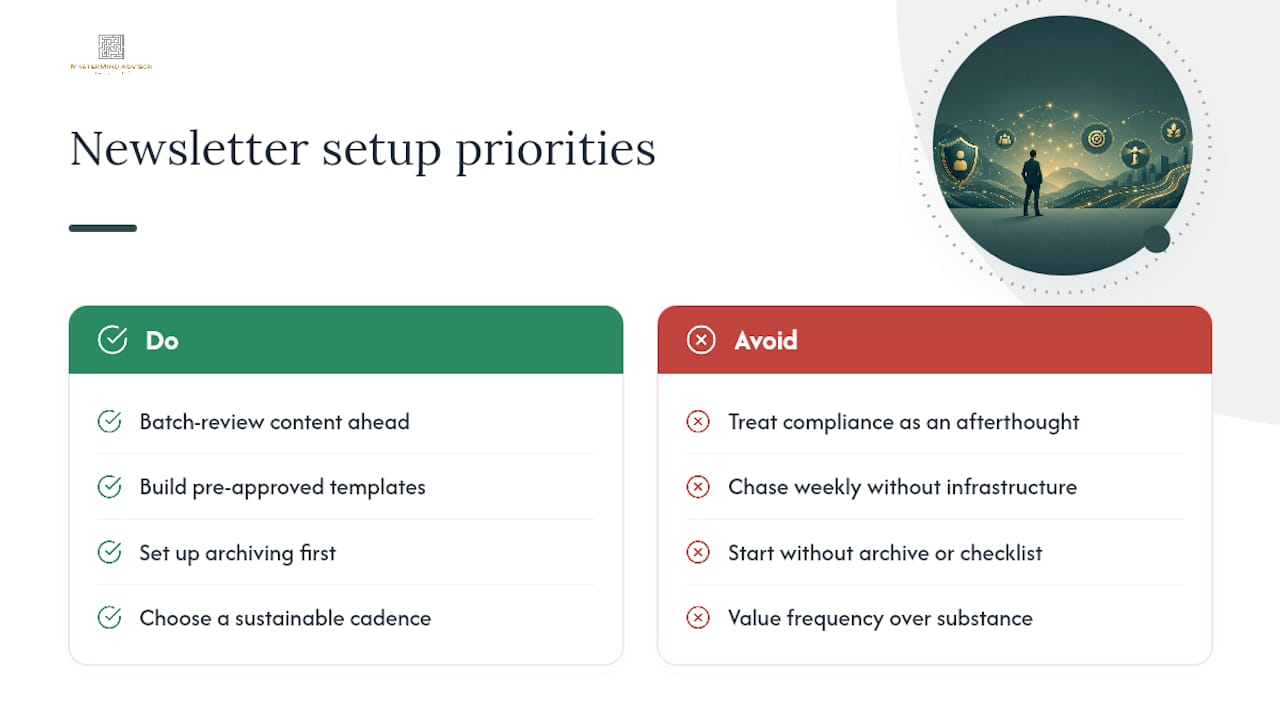
The research on this is consistent. Advisors who batch-review content, build a small library of pre-approved templates, and treat archiving as a setup task rather than an afterthought are the ones who still publish six months later. The ones chasing weekly frequency without that infrastructure usually burn out by issue four.
The overrated piece of conventional wisdom is frequency itself. A monthly newsletter with real substance beats a weekly one that gets watered down to survive compliance review. Pick the cadence your firm can sustain at full quality, not the cadence a growth hack tells you to chase.
If you take one thing from this: build your archive and checklist before you write issue one, not after issue three gets flagged.
This article is general information, not a substitute for advice from a qualified financial advisor. Consult a qualified financial professional about your own circumstances before acting on anything here.
Sources
- FINRA — Social media and communications guidance (key topics)
- Pre-Send LinkedIn Compliance Checklist for Advisors | LinkedInsider
- LinkedIn posts for financial advisors — PostInstantly