
A strong financial advisor LinkedIn profile is the single most effective digital tool for building credibility, attracting ideal clients, and generating qualified leads in financial services. LinkedIn's professional context sets it apart from every other social platform. Prospects actively search for advisors there, and they judge your expertise before they ever reply to a message. The advisors who win on LinkedIn treat their profile as a living sales asset, not a static resume. This guide covers the profile elements, content habits, and outreach sequences that convert connections into real conversations in 2026.
What must a financial advisor LinkedIn profile include?
Your LinkedIn profile is your first impression, and most prospects decide within seconds whether to keep reading. Profiles that specify niche and quantify results dramatically outperform generic ones in attracting leads. That single fact should drive every word you write.
Headline
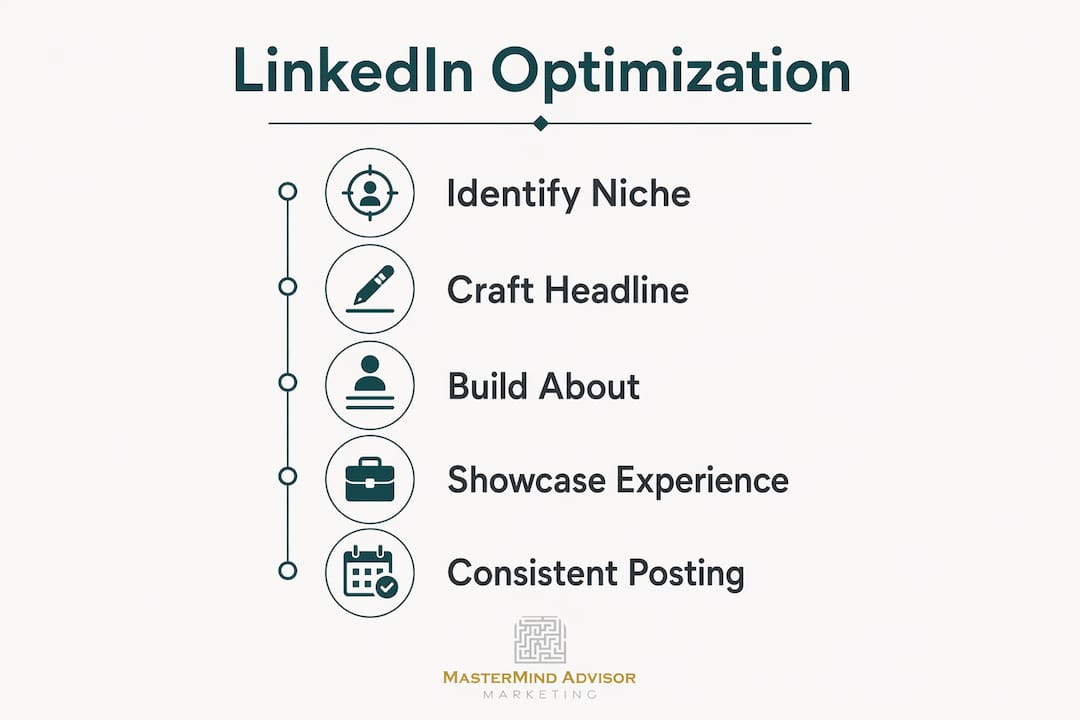
Your headline is the most visible line on your profile. Write it to answer one question: "Who do I help, and what do I help them achieve?" A headline like "Helping tech executives retire early through equity compensation planning" beats "Certified Financial Planner at XYZ Wealth" every time. Include your primary credential, your niche, and a clear outcome. Keep it under 220 characters so it displays fully in search results.

About section
The About section is where trust is built or lost. Open with a sentence that speaks directly to your ideal client's situation. Then explain your approach, your credentials, and what working with you actually looks like. Quantify results wherever compliance allows. "I've helped over 200 families reduce their tax burden in retirement" is far more persuasive than "I specialize in retirement planning." Close with a clear call to action, such as inviting prospects to connect or book a call.
Experience section
Most advisors list job duties in their experience bullets. Prospects do not care about duties. They care about outcomes. Rewrite every bullet to show impact. "Grew client assets under management by 40% over three years" tells a story. "Managed client portfolios" does not. Use the experience section to reinforce your niche and demonstrate a track record that a prospect can trust.
Pro Tip: Add a featured section to your profile and pin your best piece of content, a client success story, or a short video introduction. Profiles with featured content receive significantly more engagement than those without it.
- Write a headline that names your niche and a client outcome.
- Open your About section with your client's problem, not your credentials.
- Quantify results in every experience bullet where compliance permits.
- Pin a featured item that demonstrates your expertise immediately.
- Use your contact info and custom URL to make it easy to reach you.
How can financial advisors use LinkedIn content to build visibility?
Posting consistently on LinkedIn is one of the highest-return activities an advisor can do. Advisors who post regularly see higher inbound inquiries and connection acceptance rates than those who stay passive. Your content builds familiarity before a prospect ever receives a message from you.
The most effective content for advisors is educational, not promotional. Write posts that answer the questions your ideal clients are already asking. Topics like "What happens to your 401(k) when you change jobs?" or "Three things to check before you retire" perform well because they address real concerns. Avoid posts that read like advertisements. Prospects scroll past them.
Engaging with other people's posts matters as much as creating your own. When you leave a thoughtful comment on a prospect's post or a referral partner's article, your name appears in their notifications. That visibility compounds over time. Aim to comment on five to ten posts per week from people in your target audience.
Pro Tip: Use LinkedIn's native document posts, also called carousels, to share educational content in a swipeable format. These posts consistently outperform plain text in reach and saves.
- Post two to three times per week on topics your ideal clients care about.
- Use a mix of formats: text posts, carousels, and short videos.
- Comment on five to ten posts per week from prospects and referral partners.
- Respond to every comment on your own posts within 24 hours.
- Avoid posting product pitches or promotional language that could trigger compliance review.
For a broader view of how LinkedIn fits into your full digital marketing strategy, a multi-channel approach consistently outperforms any single platform.
What is the most effective LinkedIn outreach sequence for advisors?
Outreach is where most advisors either win or damage their reputation. The 2026 benchmark for a well-targeted campaign is a connection acceptance rate of 30% or higher. Hitting that number requires personalized requests, not copy-paste templates.
Volume control is non-negotiable. Sending low double-digit connection requests per day protects your account from restrictions and keeps your outreach feeling personal. High-volume, rapid-fire messaging triggers LinkedIn's spam filters and signals desperation to prospects.
Once someone connects, the follow-up sequence determines whether they become a lead. Space messages 5–7 days apart and limit the sequence to four touches over three to four weeks. Each message should add value or reference something specific about the prospect. Never pitch on the first message.
The most effective sequences are not linear. Conditional outreach that branches based on engagement signals outperforms fixed sequences by a wide margin. If a prospect views your profile twice after connecting, that is a buying signal. Trigger a different message than you would send to someone who has not engaged at all.
| Outreach stage | Timing | Message focus |
|---|---|---|
| Connection request | Day 1 | Personalized note referencing a shared interest or their role |
| First follow-up | Day 5–7 | Value-add message: share a relevant article or insight |
| Second follow-up | Day 12–14 | Soft question based on their situation or recent activity |
| Final touch | Day 21–28 | Low-pressure close: offer a call or ask if the topic is relevant |
Compliance is not optional. SEC marketing rules require that all outreach messages be reviewed and archived. Automation platforms with verified APIs and locked templates reduce compliance risk by generating exportable logs and preventing unapproved language. Never send a message that makes performance claims or promises specific returns.
- Personalize every connection request with a specific reference.
- Keep daily request volume in the low double digits.
- Follow up four times over three to four weeks, spaced 5–7 days apart.
- Branch your sequence based on whether a prospect has viewed your profile or engaged with your content.
- Archive all messages in a compliant CRM or approved platform.
What tools help advisors manage LinkedIn outreach and stay compliant?
The right tools make the difference between a LinkedIn strategy that scales and one that collapses under its own complexity. LinkedIn Sales Navigator remains the strongest starting point for targeted prospecting. It lets you filter by industry, job title, geography, and company size, so you spend time on prospects who actually fit your niche.
Beyond Sales Navigator, advisors need a CRM that captures LinkedIn activity and stores conversation history. When a prospect moves from LinkedIn to email to a phone call, your CRM should hold the full record. This is both a sales advantage and a compliance requirement under FINRA 2210 and SEC recordkeeping rules.
Automation tools can support outreach at scale, but only when they use verified LinkedIn API integrations and allow template locking. Locked templates prevent advisors or staff from sending unapproved language. Exportable activity logs satisfy regulators who ask for communication records. Evaluate any automation tool on those two criteria before you commit.
For advisors who want to test paid visibility alongside organic outreach, an AI-powered LinkedIn ad tool can help create and test B2B ad copy without a dedicated creative team. Paid and organic efforts work best when the messaging is consistent across both.
Connecting your LinkedIn leads to a purpose-built CRM, like the ones built into the Mastermindadvisormarketing system, means no lead falls through the cracks. Automated follow-up sequences keep prospects warm between conversations without requiring manual effort every day.
Key Takeaways
A well-optimized LinkedIn profile paired with a compliant, personalized outreach sequence is the most direct path to consistent lead generation for financial advisors.
| Point | Details |
|---|---|
| Niche-specific profiles win | Profiles that name a niche and quantify results attract more leads than generic ones. |
| Content builds trust before outreach | Regular educational posts increase connection acceptance and inbound inquiries. |
| Outreach cadence matters | Four touches over 3–4 weeks, spaced 5–7 days apart, outperforms rapid-fire messaging. |
| Branching sequences convert better | Triggering different messages based on engagement signals improves reply rates significantly. |
| Compliance is built into the tools | Use platforms with locked templates and exportable logs to satisfy FINRA and SEC requirements. |
What I've learned from watching advisors win and lose on LinkedIn
Most advisors I've seen struggle on LinkedIn are not struggling because of bad advice. They are struggling because they treat LinkedIn like a numbers game. They send 50 connection requests a day, use the same template for every prospect, and wonder why their acceptance rate sits below 10%.
The advisors who generate real leads do the opposite. They send 10 to 15 requests a day, each with a specific personal note. They post content that answers real questions, not content that promotes their services. And they follow up with patience, not pressure.
The conditional branching insight is the one most advisors miss entirely. When a prospect views your profile three times in a week, they are telling you something. A static sequence ignores that signal. A branching sequence acts on it. That difference alone can double your reply rate without changing anything else.
The other thing I'd push back on is the idea that automation is the enemy of authenticity. The right tools free you to be more personal, not less. When your CRM handles the scheduling and your templates handle the compliance, you have more mental space to write a genuinely thoughtful message. That is where the real connection happens.
If you want to see how LinkedIn fits into a full digital lead generation approach, the multi-channel view changes how you think about every platform.
— Josh
How Mastermindadvisormarketing supports your LinkedIn growth
Financial advisors who want results without building everything from scratch have a clear option.
Mastermindadvisormarketing is built exclusively for independent financial advisors. The system includes profile optimization support, compliant content marketing, custom CRM integration, and automated follow-up sequences that keep your pipeline moving. Advisors who use the platform report stronger lead flow and more consistent client conversations. Client testimonials from advisors in the system show measurable practice growth across markets. If you are ready to turn your LinkedIn presence into a real lead source, Mastermind Advisor gives you the tools and the support to do it.
FAQ
What should a financial advisor's LinkedIn headline say?
Your headline should name your niche and state a clear client outcome, such as "Helping business owners plan tax-efficient exits." Avoid generic titles like "Financial Advisor" with no additional context.
How often should financial advisors post on LinkedIn?
Posting two to three times per week is the standard for advisors who want to build consistent visibility. Educational content that answers client questions performs better than promotional posts.
What is a good LinkedIn connection acceptance rate for advisors?
A well-targeted outreach campaign with personalized connection requests should achieve an acceptance rate of 30% or higher. Rates below that signal a mismatch between your targeting and your message.
How many LinkedIn messages should advisors send in a sequence?
A four-touch sequence over three to four weeks, with messages spaced 5–7 days apart, is the recommended cadence. More than four touches without a response typically signals disinterest.
Do financial advisors need compliance approval for LinkedIn messages?
SEC marketing rules require that outreach messages be reviewed and archived. Using platforms with locked templates and exportable logs is the most practical way to meet those requirements without slowing down your outreach.