

A keyword long tail is defined as a specific, low-volume search phrase that reflects narrow user intent and converts at rates 200% to 400% higher than broad head terms. For financial advisors and marketers, this distinction is not academic. It determines whether your content attracts tire-kickers or prospects ready to act. Tools like Ahrefs, Google Search Console, and emerging AI platforms such as Perplexity have made long-tail discovery faster and more precise than ever. Sites that build structured topical authority around these phrases accelerate organic visibility by 57% compared to those chasing head terms without a content architecture behind them. In 2026, with AI Overviews absorbing generic informational queries, the long-tail approach is not a secondary tactic. It is the primary path to qualified traffic.
What is a keyword long tail and how does it differ from head terms?
A long-tail keyword is defined by search intent and specificity, not word count. "Retirement planning" is a head term. "Best retirement planning strategies for federal employees near retirement" is a long-tail keyword. The second phrase signals a specific person with a specific need, and that specificity is what drives conversion. Long-tail keywords prioritize buyer intent over raw search volume, which is why financial marketers who target them consistently outperform those chasing high-volume terms with no intent signal.
The distinction matters even more in 2026 because AI Overviews now absorb a large share of informational queries. When someone types "what is a Roth IRA," Google's AI answers it directly. No click required. But when someone searches "Roth IRA conversion strategy for high-income earners over 50," that query demands a detailed, expert resource. That is where your content wins. AI-driven queries average 25 or more words, creating a long-tail universe four times larger than traditional search. Financial advisors who recognize this shift and build content accordingly will capture traffic that competitors are not even targeting yet.

What types of long-tail keywords exist?
Not all long-tail keywords serve the same content purpose. Misclassifying them leads to wasted pages, thin content penalties, and diluted topical authority. Distinguishing between topical and supporting long-tail keywords is one of the most overlooked steps in content planning.
| Type | Definition | Content treatment |
|---|---|---|
| Topical long-tail | Unique query with its own distinct intent | Dedicated standalone page or article |
| Supporting long-tail | Variation of a broader query with overlapping intent | Grouped under a pillar page or FAQ section |
| Conversational long-tail | AI-generated hyper-specific query with near-zero volume | Addressed within structured Q&A blocks on existing pages |
Topical long-tail keywords require their own pages because the searcher's intent is distinct enough that a shared page cannot fully satisfy it. "How to choose a fee-only financial advisor in Texas" and "how to choose a fee-only financial advisor in New York" are topical variants that each deserve dedicated content. Supporting long-tail keywords, by contrast, are close enough in intent that grouping them under one page improves both user experience and SEO performance.
Conversational long-tail keywords are the newest category and the most misunderstood. These phrases emerge from AI platforms like ChatGPT and Perplexity, where users ask questions in full sentences. They carry nearly zero measurable search volume but represent real, highly specific demand. The right response is not to build a standalone page for each one. Instead, embed answers to these queries within structured Q&A sections on your existing content. Pages with structured Q&A sections covering multiple related long-tail queries increase AI citation chances significantly.
Pro Tip: Before assigning a keyword to a page, run the query in Google and check whether the top results are standalone articles or FAQ sections within broader pages. The SERP tells you exactly how to treat the keyword.
How to find long-tail keywords that drive real results
The most effective long-tail keyword discovery workflow starts with seed topics, not keyword tools. Build a list of 10 to 50 seed topics that reflect the core services and questions your ideal client has. For a financial advisor, those seeds might include "retirement income planning," "Social Security optimization," "Medicare supplement insurance," and "estate planning for business owners." Each seed becomes the center of a keyword cluster.
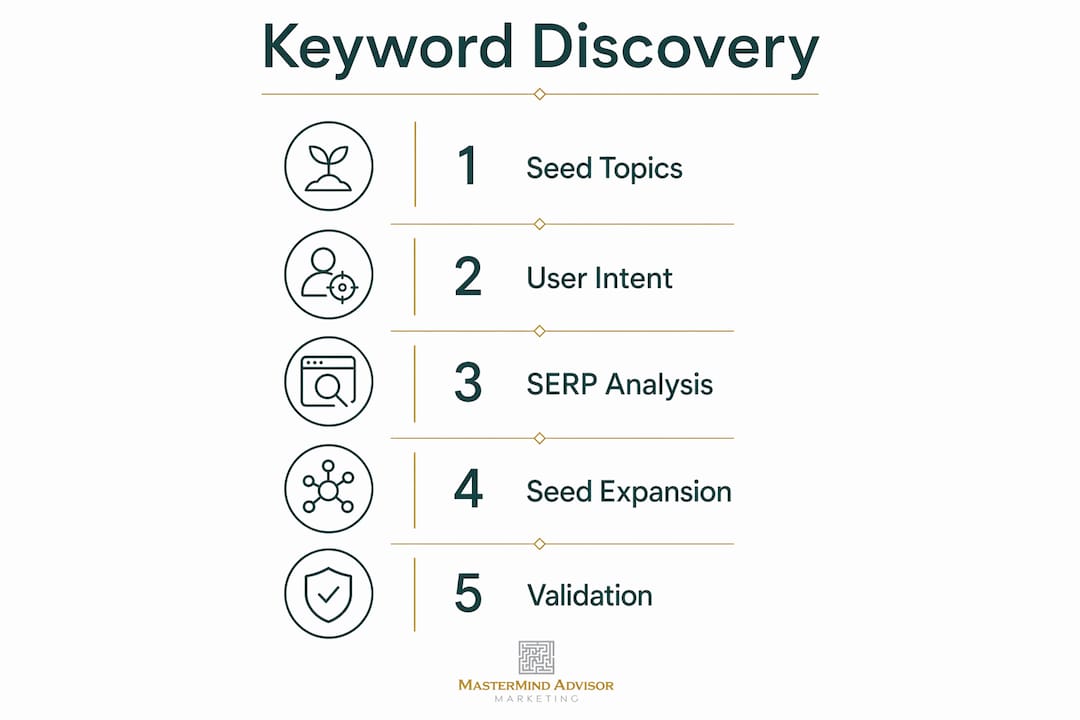
From each seed, expand into 50 to 200 long-tail candidates using Ahrefs, Google Search Console, and competitor gap analysis. The practical keyword difficulty threshold is under 30 when you are building authority from scratch. Targeting keywords with difficulty scores above 50 before you have established topical authority is a common mistake that produces no rankings and wastes content budget. Cluster 6 to 30 related articles per pillar to build the depth that search engines reward.
Here is a practical discovery sequence for financial marketers:
- List your core service areas as seed topics. Think in terms of client problems, not product names.
- Run each seed through Ahrefs or Google Search Console to surface related queries with low difficulty and clear intent.
- Mine AI platforms like ChatGPT and Perplexity by asking "what questions do people have about [seed topic]?" The responses reveal conversational long-tail queries your tools will never surface.
- Analyze competitor content gaps by identifying which long-tail queries your competitors rank for that you do not. Ahrefs' Content Gap tool makes this fast.
- Validate intent before writing. Manual SERP analysis for each keyword confirms whether the opportunity is real or already saturated by authoritative sources.
- Prioritize commercial and transactional queries over purely informational ones. AI Overviews handle the latter. You want the queries that lead to consultations, downloads, and sign-ups.
Pro Tip: Search your target keyword in Google and scroll to "People Also Ask." Every question in that box is a validated long-tail keyword with real search demand. Add the best ones to your cluster immediately.
How to build a content cluster strategy around long-tail keywords
Long-tail keywords are the structural foundation of SEO, not a supplementary tactic. The cluster model makes this concrete. A pillar page covers a broad topic at depth. Sub-pillar pages go one level deeper. Spoke pages, each targeting a specific long-tail keyword, support the sub-pillars. Internal links connect every layer, passing authority upward and signaling topical depth to search engines.
For a financial advisor, a pillar page on "retirement planning" might anchor sub-pillars on "Social Security strategies," "401(k) rollover options," and "required minimum distributions." Each sub-pillar then supports 6 to 15 spoke pages targeting specific long-tail queries like "when to claim Social Security if still working at 65" or "401(k) rollover to IRA tax implications for high earners." This architecture does two things simultaneously. It satisfies the specific intent of each long-tail searcher, and it builds the topical authority that eventually earns rankings for the broader head terms.
The AI visibility benefit of this model is significant. AI search engines perform query fan-out, breaking complex queries into multiple long-tail sub-questions and pulling answers from the most relevant pages. A well-structured cluster covers those sub-questions holistically, increasing the probability that your content gets cited across multiple AI-generated responses. AI-referred traffic converts at 6x the rate of traditional Google search traffic, making this architecture directly tied to revenue for financial advisors.
Key principles for building your cluster:
- Write each spoke page to fully answer one specific long-tail query, not to mention it briefly.
- Group supporting keywords onto existing pages rather than creating thin standalone pages for every variant.
- Use internal links with descriptive anchor text that reflects the target keyword of the destination page.
- Align content depth with query complexity. A 600-word page cannot satisfy a query that demands a step-by-step process.
- Revisit and update spoke pages quarterly, since AI-driven search patterns shift faster than traditional search trends.
You can find a detailed breakdown of this approach in this content cluster strategy guide that covers proven steps for 2026.
What pitfalls do financial marketers face with long-tail strategies?
The most common mistake is treating word count as the definition of a long-tail keyword. A five-word phrase can be a head term if it has broad intent and high volume. A three-word phrase can be long-tail if it is hyper-specific. Defining long-tail by length leads to targeting the wrong queries and building content that does not convert.
The second major pitfall is creating individual pages for every keyword variant. If you have 40 supporting keywords that all reflect the same core intent, building 40 separate pages produces thin content that search engines penalize. Group supporting keywords under one well-developed page and address each variation within the content. This approach builds page depth and avoids the cannibalization that fragments your authority.
Financial marketers also tend to over-index on informational queries because they are easier to write. But AI Overviews now answer most informational questions without sending traffic to your site. The 2026 strategy favors commercial and brand-action queries where the searcher is evaluating options or ready to contact an advisor. Prioritize those.
Pro Tip: Integrate your long-tail keyword early in H2 headings or FAQ blocks rather than forcing it into every paragraph. Search engines read context, not repetition. One well-placed keyword in a structured heading signals more relevance than five forced mentions in body copy.
The last pitfall is skipping SERP analysis before writing. If the top results for your target keyword are pages from Fidelity, Vanguard, or the IRS, no amount of good writing will displace them. Validate every keyword against actual search results before committing content resources. Opportunity lives where current results are weak, outdated, or misaligned with what the searcher actually needs. For more on building a financial advisor digital presence, the connection between keyword strategy and website architecture is direct.
Key takeaways
Long-tail keyword strategy is the fastest path to qualified organic traffic for financial advisors because it targets specific buyer intent that broad keywords cannot capture.
| Point | Details |
|---|---|
| Define by intent, not length | Long-tail keywords are specific and low-volume, not simply multi-word phrases. |
| Classify before you create | Separate topical, supporting, and conversational keywords to assign the right content treatment. |
| Build clusters, not pages | Group 6 to 30 related articles per pillar to build topical authority that compounds over time. |
| Prioritize commercial queries | AI Overviews absorb informational traffic; target queries that lead to consultations and conversions. |
| Validate with SERPs | Check actual search results before writing to confirm the opportunity is real and winnable. |
Why long-tail strategy is the smartest bet I have seen in financial marketing
I have worked with financial advisors who spent months chasing head terms like "financial advisor" and "retirement planning" with zero traction. The moment we shifted their content toward specific long-tail queries, "fee-only financial advisor for federal employees in Virginia" and "Social Security claiming strategy for married couples with age gap," the results changed within 90 days. Not because the algorithm suddenly favored them, but because they stopped competing against Fidelity and started owning the specific conversations their ideal clients were already having.
The conventional wisdom says to build authority first, then go after long-tail keywords. I think that is backwards. Long-tail content builds the authority. You do not earn the right to rank for head terms by waiting. You earn it by accumulating dozens of well-structured spoke pages that collectively signal deep expertise to search engines and AI platforms alike. The compounding effect of topical authority is real, and it is durable in a way that paid traffic never is.
The advisors I have seen succeed in 2026 treat their long-tail keyword strategy as a content asset, not a checklist. They revisit clusters, update spoke pages, and mine AI platforms for new conversational queries every quarter. That discipline is what separates the advisors who rank from those who wonder why their content is not working. If you want to understand how this connects to lead generation for advisors, the keyword layer is where it all starts.
— Josh
How Mastermindadvisormarketing can accelerate your keyword strategy
Financial advisors rarely have time to build keyword clusters, analyze SERPs, and produce consistent content while managing client relationships. That is exactly the gap Mastermindadvisormarketing fills. Their turnkey marketing system is built specifically for independent advisors, combining content strategy, CRM automation, and lead nurturing into one integrated platform.

Mastermindadvisormarketing's team understands the specific queries your prospects are searching, from retirement income planning to Medicare supplement comparisons, and builds content architectures that capture that traffic. Their advisor marketing services include keyword strategy, content cluster development, and automated follow-up sequences that turn organic traffic into booked consultations. If you are ready to stop guessing and start ranking for the queries that matter, Mastermindadvisormarketing is built for exactly that.
FAQ
What makes a keyword "long tail" in SEO?
A long-tail keyword is defined by narrow search intent and low search volume, not by word count. The phrase reflects a specific user need, which is why long-tail traffic converts at 2 to 4 times higher rates than broad head terms.
How many long-tail keywords should I target per content cluster?
An effective cluster contains 6 to 30 related articles per pillar topic. Start with 10 to 50 seed topics and expand each into 50 to 200 long-tail candidates, then prioritize by keyword difficulty under 30 and commercial intent.
Should I create a separate page for every long-tail keyword?
No. Supporting long-tail keywords with overlapping intent should be grouped onto a single well-developed page. Creating individual thin pages for every variant produces content that search engines penalize rather than reward.
How do AI platforms change long-tail keyword strategy?
AI search engines break complex queries into multiple long-tail sub-questions and pull answers from the most relevant structured content. Covering related queries holistically within one page, especially in Q&A sections, increases the probability of AI citation and drives traffic that converts at 6x the rate of traditional search.
What is the best free tool for finding long-tail keywords?
Google Search Console surfaces real queries your site already receives, making it the most practical free starting point. Pair it with the "People Also Ask" section in Google search results to identify validated long-tail queries with confirmed search demand.