
A marketing calendar for financial advisors is defined as a structured, year-long schedule that maps every planned marketing activity to a specific date, channel, and goal. Think of it as the operating system behind your marketing. Without one, you react to opportunities instead of creating them. Mastermindadvisormarketing works with independent advisors every day who describe the same pattern: bursts of marketing energy followed by weeks of silence. A well-built calendar breaks that cycle by turning marketing from a task into a system.
What is a marketing calendar for advisors, exactly?
A marketing calendar is more than a schedule. It is a comprehensive strategic tool that coordinates all marketing efforts across platforms, timelines, and audience segments. The standard industry term is "content and marketing calendar," and it covers everything from blog posts and email campaigns to webinars, seminars, and social media posts.
For financial advisors, the calendar serves a specific function. It connects your marketing activity to the three stages of the client journey: Awareness, Consideration, and Decision. A prospect who finds your educational article in january is at the Awareness stage. A prospect who attends your webinar in march is at the Consideration stage. Your calendar maps these stages so no stage gets ignored and no effort is wasted.

The marketing calendar definition also includes timing logic. Tax season, market volatility events, and year-end planning windows are all predictable. A calendar lets you schedule content around these moments months in advance, so you show up with the right message at the right time.
What are the key components of an advisor's marketing calendar?
A well-structured advisor marketing calendar contains five core elements for every planned activity:
- Content type: Blog post, email newsletter, social media post, webinar, seminar, or video
- Topic and message: The specific subject and the client pain point it addresses
- Publishing platform: Your website, LinkedIn, email list, or in-person event
- Date and time: The exact scheduled publication or delivery window
- Hashtags and distribution notes: Especially relevant for social media, where a structured social media calendar improves consistency and audience engagement
Beyond these five fields, the most effective calendars balance two content categories. Evergreen content covers topics that stay relevant year-round, such as retirement planning basics or Social Security timing. Timely content responds to market events, tax law changes, or seasonal financial concerns. Mixing these content types maintains audience interest and prevents the burnout that comes from chasing news every week.
Scheduling cadence matters as much as content type. Most advisors do well with one long-form piece per month, one email newsletter per week, and two to three social posts per week. These numbers are not arbitrary. They reflect what independent advisors can realistically sustain without a full marketing team behind them.
Pro Tip: Build your calendar in a shared tool like Google Sheets or Notion so your entire team can see what is scheduled, what is in draft, and what needs approval. Visibility prevents duplication and keeps everyone accountable.
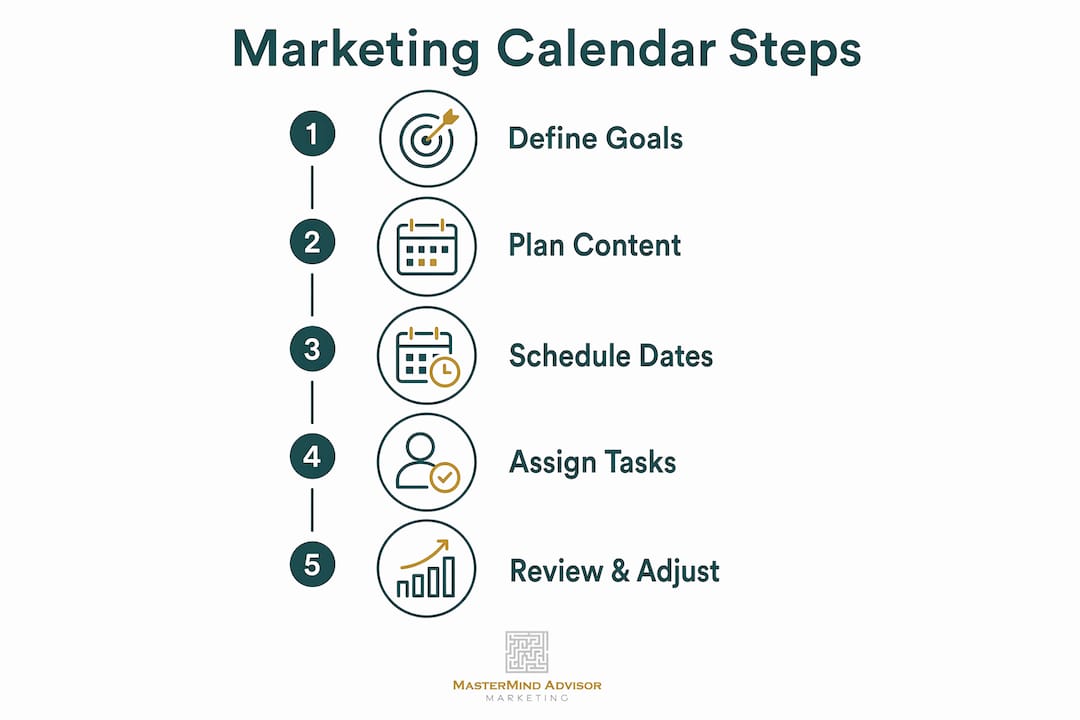
Marketing calendar templates are widely available and worth using as a starting point. A simple spreadsheet with columns for date, channel, topic, status, and owner covers most advisor needs. You can add complexity later once the habit is established.
How does a marketing calendar improve strategy and decision-making?
The most underrated benefit of a marketing calendar is what it prevents. Without a plan, every shiny new marketing idea competes for your attention. A podcast pitch arrives in your inbox in june. A conference opportunity appears in august. Without a calendar, you say yes to everything or nothing, and neither works.
"A focused marketing strategy acts as a decision-making filter. It defines what a firm will and won't do, which prevents midyear distractions and second-guessing. Clarity on priorities simplifies planning and keeps the firm moving forward."
Kitces.com, "Creating An Annual Marketing Strategy For Advisory Firms"
This filter function is the real importance of marketing calendars for advisors. When a new opportunity appears, you check it against your calendar. Does it fit your current quarter's focus? Does it reach your target audience? Does it align with your client journey stage goals? If the answer is no, you pass without guilt.
The calendar also creates alignment across the marketing funnel for advisors. Awareness content, such as educational articles and social posts, feeds prospects into your email list. Consideration content, such as webinars and case studies, moves them toward a meeting. Decision content, such as testimonials and consultation offers, closes the gap. A calendar ensures all three layers run simultaneously rather than in accidental sequence.
Advisors who plan their marketing annually report a clearer sense of what is working. When you schedule a campaign and track its results, you build a feedback loop. That loop makes next year's calendar smarter than this year's.
How to create a sustainable marketing calendar as an advisor
Building a calendar that lasts requires a different mindset than building one that looks impressive on paper. The goal is consistency over perfection.
-
Choose your home base. Pick one primary content channel where your best content lives. For most advisors, this is a blog or a podcast. Every other channel, including email and social media, distributes content from that home base. Full Advisor Coaching recommends establishing this home base before building out any other part of the calendar.
-
Set a realistic publishing schedule. One quality article per month beats four rushed posts per week. Commit to a frequency you can maintain during your busiest quarter, not your slowest one.
-
Map your content to the calendar year. Identify the predictable moments in your clients' financial lives: tax season in february and march, mid-year reviews in june, year-end planning in october and november. Assign content topics to these windows first, then fill in the gaps. Seasonal marketing ideas give you a practical starting point for this step.
-
Involve your whole team. Including non-advisor team members in content creation distributes the workload and improves output quality. A client service associate who handles common questions every week is a content goldmine. Ask them to draft a FAQ post and edit it yourself.
-
Build a repurposing workflow. One webinar becomes a blog post, three social media clips, and an email newsletter. One article becomes a LinkedIn post series. Repurposing multiplies your output without multiplying your effort.
-
Schedule a monthly calendar review. Block 30 minutes at the start of each month to check what is coming, confirm what is drafted, and adjust for anything that changed. This review keeps the calendar alive instead of letting it become a document you made once and forgot.
Pro Tip: Accept that some content will be imperfect. Advisors who wait for the perfect article publish nothing. Advisors who publish consistently build audiences. Done beats perfect every time.
What challenges do advisors face with marketing calendars?
The three most common obstacles advisors report are content fatigue, compliance friction, and schedule collapse under client pressure.
-
Content fatigue hits when you run out of ideas after the first few months. The fix is a running idea list. Keep a shared document where anyone on your team can add topic ideas as they come up. Client questions, news events, and advisor forums are all reliable sources.
-
Quality versus quantity tension causes many advisors to either over-produce and burn out or under-produce and disappear. The most common obstacles in calendar planning include this exact trade-off. Set a minimum viable output standard and protect it.
-
Compliance review delays can derail a calendar if they are not built into the workflow. Add a compliance review step to every content item before it is scheduled for publication. Build the review window into your timeline, not as an afterthought.
-
Schedule collapse happens when a busy client season pushes marketing to the back burner. The solution is batch creation. Write four weeks of content in one sitting during a slower period. When the busy season hits, you publish from your backlog without missing a beat.
-
Lack of accountability is the silent killer of most marketing calendars. Assign ownership for every item on the calendar. Someone's name goes next to every task. Without ownership, nothing gets done.
The content marketing fundamentals behind a sustainable calendar are not complicated. They require discipline, not creativity.
Key Takeaways
A marketing calendar is the single most effective tool an independent financial advisor can use to maintain consistent, client-focused marketing throughout the year.
| Point | Details |
|---|---|
| Define your calendar clearly | A marketing calendar maps every activity to a date, channel, and client journey stage. |
| Balance content types | Mix evergreen and timely content to maintain audience interest without burning out. |
| Use it as a decision filter | A calendar tells you what to say yes to and what to skip, preventing scattered effort. |
| Build for sustainability | Set a publishing schedule you can keep during your busiest weeks, not just your slow ones. |
| Involve your whole team | Non-advisor staff members reduce the content load and often generate the best topic ideas. |
The part most advisors skip entirely
Most articles about marketing calendars focus on the mechanics: what columns to use, how often to post, which tools to pick. That advice is fine, but it misses the harder question. What are you actually trying to say, and to whom?
I have seen advisors build beautiful, color-coded calendars that produce nothing because the content had no point of view. A blog post titled "Five Retirement Tips" is not a marketing asset. It is noise. The advisors who get real results from their calendars are the ones who decide, before they schedule a single post, what they stand for and who they serve.
The calendar is not the strategy. It is the container for the strategy. If you fill it with generic content, you get generic results. If you fill it with specific, opinionated content aimed at a defined audience, you build authority. That authority is what turns a prospect into a client.
Flexibility inside the structure also matters more than most guides admit. A rigid calendar that cannot absorb a market event or a client crisis becomes a source of stress rather than relief. Build in two or three "flex slots" per quarter. These are open calendar spots you can fill with timely content when something relevant happens. That flexibility keeps the calendar useful when the world does not cooperate with your plan.
— Josh
How Mastermindadvisormarketing supports your marketing calendar
Mastermindadvisormarketing builds turnkey marketing systems for independent financial advisors, and the marketing calendar sits at the center of every system. The platform provides customized webinar and seminar frameworks, content marketing strategies, and automated email workflows that plug directly into your calendar structure.
Advisors who work with Mastermindadvisormarketing get a calendar that is already mapped to the client journey, pre-loaded with content themes, and connected to a CRM that tracks every touchpoint. You do not start from a blank spreadsheet. You start from a system that has already worked for advisors in practices like yours. If client events are part of your calendar, the seminar planning resource gives you a proven framework for making those events count.
FAQ
What is a marketing calendar for financial advisors?
A marketing calendar for financial advisors is a structured annual schedule that maps every planned marketing activity, including emails, blog posts, webinars, and social media posts, to a specific date, channel, and goal. It connects marketing efforts to the client journey stages of Awareness, Consideration, and Decision.
How often should advisors update their marketing calendar?
A monthly review is the minimum. Block 30 minutes at the start of each month to confirm upcoming content, check what is in draft, and adjust for any schedule changes or new opportunities.
What should a financial advisor include in a marketing calendar?
Each calendar entry should include the content type, topic, publishing platform, scheduled date and time, and any distribution notes such as hashtags or email subject lines. A structured calendar improves consistency and audience engagement.
How does a marketing calendar help with compliance?
Building a compliance review step into the calendar workflow prevents last-minute delays. Assign a review window to every content item before its scheduled publication date so approvals never hold up your publishing schedule.
What is the biggest mistake advisors make with marketing calendars?
The most common mistake is building a calendar without a clear content strategy behind it. A calendar filled with generic topics produces generic results. Define your audience and your point of view before you schedule a single post.