
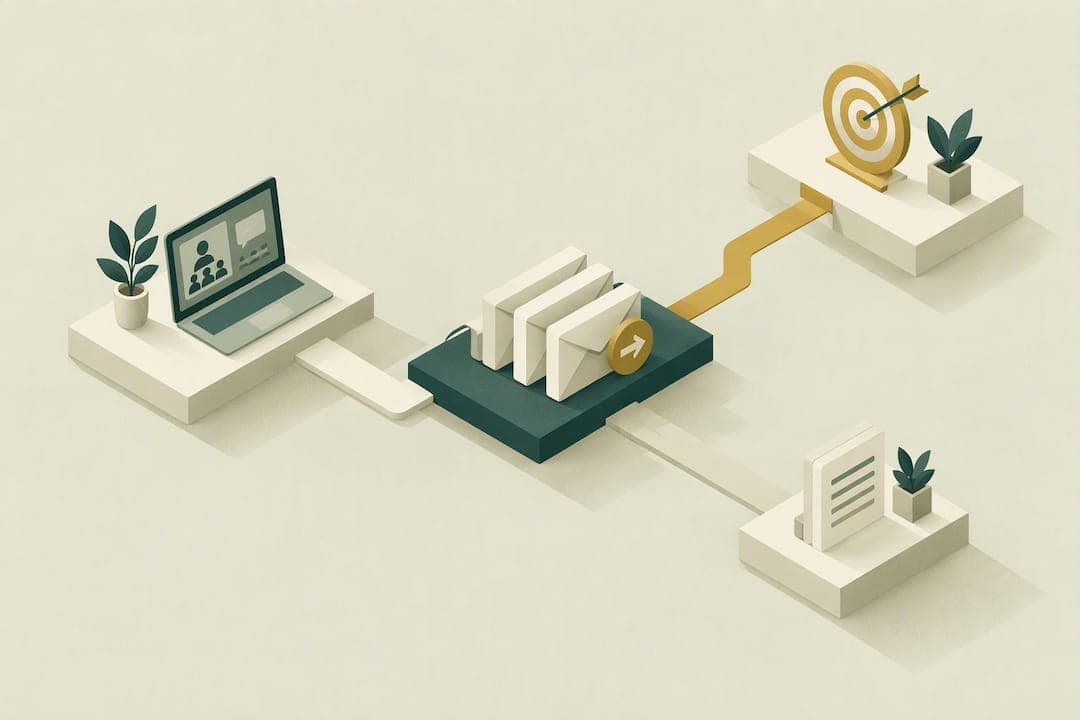
The best move after a webinar is to send a targeted follow-up within 24 hours and immediately launch a behavior-driven nurture sequence. That first email should thank attendees, deliver the replay, and offer one clear next step, while your segmentation rules start sorting people by attendance and engagement. At the same time, set your sales handoff thresholds so hot leads get a call before interest cools with support from a top web design agency that can enhance your multi-location marketing and digital follow-up experiences.
TL;DR:
- Segment attendees based on engagement metrics such as watch time, poll responses, and behavior signals to tailor follow-up and improve conversion chances.
- Send a personalized follow-up email within 24 hours containing a webinar recap, replay link, and one clear next step to maintain momentum.
- Develop a multi-step nurture sequence over the following weeks, designed to build authority and guide warmed leads toward sales conversations through behavior-based branching.
- Use integrated tracking of webinar data and send triggers to avoid duplicate emails and ensure accurate marketing and sales handoff.
- Focus on generating hot leads with a scoring model that considers engagement, resource downloads, and CTA clicks, providing sales with a prioritized list within 72 hours.
Table of Contents
- Segmenting attendees and registrants for relevant follow-up
- Immediate follow-up that preserves momentum (first 24 hours)
- Designing the post-webinar email nurture sequence
- Multi-channel nurture: when and how to add social, retargeting, and SDR outreach
- Identifying hot leads and the sales handoff
- Measure, report, and optimize your post-webinar funnel
- Integrations and operational checklist (who sends what: webinar tool vs CRM)
- How this blueprint applies to financial advisors
- A practical shortcut most teams skip
- How Mastermind Advisor Marketing helps run compliant, high-converting post-webinar nurture
- Sources
- FAQ
Segmenting attendees and registrants for relevant follow-up
A single follow-up email sent to everyone who registered wastes the behavioral data a webinar generates. Attendees who stayed for the full session, answered every poll, and asked questions are in a different buying stage than no-shows who registered and vanished.
Useful segmentation variables include:
- Attendance status: live attendee, no-show, or partial attendee who dropped off early.
- Watch time: percentage of the session viewed, which signals interest depth.
- Poll and Q&A responses: direct indicators of which pain point or product area resonates.
- Role, company size, or practice type: shapes which case study or resource lands best.
- Expressed intent: requests for pricing, a demo, or a follow-up call during the session.
Most CRMs let you build these as simple rules: tag anyone who watched more than 20 minutes as "engaged," anyone who clicked a poll about a specific topic as interested in that topic, and anyone who registered but never joined as a "replay" segment. The 2025-26 B2B Webinar Benchmark Report notes that AI tools now convert poll responses and watch-time data into micro-segments automatically, which moves programs from one-size-fits-all batches to dynamic, individualized paths without added manual work.
Immediate follow-up that preserves momentum (first 24 hours)
The first 24 hours after a webinar carry the highest attention and recall. Waiting a week to follow up means competing with everything else that has landed in a prospect's inbox since.
Your first email should include, in order:
- A thank-you line that names the specific webinar topic.
- A short, two or three-sentence recap of the core takeaway.
- A replay link, even for live attendees, since many will rewatch sections.
- One clear call to action, whether that's booking a call or downloading a related resource.
- A one-line next step telling the reader exactly what happens if they take that action.
Statistic: According to the 2025-26 B2B Webinar Benchmark Report, engagement-first branches built on opens, clicks, and watch time consistently predict conversion better than demographic-only segmentation, especially in shorter sales cycles. That means your 24-hour email is also your first data point for the nurture branches that follow.
A short survey or single poll question can go out alongside or shortly after this first email, asking what topic the reader wants covered next. It doubles as both feedback and a segmentation signal.
One compliance note matters here: if your follow-up includes marketing content, not just event logistics, it counts as a commercial email under FTC CAN-SPAM guidance, which means it needs a working opt-out link regardless of how you label it internally.
Designing the post-webinar email nurture sequence
A single follow-up email is not a nurture sequence. The sequence is what turns a warm attendee into a sales conversation over the following two to four weeks.
A reusable blueprint runs four to seven messages:
- Email 1 (within 24 hours): thank-you, recap, replay link, one CTA.
- Email 2 (day 3 to 4): a deep-dive resource tied to the webinar's main topic.
- Email 3 (day 7): a case study or proof point relevant to the attendee's segment.
- Email 4 (day 10 to 12): a soft CTA, such as a short guide or checklist.
- Email 5 (day 16 to 18): a direct ask, like booking a consultation or demo.
Each message earns its place: the recap keeps the topic fresh, the deep-dive resource builds authority, the case study answers "does this work for someone like me," and the final ask converts warmed interest into a booked conversation.
Branching should follow behavior, not a fixed calendar. If a reader opens every email but never clicks, move them to a lighter-touch track. If they click a pricing or demo link, skip ahead and escalate to a sales-focused message immediately. The HubSpot benchmark report recommends if/then branches based on opens, clicks, replay watch minutes, and content downloads rather than static day-by-day sends, since behavior signals shift the right message at the right time.
Pro Tip: Build one branch specifically for "watched replay after missing the live session." These attendees often convert faster than live viewers because they chose to catch up on their own time.

Multi-channel nurture: when and how to add social, retargeting, and SDR outreach
Email carries most of the nurture weight, but it works better paired with other channels at the right moments. Retargeting ads and LinkedIn outreach should trigger off nurture behavior, not run on a separate schedule.
- Launch retargeting ads to attendees who opened two or more nurture emails but haven't clicked a CTA.
- Add a LinkedIn connection request or comment from a sales rep once a lead hits your "engaged" threshold, not before.
- Space outreach so no single contact receives an email, an ad impression, and an SDR message within the same 24-hour window.
- Keep the message consistent across channels: if the email references a specific case study, the ad or outreach should reinforce the same idea rather than introduce a new pitch.
Done this way, the channels reinforce one story instead of competing for attention, and prospects don't feel chased.
Identifying hot leads and the sales handoff
Marketing's job after a webinar is to hand sales a short list of people worth calling today, not a spreadsheet of every registrant.
- Build a simple scoring model: attendance (10 points), watch time over 75% (15 points), poll responses (5 points each), resource downloads (10 points), and CTA clicks (20 points).
- Set a threshold, such as 40 points, that automatically flags a lead as "hot" and creates a CRM task for sales.
- Give sales a 48 to 72 hour window to act on hot leads before the status expires, a practice drawn from practitioner guidance on HubSpot's community forum.
- Attach context to the CRM task: which poll answers they gave, how long they watched, and which resource they downloaded, so the rep's first outreach feels informed rather than generic.
Skipping that context is a common miss. A one-line note about what the lead engaged with during the session noticeably increases the odds a prospect accepts a follow-up meeting.
Measure, report, and optimize your post-webinar funnel
A nurture sequence without measurement is a guess dressed up as a strategy. A handful of KPIs tell you whether the funnel is actually working.
- Attendee-to-opportunity rate: the percentage of attendees who become a sales conversation.
- Email click-through rate by sequence step, to spot where interest drops off.
- Replay watch rate among no-shows, which shows whether your recovery emails are working.
- Conversion rate from nurture to booked call or demo, your clearest bottom-line number.
Statistic: The 2025-26 B2B Webinar Benchmark Report points out that engagement-first signals like opens and watch time outperform demographic data for predicting conversion, which makes them the right metrics to test against, not just report.
Run one A/B test per quarter, such as subject line framing or CTA placement, and review results against a consistent attribution window, typically 30 to 60 days post-webinar, so stakeholders see results on a comparable timeline each time.
Integrations and operational checklist (who sends what: webinar tool vs CRM)
Confusion over who sends what causes duplicate emails and missed triggers. Practitioner guidance from HubSpot's community recommends a clean split: the webinar platform handles confirmations, unique join links, and reminders, while the CRM owns everything after the event, including segmentation and nurture.
Before launch, confirm each of these:
- Attendee and registrant data syncs automatically from the webinar platform to the CRM.
- Poll answers and watch-time data transfer as fields the CRM can use for scoring.
- Replay hosting links are stable and tracked, so clicks register as a behavior signal.
- Trigger mapping is tested: a "watched 75%" event should fire the right branch, not a generic one.
The most common pitfall is relying on the CRM to replicate personalized join links instead of letting the webinar tool handle that natively, which tends to break reminder sequences.
How this blueprint applies to financial advisors
Financial advisory marketing runs on longer nurture windows and compliance-reviewed language, since prospects weigh a fiduciary relationship far more carefully than a typical B2B purchase. Mastermind Advisor Marketing's internal benchmark data shows webinar registration converting at roughly 20 to 40% of warm traffic for advisor audiences, underscoring webinars as a strong lead channel when nurture follows correctly. For ready-to-use templates and sequencing, see this guide to webinar follow-up emails and this overview of generating leads from financial webinars.
A practical shortcut most teams skip
Split responsibilities early: let the webinar platform own reminders and join links, and let the CRM own every nurture decision after the event. Teams that mix the two spend hours untangling duplicate sends instead of writing better emails.
— Josh
How Mastermind Advisor Marketing helps run compliant, high-converting post-webinar nurture
Running this blueprint takes time most advisory practices don't have alongside client work and compliance reviews. Full-service marketing providers handle the entire system so advisors don't have to build it themselves.
- Fully produced webinars paired with automated, compliance-friendly follow-up sequences.
- A content library built specifically for regulatory requirements in financial services.
- CRM and email automation integration that handles segmentation and sales handoff without manual setup.
- Growth strategy support that maps nurture timing to an advisor's actual sales cycle.
If building and maintaining this kind of system sounds like more than your team can take on alongside client work, explore Mastermind Advisor Marketing's services to see how a done-for-you webinar and nurture system could fit your practice.
Sources
- 2025–26 B2B Webinar Benchmark Report (HubSpot PDF)
- Candid answers to CAN-SPAM questions | Federal Trade Commission
- Webinar Purchase + Follow Up Emails - HubSpot Community
FAQ
Are webinars still effective in 2026?
Yes, webinars remain an effective lead generation channel when paired with a fast, behavior-driven follow-up. Their value increasingly depends on how well the nurture sequence that follows uses attendance and engagement data, not just the live session itself.
What should I include in my post-webinar follow-up email?
Include a thank-you, a short recap of the main takeaway, a replay link, and one clear call to action. Keep the next step to a single line so the reader knows exactly what to do.
What are common webinar mistakes to avoid?
The most common mistake is sending one generic follow-up to every registrant regardless of attendance or engagement. Another is waiting too long to reach out, which lets interest fade before the nurture sequence even starts.
What is a nurture email sequence?
A nurture email sequence is a series of emails, typically four to seven messages over two to four weeks, that gradually builds interest through recaps, resources, and case studies before a direct call to action. Branches shift based on behavior like opens, clicks, and content downloads rather than running on a fixed calendar alone.