
A good webinar registration conversion rate lands between 20% and 40% of landing-page visitors for warm traffic, with registration-to-attend rates typically clustering in the high 40s percent range. The two levers that move these numbers fastest are traffic segmentation (never blend warm and cold results into one number) and landing-page friction (every extra field or exit link costs you registrants). Fix those two before touching anything else.
TL;DR:
- Segment traffic sources to avoid misdiagnosing warm audience performance as cold traffic failure, as warm lists can convert at 30% or higher.
- Optimize landing pages by using targeted, benefit-driven headlines, removing navigation, and ensuring the offer and registration form are visible above the fold.
- Keep registration forms minimal with only two visible fields, and frame CTA copy around outcomes rather than actions to boost sign-up rates.
- Structure promotion in phased campaigns, focusing on organic and warm channels early, then scaling with paid ads during the final week, to maximize overall signups.
- Automate CRM integration for real-time registration and attendance tracking, enabling personalized follow-up sequences and maintaining compliance standards.
Table of Contents
- Webinar Registration Conversion Metrics and 2026 Benchmarks
- Landing-Page Elements That Move Webinar Registration Conversion
- Form Design and CTA Copy That Convert
- Traffic Segmentation and Promotion Timing for Webinar Signups
- Confirmation and Reminder Sequences That Lift Attendance
- Measuring Webinar Registration Conversion the Right Way
- What Advisor Webinar Metrics Mean for Customer Acquisition Cost
- Connecting Webinar Signups to Your CRM and Marketing Automation
- The Trade-Offs Experienced Marketers Actually Weigh
- How Mastermind Advisor Marketing Handles Webinars for Advisors
- Sources
- FAQ
Webinar Registration Conversion Metrics and 2026 Benchmarks
Three numbers matter here, and marketers routinely confuse them. Registration rate measures visitors who land on your page and complete the form. Registration-to-attend (often called show rate) measures how many of those registrants actually show up live. Attended-to-pipeline tracks how many attendees turn into a sales conversation or opportunity.
Digital Applied's 2026 analysis puts the registration-to-attend median at 41.6% across large platform datasets, while Livestorm's benchmark report, built from 33,786 sessions, finds show rates clustering closer to 47% to 51% depending on day and format.
Statistic Callout: Nearly half of all webinar registrations, 49.6% according to Livestorm, happen in the final week before the event. If you close registration early or stop promoting seven days out, you're cutting off your single largest signup window.
The blended-metric trap catches even experienced teams. If your overall registration CVR looks like 12%, that number is meaningless without knowing the mix behind it:
- Warm list traffic (existing subscribers, past attendees): often converts at 30% to 40%+
- Retargeting traffic: typically lands in the mid-teens to low 20s
- Cold paid traffic: frequently sits in single digits to low teens
Blend those together and you'll misdiagnose a strong warm-audience page as "underperforming," or worse, tweak a page that's already working because a weak cold campaign dragged the average down. Segment first. Optimize second.
Landing-Page Elements That Move Webinar Registration Conversion
Your registration page has exactly one job. Everything on it should serve that job or get removed. Operator playbooks that follow an eight-element checklist, headline, subhead, date and time, bullets, social proof, host credibility, a short form, and a single call to action, report conversion rates above 40% on warm traffic when the rest of the funnel supports it.
- Write the headline as a formula, not a slogan. Combine audience, specific benefit, timeframe, and a credibility marker. "How Fee-Only Advisors Add 5 Qualified Prospects in 45 Minutes, Hosted by a 15-Year RIA Veteran" beats "Join Our Free Webinar" every time. Testing on real landing pages shows headlines built this way consistently outperform generic versions.
- Put the offer and the form above the fold. Date, time, and duration need to be visible without scrolling. Ambiguity here is a silent conversion killer.
- Use targeted social proof, not a wall of logos. A handful of relevant company names, one or two micro case studies, or a simple attendee counter ("1,240 advisors already registered") does more work than a generic testimonial carousel.
- Strip the navigation entirely. No header menu, no footer links, no "back to homepage" button. Every exit point is a leak in your funnel.
- Treat page speed as a conversion feature. Conversion drops sharply as load time climbs past a few seconds, so compress images and cut third-party scripts before you touch the copy.
Pro Tip: Build your registration page mobile-first, not desktop-first-then-adapted. More than half of your traffic will likely hit this page from a phone, and a form that requires pinching to zoom will lose registrants before they ever read your headline.
Form Design and CTA Copy That Convert
Fewer fields means more signups, almost without exception. Ask for first name and email only on the visible form. If you need a phone number for SMS reminders, make it optional and explain why in one short line next to the field.
- Two visible fields (first name, email) outperform four or five in nearly every documented test
- Add an optional SMS opt-in only if you actually plan to send day-of reminders by text
- Use progressive profiling to collect qualification data (firm size, role, AUM range) after registration, not before, through a follow-up email or the confirmation page
- Surface a single qualifying question only when lead quality matters more than raw volume, and frame it as helping you "tailor the session," not screening them out
CTA copy should describe the outcome, not the action. "Save My Seat" and "Get the Playbook" tend to beat "Register Now" or "Submit" because they name what the registrant gets. Test outcome-focused variants like "Reserve My Spot" against benefit-driven ones like "Show Me the Strategy," and let the data pick the winner rather than guessing. Sharper CTA wording alone can shift conversion by several points.
Pro Tip: Set your minimum tap target to at least 44 pixels on mobile buttons. A CTA that's technically clickable but hard to hit with a thumb quietly bleeds conversions you'll never see in your analytics.
Microcopy matters too. A line under the button like "Takes 15 seconds. Calendar invite sent instantly." reduces hesitation by setting expectations before the click.
Traffic Segmentation and Promotion Timing for Webinar Signups
Different channels convert at wildly different rates, and treating them as one funnel produces bad decisions. Warm email lists routinely convert registrants at 30% or higher. Retargeting ads to site visitors who didn't convert the first time typically land in the mid-teens to low 20s. Cold paid social or search traffic often sits in single digits.
Statistic Callout: Roughly half of registrations arrive in the final seven days, and 15.3% register on the day of the event itself. A promotion plan that front-loads all its effort three weeks out and coasts is leaving the biggest wave of signups unpromoted.
Structure promotion in phases rather than one flat push:
- Weeks 3 to 2 out: Announce through email and organic social, seed the topic with partners
- Week 1 (the sprint): Heavy email cadence, paid retargeting, LinkedIn posts from personal profiles (these consistently outperform brand-page posts for B2B), and any partner co-promotion
- Day of: Final reminder push across every channel you have, including SMS if you collected numbers
Email should carry the bulk of the load for warm audiences. LinkedIn works best for B2B contexts like financial advisory, especially when the host posts personally rather than through a company page. Retargeting exists to recapture the visitors who almost converted, and paid cold traffic should be reserved for scaling reach once your organic and warm channels are maximized.
Confirmation and Reminder Sequences That Lift Attendance
Attendance lives or dies in the days between registration and the event, not on the registration page itself. Livestorm's data points to an immediate confirmation paired with a multi-touch reminder cadence as the single most effective lever for show rate.
- Send confirmation within seconds of signup. Include the calendar file (.ics), the join link, and a one-line summary of what they'll get from attending.
- D-7: A value-focused email. Remind them why they signed up, not just when.
- D-3: A logistics-focused email. Confirm time zone, platform, and how to join.
- D-1: A final value reminder plus the join link again. Assume they've lost the original email by now.
- Morning of: SMS and email together. This single touch often recovers registrants who would otherwise forget.
- At go-live: A short "we're starting now" message and, if your platform supports it, a countdown timer on the registration page itself for latecomers.
Ready-made follow-up email templates can save you from building this cadence from scratch every time.
Measuring Webinar Registration Conversion the Right Way
Five numbers tell you almost everything you need: click-through rate (CTR) from promotion to landing page, conversion rate (CVR) on the landing page itself, cost per lead (CPL), registration-to-attend rate, and attended-to-pipeline rate.
- Track CTR and CVR separately by channel, never as a blended average
- Segment every number by traffic source, ad creative, and campaign before drawing conclusions
- Sync registration and attendance data to your CRM so sales can see who showed up, not just who signed up
Statistic Callout: BenchMarketing's conversion-type data recommends pairing registration CVR with attendance and pipeline outcomes rather than treating signup rate as the finish line. A page converting at 35% means little if only a quarter of those registrants show up and none convert to opportunities.
Show-rate data also doubles as a lead-quality signal. Registrants who attend live, especially those who stay past the halfway mark, are worth prioritizing in follow-up over no-shows, regardless of how they scored on your original qualifying question.
What Advisor Webinar Metrics Mean for Customer Acquisition Cost
For independent financial advisors, these conversion numbers translate directly into cost per client acquired. A firm running its own seminar and webinar programs internally often lands in a customer acquisition cost range of $500 to $1,000 once ad spend, staff time, and platform costs are totaled.
- Map registration-to-attend and attended-to-pipeline rates to actual cost per acquired client, not just cost per lead
- Advisor-specific webinar strategy templates shortcut the trial-and-error most solo practices go through
- Firms with limited internal marketing bandwidth typically see faster payback from managed services than from building this infrastructure in-house
The math changes fast once compliance review time and internal opportunity cost get factored in.
Connecting Webinar Signups to Your CRM and Marketing Automation
A registration page disconnected from your CRM is a data dead end. Every registrant, attendee, and no-show needs to sync automatically into whatever system your sales team actually uses, otherwise follow-up happens late or not at all.
The practical setup: your registration platform should push contact records and attendance status directly into your CRM in real time, tagged by source and campaign. This lets sales see, at a glance, who registered, who showed up, and how long they stayed, without waiting on a manual export from marketing. Automated email drip sequences can then branch based on that data. Attendees get a different follow-up path than no-shows, and highly engaged attendees (those who stayed for Q&A or clicked a resource link) can be flagged for faster outreach.
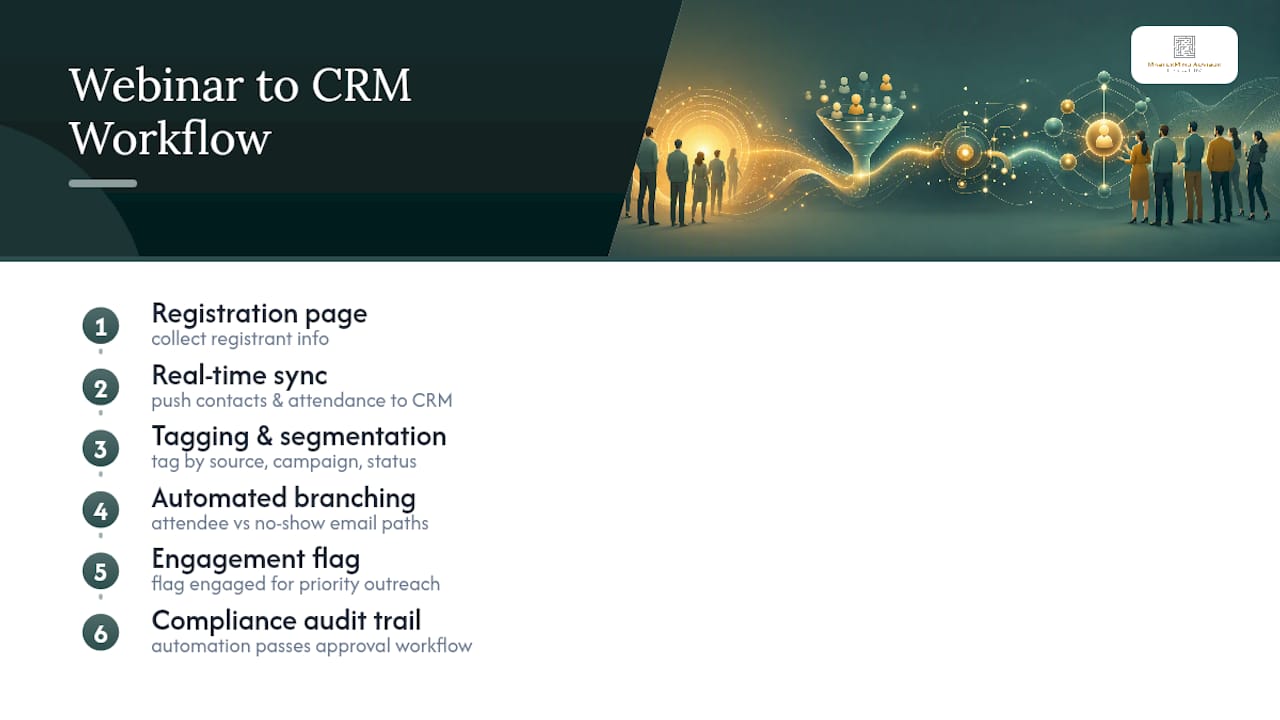
For financial advisory practices specifically, this integration matters more than in most industries because of compliance review requirements. Every automated email touching a prospect needs to run through the same approval process as any other client communication, so the automation platform has to support that review workflow, not just fire messages on a timer. A CRM that separates "registered," "attended," and "engaged" into distinct fields gives your compliance team a clean audit trail while giving your follow-up sequences the granularity to actually convert.
The Trade-Offs Experienced Marketers Actually Weigh
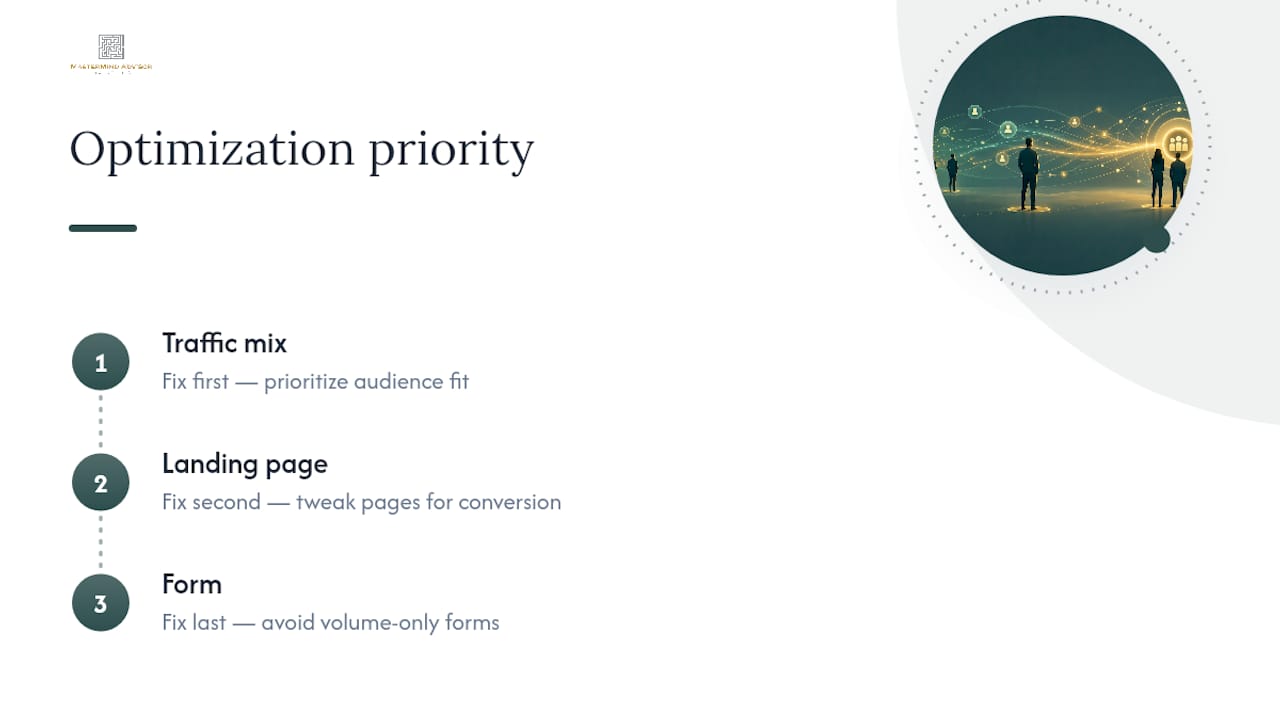
Audience fit beats marginal landing-page tweaks almost every time. A page converting at 25% with the right audience will outproduce a page converting at 40% with the wrong one, every single time it runs.
The real skill is balancing lead-quality needs against raw conversion goals instead of treating them as the same target. The biggest rookie mistake I see is optimizing a form for volume, then wondering why sales won't work the leads. Triage it simply: fix your traffic mix first, your page second, your form last.
— Josh
How Mastermind Advisor Marketing Handles Webinars for Advisors
Building and running this entire system yourself, landing pages, reminder cadences, CRM syncing, compliance review, eats weeks most advisory practices don't have. A managed service can run the whole webinar and seminar operation for you: customized registration pages, automated reminder sequences, and CRM integration built specifically around the compliance requirements and long buying cycles unique to financial services, not repurposed from a generic marketing template.
The system suits solo RIAs and small advisory teams alike, particularly firms that know their message but lack the bandwidth to build and test registration pages, reminder sequences, and follow-up automation on their own. Advisors working with a specialized marketing service get access to proven templates, including the seminar-to-CAC framework referenced earlier, along with seminar hosting resources built from real advisor engagements.
If your current registration numbers are inconsistent or your follow-up is manual and inconsistent, start by reviewing the webinar and seminar services page to see what a managed, compliance-aware setup looks like for a practice your size.
Sources
- Livestorm — Webinar Benchmark Report 2026
- Digital Applied — Webinar Statistics 2026: Attendance and Conversion Data
- BenchMarketing — Webinar signup benchmarks
- GHL Webinar Snapshot — Webinar registration page (2026)
FAQ
Are Webinars Still Effective in 2026?
Yes. Registration-to-attend rates hovering around 40% to 50% show webinars still pull real, engaged audiences, and replay viewership often exceeds live attendance within 30 days, extending the value further. For advisor firms specifically, webinars remain one of the more cost-efficient ways to generate qualified prospect conversations.
Is a 12% Conversion Rate on a Website Good?
It depends entirely on the traffic behind it. A 12% blended rate could mean a weak cold-traffic campaign or a strong one, so segmenting by source before judging the number is essential. For warm list traffic, 12% would be underperforming; for cold paid traffic, it could be solid.
Can More Than 500 People Register for a Zoom Webinar?
Zoom's standard webinar plans cap capacity at set tiers, and going beyond 500 or 1,000 attendees typically requires an add-on package with a higher registrant limit. Check your specific plan's capacity before promoting heavily, since hitting a registration cap mid-campaign wastes ad spend.
Do Teams Webinars Require Registration?
Microsoft Teams webinars can be configured with or without mandatory registration, depending on how the organizer sets up the event. Requiring registration is generally recommended for lead capture and reminder sequencing, even when the platform allows a registration-free option.