
Yes. Word of mouth is still the primary engine that brings new clients to independent financial advisors, and it's more systematic than most advisors treat it. Research tied to Cerulli data reported by InvestmentNews shows friends-and-family referrals alone account for a majority share of new advisory clients, with a significant portion coming from centers of influence. Matt Oechsli's research on advisor behavior identifies "Generators," the advisors who produce ten or more unsolicited referrals a year through deliberate activation tactics rather than luck. A turnkey system like Mastermind Advisor Marketing exists precisely because most advisors never build the repeatable process that turns casual client satisfaction into a steady referral pipeline.
If you take one action after reading this, make it these three:
- Audit where your last 20 clients actually came from, not where you assume they came from.
- Draft a simple referral playbook with specific ask language and timing.
- Set a baseline conversion rate for referred leads so you can measure improvement.
Key Takeaways
Word of mouth drives the majority of new client relationships in independent finance, and advisors who systematize referral activation consistently outperform those who wait passively for them.
| Point | Details |
|---|---|
| Referrals dominate acquisition | Friends and family account for roughly 55% of new clients, with centers of influence adding another 14%. |
| Become a Generator, not a Laggard | Oechsli's model shows top advisors produce 10+ unsolicited referrals a year through deliberate activation tactics. |
| Verification happens online | A majority of prospects check reviews and websites before contacting a referred advisor, so reputation upkeep matters. |
| Compliance shapes referral language | Testimonials and incentives must stay factual and documented to avoid SEC and FINRA exposure. |
| Mastermind Advisor Marketing operationalizes this | The turnkey system combines webinars, testimonial capture, and CRM tracking into one referral engine for advisory firms. |
Table of Contents
- Why the Role of Word of Mouth in Independent Finance Keeps Growing
- How Does a Referral Actually Become a Client?
- Building a Referral System That Runs Without You
- What Should You Measure, and How Long Does It Take?
- Do Reviews and Online Content Really Amplify Word of Mouth?
- Where Do Referral Programs Usually Break Down?
- How a Marketing Partner Approaches Word of Mouth for Advisors
- Get a Referral System That Runs Itself
- Sources
Why the Role of Word of Mouth in Independent Finance Keeps Growing
The numbers are more lopsided than most advisors expect.
Oechsli's framework sorts advisors into three tiers: Generators (10+ unsolicited referrals annually), Middlers (3 to 9), and Laggards (0 to 2). The differentiator isn't luck or tenure. It's whether the advisor actively creates conditions for referrals through emotional connection with clients and specific activation tactics, rather than passively hoping satisfied clients will mention them.
Top-performing advisors don't wait for referrals to happen. They engineer the moments that make clients want to talk about them, then refine the story clients actually tell their friends.
There's a behavioral layer too. Most prospects who hear a name from a trusted friend still go online to verify before calling, which means your reviews and website credibility are gatekeepers, not afterthoughts, in a process that started as pure word of mouth.
How Does a Referral Actually Become a Client?
The path from mention to signed client follows a predictable sequence, and knowing each stage tells you where to intervene.
- Unsolicited mention: A client, friend, or center of influence brings up your name in conversation, often triggered by a life event like a job change or inheritance.
- Trusted verification: The prospect asks the referrer a follow-up question, "Do you actually trust this person with your money?"
- Online check: The prospect searches your name, reads reviews, and checks your website for credibility signals.
- Inbound contact: The prospect reaches out, usually expecting a warm, low-pressure first conversation.
- Conversion: You either meet their expectations from the referral or lose them to hesitation.
Organic buzz and structured referral systems feed this funnel differently. Buzz happens when a client is simply impressed enough to mention you unprompted. A structured system, by contrast, prompts that mention at a specific moment, like right after a successful planning milestone. Advisory research on referrals versus word of mouth makes the distinction explicit: referrals are personal introductions, word of mouth is the broader ambient reputation, and advisors need both running in parallel.
Centers of influence, meaning accountants, attorneys, and other professionals who see financial need before you do, matter because they transfer trust they've already earned. A referral from a client's CPA carries different psychological weight than a random online ad precisely because that trust has been proven over years.

Pro Tip: Give clients a one-sentence version of what you do that's easy to repeat verbatim. "I help small business owners exit their companies without a tax disaster" travels much further than "comprehensive wealth management services."
Building a Referral System That Runs Without You
A referral engine that depends on your memory or mood will fail. Here's a sequence that builds a repeatable one.
- Audit your current sources. Pull the last 12 to 24 months of new clients and tag each by origin: family referral, COI, event, online search, cold outreach.
- Define your ideal client profile. Vague referral asks produce vague referrals. Specificity, like "business owners planning a sale in the next three years," gives referrers something concrete to listen for.
- Build a client experience checklist. Identify the two or three moments in your service (onboarding, first review meeting, plan completion) where satisfaction peaks and referrals are easiest to seed.
- Create activation tactics. Host small client appreciation events, send curated content clients actually want to forward, and make personal introductions between clients and relevant COIs.
- Formalize the ask. Replace "let me know if you know anyone" with a specific, time-bound request tied to a real moment.
- Follow up and recognize. Thank referrers promptly and specifically, and track whether that recognition increases repeat referrals.
Concrete activation tactics worth testing:
- Client-only educational dinners or webinars with a "bring a colleague" invite built in.
- Short testimonial videos clients can share with permission, reviewed for compliance before publishing.
- Quarterly check-ins with your top three centers of influence, not just an annual holiday card.
Compliance matters here more than in most marketing contexts. Testimonials need factual, approved language, not performance claims. Incentivizing referrals with cash or gifts above regulatory thresholds can trigger SEC or FINRA scrutiny, so document any recognition program and keep it modest and disclosed. Phrase client-facing referral language around introductions and relationships, never around investment results.
Pro Tip: Give clients a two-sentence "referral script" they can literally repeat to a friend. Most clients want to help you but freeze up when asked to explain what you do on the spot.
For advisors who want this entire sequence built and running rather than assembled piecemeal, Mastermind Advisor Marketing packages the webinars, testimonial capture, and CRM follow-up into one system rather than five separate vendors.
What Should You Measure, and How Long Does It Take?
Track five numbers: referral share of new clients, referral-to-meeting conversion rate, time-to-first-meeting, lifetime value of referred clients versus other sources, and a source-attribution breakdown across client, COI, and online review.
Set expectations honestly. Seeded activation tactics, like a client event or a formalized ask, tend to show incremental lift within 3 to 12 months. The compounding Generator effect Oechsli describes, where referrals snowball because satisfied referrers become repeat referrers, typically takes multiple years to fully mature.
- Capture referral source as a mandatory CRM field at intake, not an optional note.
- Run small experiments, like testing one new activation tactic per quarter, before scaling anything firmwide.
- Watch your speed-to-contact. Firms that centralize lead response and act within minutes convert noticeably more inbound leads into meetings.
Do Reviews and Online Content Really Amplify Word of Mouth?
Yes, and the sequence explains why. A majority of consumers begin their advisor search online even when the initial spark was a personal recommendation, which means your website and reviews function as a verification checkpoint rather than a discovery channel.
Prioritize in this order: collect and display client reviews and testimonials, keep a niche-focused website current, and produce recorded webinars or short-form content that gives prospects something to share before they even call. Platforms that surface client reviews, including options like Wiser Advisor, are increasingly part of how prospects validate a referral before booking.
The advisor who gets the referral but has a stale website or zero reviews loses prospects at the verification step, even when the initial word of mouth was strong.
A short testimonial video, a downloadable client guide, or a "bring a friend" invite after a seminar all create shareable moments that extend a single referral into several. Smaller firms should spend their own time on relationship-building activities like COI outreach and client events, and consider outsourcing content production and review management, an approach outlined in why advisors need an online presence and in partner guidance on SEO for financial advisors.
Where Do Referral Programs Usually Break Down?
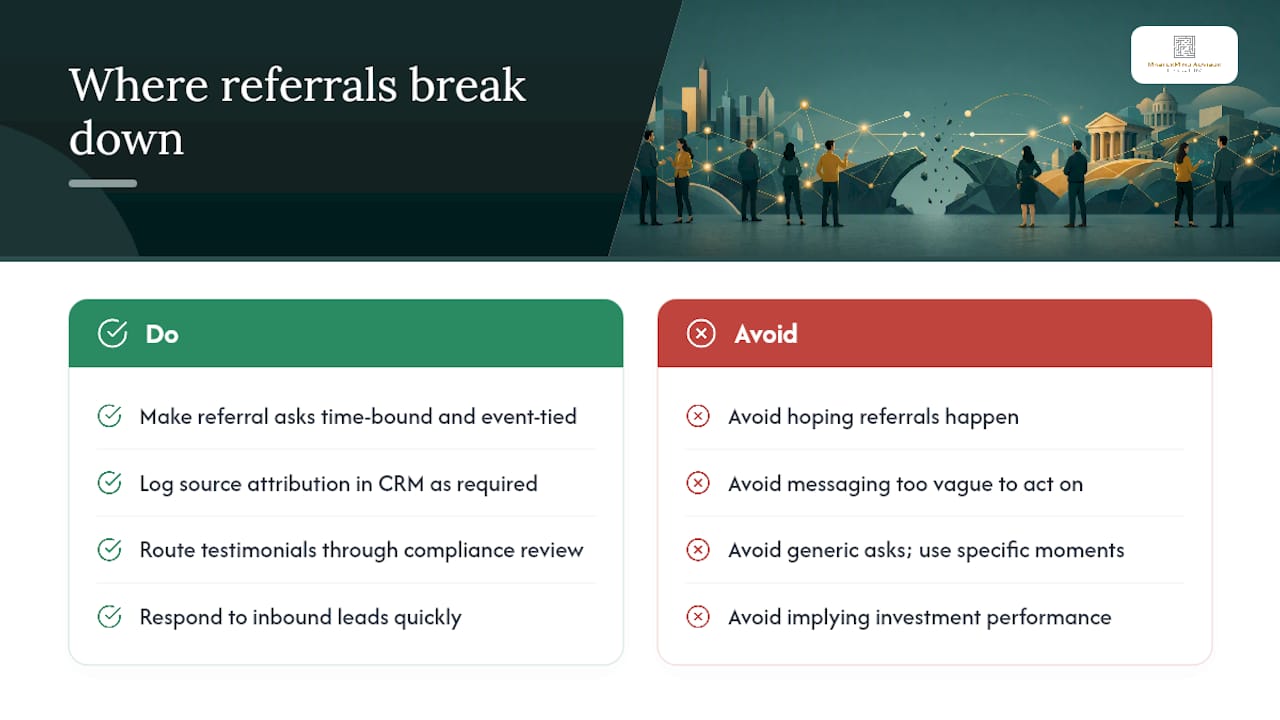
Most failures trace back to five habits: hoping referrals happen instead of prompting them, messaging that's too vague for anyone to act on, asking for referrals generically instead of at a specific moment, never logging where clients actually came from, and responding to inbound leads too slowly to capitalize on the trust they arrived with.
Compliance red flags deserve equal attention. Testimonials that imply investment performance, referral incentives that cross regulatory thresholds without disclosure, and vague "results may vary" language used as a shield rather than a genuine disclosure all invite scrutiny.
Fix each mistake with a specific corrective: make referral asks time-bound and tied to a real event, log source attribution as a required CRM field, and route every testimonial through a compliance review before it's published anywhere.
How a Marketing Partner Approaches Word of Mouth for Advisors
A partner-led approach to word of mouth means integrating client events, sharable content, testimonial capture, and CRM follow-up into one compliance-reviewed workflow instead of five disconnected efforts. That integration is what separates advisors who generate referrals reliably from those who generate them occasionally. A turnkey system doesn't manufacture word of mouth out of nothing. It removes the execution friction that keeps good intentions from becoming a repeatable habit, and it makes the results measurable instead of anecdotal.
Get a Referral System That Runs Itself
Mastermind Advisor Marketing is built specifically for the referral mechanics described above, so you're not stitching together five vendors to run one client-acquisition engine.

The turnkey system includes custom lead-generation webinars, fully produced seminars, a compliance-friendly content library, automated email drip campaigns, and CRM integration that logs referral source automatically instead of relying on memory. Advisors using the system have reported stronger lead flow and more organized follow-up once testimonial capture and event sequencing were handled for them rather than pieced together internally, a pattern echoed across the independent advisor case studies Mastermind Advisor Marketing has documented.
This is a retainer-based service for advisory firms that want implemented support, not a DIY toolkit. If your referral pipeline runs on hope rather than process, visit Mastermind Advisor to see how the system maps onto your practice and get a strategy conversation started.