
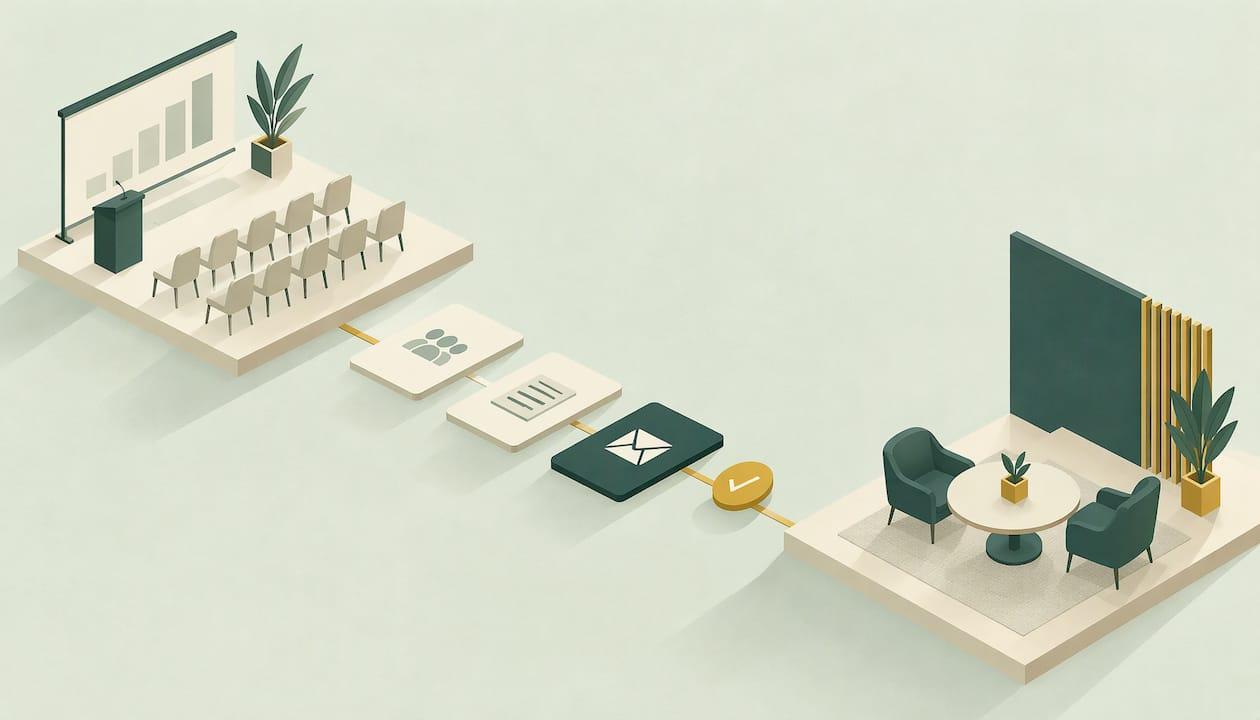
A seminar fills a room, but the follow-up fills your calendar. The strategy that works has four parts: contact everyone within 24 hours, send attendees and no-shows different messages, keep a short, spaced sequence going for about a month, and offer one clear next step that fits what each person told you. Every message also has to clear your compliance process before it goes out. This guide walks through each part for independent advisors and RIAs.
TL;DR
- Send the first message within 24 hours, and no later than 72 hours. Attendees get the promised resource and a next step. Registrants who did not attend get a recap or replay.
- Segment by behavior: registered, attended, asked a question, requested a meeting. Each group gets a different path.
- Follow a week later if the requested action has not happened, then move quiet prospects into a slower educational sequence rather than pushing harder.
- Offer one specific, low-pressure next step tied to the seminar topic, not a generic "let's talk."
- Follow-up emails to groups of prospects are advertising or retail communications. Route them through your compliance review and keep records.
Table of Contents
- Why the follow-up decides the seminar's return
- The first 24 hours: split attendees from no-shows
- What the first email should contain
- The 30-day cadence
- Match the follow-up to readiness
- Offer a next step that is easy to say yes to
- Compliance: what applies to follow-up messages
- Extend the seminar's reach after the event
- Measure what the follow-up produces
- Promo: follow-up that runs without you chasing it
- Perspective: why the follow-up is where seminars are won
- FAQ
- Sources
Why the follow-up decides the seminar's return
Most seminar budgets go to the room, the venue, the invitations and the speaker. The follow-up usually gets an afternoon and a generic thank-you. That is backwards, because a financial services buying cycle is long. A prospect who enjoyed your talk on retirement income may not be ready to share account statements for months. What you do in those months determines whether you are the advisor they call.
A good follow-up system does three jobs:
- It converts the people who are ready now into conversations.
- It keeps the people who are interested but not ready in a relationship with you.
- It tells you who is which, so your time goes to the right people.
The rest of this article builds that system step by step. If you want the event itself covered first, our guide to advisor seminars that win clients and fill pipelines goes through planning and promotion.
The first 24 hours: split attendees from no-shows
Timing is the one point nearly every source agrees on. Industry coverage for advisors says the first follow-up should usually arrive within 24 hours, while the event is still fresh, and that attendees and no-shows should not receive the same message. SEI's guide to high-net-worth client events sets a slightly wider outer limit: attendee follow-up within 72 hours, which thanks them and restates the call to action. Treat 24 hours as your target and 72 as the line you never cross.
Before the event ends, you should already know who falls into which group. That requires capturing registration and attendance data. If you only have a registration list, you cannot segment, and everyone gets the same weak email.
| Group | What they want | First message (within 24 hours) | Next step offered |
|---|---|---|---|
| Attended and engaged (asked questions, stayed to the end, handed in a feedback form) | Answers and a clear path | Personal thank-you, the promised resource, a reference to their question | A short discovery conversation |
| Attended, no sign of interest | Something useful, no pressure | Thank-you, key takeaways, the slides or checklist | A related guide or the next event |
| Registered, did not attend | Catch-up | Short note that you missed them, replay or recap | Watch the replay, then a related invitation |
| Requested a meeting at the event | Speed | A personal reply, ideally a call or direct email from you, not a template | Specific times on your calendar |
The fourth row matters most. Anyone who raised their hand should hear from a human fast, not enter an automated sequence. Automation is for everyone else.
What the first email should contain
Keep the first email short. It has to be read on a phone in under a minute. A strong one includes:
- A thank-you that names the event. "Thank you for joining Tuesday's session on tax-smart retirement income" beats "Thanks for attending our event."
- What they were promised. If the invitation said attendees would receive a checklist, a worksheet or the slides, deliver it in this email. Making people ask for it is the fastest way to lose the goodwill you just built.
- Two or three takeaways. A short recap helps people who zoned out for part of it and gives them something to forward to a spouse. Spouses often take part in these decisions.
- One call to action. Not three. The SEI guide's advice is to restate the call to action from the event itself, so the email matches what you asked for on stage.
- Your name and a real reply address. Replies from a person get answered. Replies to a no-reply address are lost.
For no-shows, change the lead. Skip the thank-you. Say you were sorry to miss them, give the replay or a recap, and mention the next session. If the event was a webinar, our post-webinar nurture blueprint shows the same 24-hour logic in more detail, and the guide to advisor webinars covers the replay side.
A sample email for attendees
Subject: Your retirement income checklist from Tuesday
Hi Maria,
Thank you for joining us on Tuesday. Your question about timing Social Security alongside portfolio withdrawals came up for several people, so I added a short section on it to the checklist attached.
Three ideas worth revisiting: (1) decide your essential spending floor first, (2) map which accounts you will draw from in which order, (3) review the plan every year, not just at retirement.
If it would help to walk through the checklist against your own numbers, you can book a 20-minute conversation here: [link]. No preparation needed.
Best, [Name]
The example is a template, not a script. Replace the details with what actually happened in your room, and have it reviewed by compliance before you use it (more on that below).
A sample email for no-shows
Subject: Sorry we missed you: replay and recap inside
Hi David,
We missed you on Tuesday. Here is the 40-minute replay, plus a one-page summary if you are short on time: [link].
We run a follow-up session next month on [topic]. I will send details when the date is set.
Short, useful and no guilt.
The 30-day cadence
The goal is steady presence, not volume. SEI's guidance is to follow up again after about a week if the requested action has not happened, and to add a call or two for prospects who have not responded. It also suggests repurposing the event's ideas in a newsletter, blog or social media. Here is a cadence built on those points.
- Day 0 to 1: Thank-you or replay email with the promised resource. Personal outreach to anyone who asked for a meeting.
- Day 3 to 4: Booking reminder, only for people who showed interest and have not scheduled. Keep it to two sentences.
- Day 7: A second email that adds something new: a short article, a worked example or an answer to a common question from the event. This is the follow-up for those who did not take the requested action.
- Day 7 to 10: A phone call or personal email to engaged attendees who have not responded. Reference something specific from the event.
- Day 14: An educational piece related to the seminar topic, with no ask beyond reading it.
- Day 21 to 30: Invitation to the next event or webinar, or a short feedback request. After this, move the contact to your regular newsletter.
That is five or six touches in a month, and only two are direct asks. The rest give something. People who feel pushed unsubscribe, and people who receive useful material stay.
What to do with silence
About half your list may do nothing after the first email. That does not mean no. Move them into a slower educational track instead of continuing the sequence. A monthly compliance-first email newsletter works well here. If you need the mechanics of setting up the sequences, the email campaign setup guide covers it.
Match the follow-up to readiness
The more you know about each person, the less generic your follow-up reads. Useful signals to capture:
- Registration details: how they found you, which topic they chose if you ran more than one.
- Attendance: present or absent, and how long they stayed if it was virtual.
- Feedback forms: a few short questions at the end, including whether they would like a one-to-one conversation.
- Appointment requests: the strongest signal you will get.
Rework's seminar guide recommends using these same signals (registration information, attendance, feedback and appointment requests) to prioritize who gets follow-up first. In practice that gives you three tiers:
- Ready: requested a meeting or ticked the box on the feedback form. Personal contact the same day.
- Warm: attended, engaged, no request. The standard sequence with one phone call.
- Cool: registered only, or attended with no engagement. Replay or recap, then the slow educational track.
A simple tag in your CRM for each tier is enough. The point is that the person who asked for a meeting never waits behind a mass email, and the person who barely engaged never receives a hard sell.
Offer a next step that is easy to say yes to
The most common mistake in seminar follow-up is a vague invitation: "Let me know if you'd like to chat." It asks the prospect to do the work of deciding what the conversation is about.
Better is a next step tied directly to the seminar topic. SEI gives an example for a tax-strategy event: invite attendees to submit a prior-year tax return so you can discuss which strategies might apply. Notice how that works. It is specific, it is useful to the prospect and it gives you the material for a real conversation.
Adapt that principle to your topic:
| Seminar topic | Specific next step |
|---|---|
| Retirement income | A 20-minute review of how their income sources would stack up against their spending floor |
| Tax planning | A look at last year's return for planning opportunities |
| Estate and legacy | A walk-through of a beneficiary and account-titling checklist |
| Market volatility | A review of their current allocation against their stated comfort level |
Keep the tone low pressure. Say how long it takes, say what they will get from it and say what you need from them, if anything. Do not imply urgency you cannot justify.
An additional option is a short continuation for people who engaged but are not ready for a meeting: a themed office hour or a small group discussion. It keeps them in the conversation without asking for a commitment.
Compliance: what applies to follow-up messages
Follow-up is marketing, and marketing is regulated. The details depend on whether you are an SEC-registered adviser, a state-registered adviser or a broker-dealer representative, so confirm your own obligations with your chief compliance officer or securities counsel. These are the points to have in mind.

FINRA firms. FINRA Rule 2210 defines a retail communication as written or electronic communication made available to more than 25 retail investors in any 30-calendar-day period. A seminar follow-up email sent to a full attendee list can meet that definition. The rule generally requires a qualified registered principal to approve retail communications before use, correspondence is subject to supervision and review, and the rule sets recordkeeping obligations.
SEC-registered advisers. The SEC's 2024 examination risk alert on the Marketing Rule says advisers should have written, tailored marketing policies and procedures and should preserve advertisements and supporting documents. Staff observed deficiencies in both areas. Your follow-up templates, the replay link, the slides and any testimonials or performance figures you use are all part of that record.
Performance figures. If you mention results in a follow-up, the SEC's Marketing Compliance FAQ says gross performance in an advertisement must be accompanied by net performance over the same period, using the same type of return and methodology, presented so the two can be compared. The simplest policy is to leave performance numbers out of follow-up emails entirely.
A practical approach is to get your templates approved once, in advance, so the sequence can run on a schedule without a review bottleneck each time. Any new wording, a new offer or a new resource goes back through review. For deeper reading, see our guides on seminar compliance under SEC and FINRA rules and the SEC versus FINRA advertising checklist.
Extend the seminar's reach after the event
A seminar produces more than a list of attendees. It produces content: a recording, a slide deck, answers to real questions. Turn those into assets that keep working.
- Publish a blog post answering the best question from the Q&A. Our guide to building a financial planning blog shows how to do it in a way that generates leads.
- Cut the replay into two or three short clips for social media, subject to the same compliance review.
- Feed the topic into your newsletter so no-shows and cool contacts keep seeing you.
- Make the content findable. A guide on SEO for financial advisors explains how search visibility compounds the value of content like this over time.
- Plan your next event while the first is fresh; this event marketing strategy guide covers the planning side of events.
For the wider picture of how seminars fit with web, email and content, the financial services digital marketing strategy guide is a good map.
Measure what the follow-up produces
Track a few numbers for every event, and compare them across events:
- Share of registrants who attended.
- Share of attendees who opened the first email and clicked the resource.
- Number of appointment requests within seven days, and within 30 days.
- Number of meetings that actually happened.
- Number of new clients, and how long they took.
The last number is slow, and that is the point of the 30-day plan and the slower educational track. Some seminar attendees become clients six months later. Tag every contact with the event they came from so you can credit the seminar when that happens.
Promo: follow-up that runs without you chasing it
Seminar follow-up needs a registration list, segmented messages, scheduled emails, a content library you can use safely and a CRM that tells you who to call. Mastermind Advisor Marketing builds that as a turnkey system for independent advisors: lead-generation webinars, fully produced in-person and virtual seminars, a compliance-friendly content library, automated email drip campaigns and integration with custom CRM and email automation tools.
If you want the event and the follow-up designed together, see our webinar, seminar, content library and email services, or start from the Mastermind Advisor home page.
Perspective: why the follow-up is where seminars are won
We are practicing advisors who have grown real advisory practices, and the lesson we keep coming back to is simple: the seminar is the introduction, the follow-up is the relationship.
Most advisors invest heavily in the day itself and then send one thank-you. We built our approach around the long buying cycle of financial services, where a prospect may need weeks or months before they are ready to meet. That is why our system pairs seminars and webinars with automated email drip campaigns, a content library written with regulatory needs in mind and a CRM that keeps every contact's history in one place.
Our playbook, which we describe as a $25M/year playbook, is designed so that nothing is wasted on vanity marketing. Every touch has a purpose: thank, deliver, educate, invite. Advisors should spend their time in conversations with people who are ready, and the system should carry the patient work in between.
If you take one thing from this article, take this: decide before the event what the next step is, who gets a personal call and what everyone else receives. Then build it once and let it run.
Josh
FAQ
How soon should I follow up after a seminar?
Send the first message within 24 hours, while the event is fresh. Treat 72 hours as the outer limit. Anyone who asked for a meeting should hear from you personally the same day if possible.
What should I send people who registered but did not attend?
Send a short note without guilt, with a replay or one-page recap, and mention your next event. Do not send them the attendee thank-you, because it will read as a template. Then move them to a slower educational sequence if they do not engage.
How many follow-up emails are too many?
Five or six touches over about 30 days is a reasonable ceiling, with only two or three containing a direct ask. Spacing and usefulness matter more than the count. If someone has not engaged by day 30, move them to your regular newsletter rather than continuing the sequence.
Do seminar follow-up emails need compliance approval?
Usually yes. Under FINRA Rule 2210, communications sent to more than 25 retail investors in 30 days are retail communications that generally need principal approval, and SEC-registered advisers must keep marketing policies and preserve advertisements. Check the specifics with your compliance officer and have templates approved in advance.
Sources
- Your Event Is Over. Your Marketing Shouldn't Be.
- A blueprint for a successful high-net-worth client event
- Seminar and Event Marketing for Financial Advisors
- FINRA Rule 2210: Communications with the Public
- SEC Exams Risk Alert: Marketing Rule Observations (2024)
- SEC Marketing Compliance Frequently Asked Questions
- SEO for Financial Advisors
- Event Marketing Strategy Guide