

A seminar can fill an advisor's calendar with qualified first meetings, but only when the whole chain works: a narrow audience, an invitation that reaches them, a presentation that stays inside the rules, and a follow-up that starts within days. Most seminars fail in the gaps between those steps, not in the room. We build seminars for independent advisors as a managed system, with the webinars, invitations, content, email follow-up and CRM tracking connected, and this guide shows the routine and where each step usually breaks.
TL;DR
- Pick one ideal client and one topic for that client. A seminar for "anyone with money" attracts no one in particular.
- Invite early (about three weeks out), confirm instantly, remind often, and call every RSVP personally the week of the event.
- Treat the seminar as a regulated communication: slides, scripts and handouts need approval, and nothing may suggest the event is purely educational if you plan to offer your services.
- Judge a seminar by cost per consultation and cost per client, not attendance alone.
- Start follow-up within two days. The appointment is won or lost in that window.
Table of Contents
- Why seminars still work for advisors
- Step 1: Define the audience before the topic
- Step 2: Choose the format and venue
- Step 3: Build the invitation and registration flow
- Step 4: Stay inside SEC and FINRA expectations
- Step 5: Run the event so it ends in an appointment
- Step 6: Follow up within two days
- What to measure and what it costs
- Our view: seminars are a system, not an event
- Put the system to work
- FAQ
- Sources
Why seminars still work for advisors
Financial advice is a long-cycle, trust-based purchase. A prospect rarely hires someone from a single ad click. A seminar compresses several touchpoints into one hour: they see you, hear how you think, watch peers react, and meet you in person or on video. That is why advisors keep returning to the format, and why the same format attracts regulatory attention.
The flip side is that a seminar is a high-fixed-cost activity. Venue, meals, mailers or ads, and your own prep time are spent before a single person books a meeting. That makes the planning steps below worth doing carefully. For more on the strategic side, see our piece on advisor seminars that win clients and fill pipelines.
Step 1: Define the audience before the topic
Start with who you want to serve, and define that beyond net worth. Capital Group's practice guide for advisors recommends defining an ideal client and tailoring the topic to that niche. Its examples: a firm serving women or divorcees might run a divorce-planning seminar, and one serving senior executives might run a concentrated-wealth seminar.
Good topic tests:
- A specific problem, not a product. "What to do with company stock before a liquidity event" beats "Investment strategies for 2027."
- A decision the audience is facing now. Retirement transitions, a sale of a business, an inheritance, Medicare and income timing.
- A topic you can already serve well. The seminar should lead naturally to the first meeting you actually want.
Where it goes wrong: choosing a topic that interests you but not your target household, or a topic broad enough that attendees have no reason to book a one-on-one afterward.
Our seminar and webinar work starts here, with the audience and topic mapped to your practice, because every later step depends on it.
Step 2: Choose the format and venue
There are three formats advisors use most:
| Format | Best for | Main risk |
|---|---|---|
| In-person seminar (restaurant, library, club, hotel room) | Local prospects, retirees, business owners who value face time | Higher fixed cost, no-shows hurt more |
| Webinar | Geographic reach, lower cost per attendee, easy replay content | Attention drifts, harder to build rapport |
| Small client-and-guest event | Referral-driven growth in a defined niche | Depends on your existing client base |
The same Capital Group guide notes there is no audience too small: for a handful of attendees, a fireside-style conversation can replace a slide deck. If you plan a meal, finish the presentation before dessert so the room is still engaged when you ask for the next step.
If you are weighing the webinar route, our financial webinar lead generation guide and advisor webinar strategy cover it in depth. We produce both in-person and virtual seminars, so the format can follow the audience rather than the other way around.
Step 3: Build the invitation and registration flow
This is where most seminar lead generation is won. The mechanics Capital Group recommends are simple: email invitations about three weeks ahead, send weekly reminders, and add a day-of reminder. It also suggests asking existing clients to bring two or three connections, which tends to produce warmer attendees than cold lists.
A workable registration flow has five parts:
- A landing page with one topic, one date, one button. State who the event is for.
- Instant confirmation by email, with the venue or link, parking or access details and a calendar attachment.
- Reminders at roughly one week, one day and the morning of the event.
- A personal phone call to every RSVP during the event week. It confirms attendance and tells you what each person hopes to learn.
- Over-registration, since some registrants will not show. Plan for the audience size you need after drop-off, not before.
Where it goes wrong: invitations that go out ten days before, a landing page that tries to explain your whole firm, or confirmations that arrive hours late. Prospects who register and hear nothing treat the event as optional.
This is the part we take off your hands. Our webinars and seminars are supported by email drip campaigns and automated reminders tied to a custom CRM, so registrants move through confirmation and reminders without anyone on your team sending each message by hand.
Step 4: Stay inside SEC and FINRA expectations
Seminar rules are not a footnote for advisors. They shape what you can say, what you can hand out and what you must keep on file.
Why regulators watch seminars
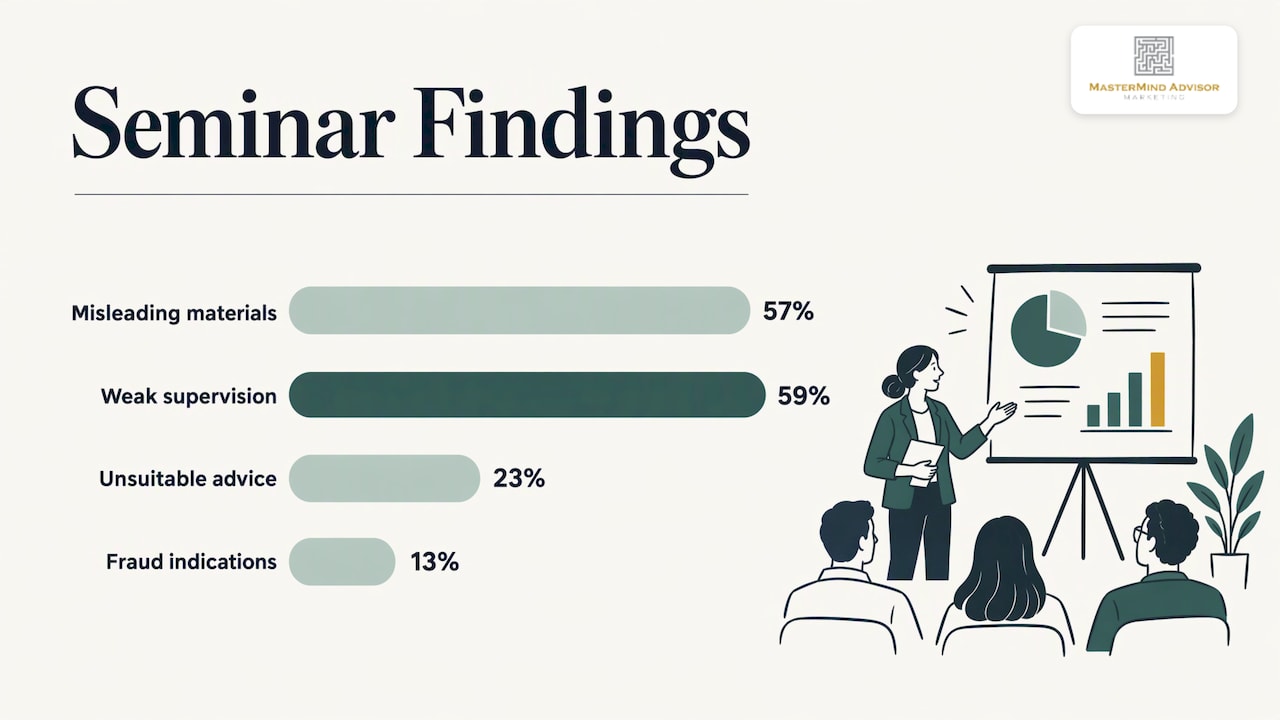
A joint report from FINRA, NASAA and the SEC examined 110 seminars between April 2006 and June 2007. It found that 57% involved potentially misleading or exaggerated materials, 59% showed weak supervision, 23% involved possibly unsuitable recommendations, and 13% showed indications of possible fraud. The same report found that events billed as educational or "nothing will be sold" were often built to open accounts and sell products, and that attendees often did not know which firm sponsored the event. Regulators recommended that firms review and approve all seminar materials and take particular care with seniors.
The lesson for an independent advisor is practical: say plainly who is hosting, what the event is, and that you will offer to discuss your services.
What to approve and what to file
FINRA Rule 2210 applies to broker-dealer communications, so check with your own compliance resource which rules govern your firm. Under that rule, as summarized by Achievable:
- A seminar counts as a public appearance. Unscripted live speaking follows the general content standards, while scripts, slides and handouts are separate communications that must be classified and approved.
- A written communication sent to more than 25 retail investors within 30 days is a retail communication needing principal approval before use. Correspondence to 25 or fewer is supervised rather than pre-approved.
- Firms need written procedures to supervise public appearances.
- No communication may project or predict performance, with narrow exceptions, and an amendment is set to take effect on February 1, 2027. Confirm the final text on FINRA's own site before you plan around it.
- Records are kept three years under SEC Rule 17a-4(b).
A compliance manual excerpt filed with the SEC describes a permanent seminar file: title, date, location, speaker, approval date, invitee list, attendee list (client or prospect), approved advertisements and copies of the approved presentation. Keeping that file from the first seminar is far easier than rebuilding it later.
Our content library is compliance-friendly and the seminar materials are tailored for the regulatory needs of financial services. For the full walkthrough, read our guide to advisor seminar compliance under SEC and FINRA rules. Your firm's compliance officer still gives final sign-off on your materials, as the rules require.
Step 5: Run the event so it ends in an appointment
A seminar that educates and then lets everyone leave has produced goodwill, not leads. The structure that works:
- Open with the audience's problem, not your credentials. One or two minutes on who you are is enough.
- Teach three or four ideas that a person can use whether or not they hire you.
- Show the next step. Capital Group's adviser Leah Ryan describes the close as the moment to ask for the appointment while taking the mystery out of what an initial meeting involves. Tell people what happens in the first meeting, how long it takes and what to bring.
- Collect information openly. A short response card or a form with a QR code, stating that you will contact them about a meeting, keeps the tone honest and keeps you consistent with the disclosure concerns above.
- Avoid performance promises in any form, spoken or on a slide.
Where it goes wrong: a hard product pitch (the thing regulators flagged), no clear ask, or a form that is so long people skip it.
Step 6: Follow up within two days
Capital Group recommends thank-you emails within two days of the event, with appointment calls starting at the same time, and handwritten notes where you have addresses. That cadence matches how attention fades: by the following week, the seminar is one of many things the prospect has seen.
A simple sequence:
- Day 0 or 1: thank-you email with the slides or a summary you have already had approved, plus a link to book a time.
- Day 2: personal call to everyone who attended, and a short note to registrants who missed it with the replay or an alternative date.
- Week 1 to 2: a second email with one useful piece of content related to the topic.
- Weeks 3 to 8: a slow drip for those who did not book, because the buying cycle in this business is long.
We cover this in detail in our seminar follow-up strategy and have copy-ready webinar follow-up emails you can adapt. Our email marketing and CRM integration run this sequence automatically, so a missed call does not mean a lost lead.
Seminar attendance also rises when the invitation is seen more than once. A consistent posting calendar helps, and social media scheduling across networks can keep event promotion on a single plan. A findable website matters too: prospects often search your name after an invitation arrives, so SEO for financial advisors supports the same goal.
What to measure and what it costs
Track the funnel from the first invitation to the signed client:
| Metric | What it tells you |
|---|---|
| Invitations sent and registrations | Whether the topic and list fit |
| Show rate (attendees divided by registrants) | Whether confirmation and reminders work |
| Consultations scheduled | Whether the close and follow-up work |
| Cost per attendee, per consultation, per client | Whether the event pays |
| Assets or revenue per new client | Whether you attracted the right people |
A simple illustration, with invented numbers for the arithmetic only: if an event costs $6,000 in all, produces 12 first meetings and 4 new clients, your cost per consultation is $500 and your cost per client is $1,500. Compare that with the lifetime fee revenue of a client in your practice. If 12 meetings had come from 60 attendees, you would also know your meeting rate, and you can change the topic, the close or the follow-up one variable at a time.
The cost depends heavily on venue, list source and meal choices, so build your own budget from real quotes. Our seminar marketing cost guide lays out the line items, and our piece on seminar conversion rates and client acquisition cost shows how to translate attendance into cost per client.
Our view: seminars are a system, not an event
Most advisors who tell us seminars "didn't work" ran a good event inside a broken process. The room was fine. The invitation went out late, the follow-up started a week after, and nobody could say what each client had cost.
We are practicing advisors who have grown real advisory practices, and we built our marketing around the way advisors actually win clients: long buying cycles, a regulated message, and trust built over several touches. A seminar is the strongest of those touches, so we treat it as the center of a system. Webinars and seminars bring prospects in, the content library and email drip keep the conversation going, the website gives them somewhere credible to land, and the CRM shows what each event produced.
That is why we work only with financial advisors. Generic agencies optimize for clicks. We optimize for a booked first meeting that your compliance process can stand behind.
Josh
Put the system to work
If you want seminars that run end to end without your team building each piece, our turnkey marketing system covers customized webinars, fully produced in-person and virtual seminars, a compliance-friendly content library, email marketing, social media and websites, all tailored for independent advisors. See the full list on our services page, or start with our growth strategy to map the plan for your practice.
FAQ
How far ahead should I promote a seminar?
Plan on about three weeks, with weekly reminders and a final reminder the day of the event, as Capital Group's practice guide recommends. Call each RSVP personally during event week. Start building the landing page and getting materials approved before that, since compliance review can take time.
Are webinars or in-person seminars better for lead generation?
It depends on your audience. In-person events suit local retirees and business owners who value face time, and webinars reach further at lower cost and leave you with replay content. Many advisors run both, and we produce both formats.
Can I say a seminar is educational?
Only if it is accurate. The joint FINRA, NASAA and SEC report found events billed as educational that were designed to sell products. State who is hosting, make clear you will offer to discuss your services, and have your compliance officer approve the slides, scripts and handouts.
What should I track after a seminar?
Registrations, show rate, consultations scheduled, cost per attendee, cost per consultation, and cost per client. Those six numbers tell you whether to change the topic, the invitation or the follow-up.
Sources
- Protecting Senior Investors: Report of Examination of Securities Firms Providing Free Lunch Sales Seminars (FINRA, NASAA, SEC)
- Compliance manual excerpt on seminar supervision, filed with the SEC
- FINRA Rule 2210 explained: Communications with the public
- How to hold prospecting seminars that turn investors into clients (Capital Group)