
Relationship-based marketing (RBM) is a deliberate strategy where financial advisors replace one-time transaction thinking with a long-term operating model built around trust, personalized communication, and consistent value delivery to each client. The payoff is direct: higher client retention, more inbound referrals, and deeper wallet share from clients who already trust you. Research published in the Journal of Marketing Theory & Practice confirms that even clients who behave transactionally still perceive relational attributes, meaning RBM is relevant across your entire book, not just your most engaged clients. Harvard Business Review's retention research makes the business case bluntly: keeping the right clients creates disproportionate long-term value for service firms. Mastermindadvisormarketing was built specifically to operationalize this for independent advisors.
Quick outcomes advisors typically see when they commit to RBM:
- Retention rates tend to climb as clients feel genuinely known, not just managed
- Referral volume often increases because satisfied clients introduce people in their network
- Average revenue per client can grow as trust opens conversations about additional planning needs
Key Takeaways
Relationship-based marketing is the highest-ROI strategy available to financial advisors because trust compounds over time in ways that no single campaign can replicate.
| Point | Details |
|---|---|
| RBM definition for advisors | A long-term operating model built on trust, personalization, and consistent value delivery across every client touchpoint. |
| Retention drives compounding revenue | Improving retention by a few percentage points on a typical client book can preserve significant annual revenue before considering referral gains. |
| Segment before you systemize | Divide your book into three tiers and match touchpoint frequency and format to each tier's relationship depth. |
| Measure the right KPIs | Track retention rate, referral rate, CLV, engagement rate, meetings per client, and NPS at 3, 6, and 12-month intervals. |
| Mastermindadvisormarketing | A turnkey system that maps webinars, CRM automation, compliance-ready content, and seminar production directly to RBM KPIs. |
Table of Contents
- What is relationship-based marketing for financial advisors?
- Why RBM matters more in wealth management than in almost any other industry
- The core principles behind RBM and what they mean for your practice
- How to implement RBM inside your advisory practice
- How do you measure RBM success in an advisory practice?
- Common mistakes advisors make with RBM
- Real-world RBM plays in advisory practices
- How Mastermindadvisormarketing operationalizes RBM for advisors
- The case for prioritizing RBM right now
- Mastermindadvisormarketing gives advisors a faster path to RBM results
- Sources
What is relationship-based marketing for financial advisors?
Relationship-based marketing, sometimes called relational marketing in academic literature, is the practice of designing every client and prospect touchpoint to deepen trust rather than simply close a transaction. For advisors, that means moving beyond the annual review call and the quarterly newsletter blast toward a model where your firm knows each client's life stage, financial anxieties, and communication preferences, and acts on that knowledge consistently.
The distinction from transactional marketing is not about abandoning lead generation. Kitces makes this clear: advisors who balance transactional tactics for awareness with relationship-focused methods for conversion and retention see stronger lifetime value and ROI than firms relying on only one approach. Transactional marketing fills the top of the funnel. RBM converts and retains.
The practical difference shows up in daily behavior. A transactional advisor sends a market update email to everyone on the list. A relational advisor sends that same update, then flags the three clients whose portfolios are most affected and calls them personally before the week ends.
Why RBM matters more in wealth management than in almost any other industry
Financial advice is a high-stakes, long-cycle, anxiety-laden purchase. Clients are not buying a product they can return. They are trusting you with their retirement, their children's education, and their peace of mind. That context makes trust the primary currency, and trust is built through repeated, relevant, personalized contact over time.
The ABA Banking Journal's wealth management marketing overview identifies trust, personalization, life-event targeting, and the pairing of digital scale with timely human support as the core levers for converting introductions into enduring client relationships. Firms that get this right do not just retain clients longer. They get introduced to the client's adult children, their business partners, and their friends going through a divorce or an inheritance.
Retention is often worth more than acquisition. HBR's analysis shows that keeping the right customers creates disproportionate long-term value, particularly for service firms where the cost of replacement is high and the revenue from a loyal client compounds over years.
Timeline expectations matter here. Most advisors may see early signals within a few months, such as improved engagement and referral activity, with retention improvements measurable over the course of a year. RBM is not a campaign. It is a compounding asset.
The core principles behind RBM and what they mean for your practice
Three psychological principles drive every effective RBM program.
Trust is the foundation. Clients stay with advisors they believe are competent and genuinely acting in their interest. Every interaction either builds or erodes that belief. Advisor behavior that builds trust: proactive communication before clients ask, transparent fee explanations, and admitting when a recommendation did not perform as expected.

Reciprocity is the mechanism. When you consistently deliver value without an immediate ask, clients feel a natural pull to reciprocate, usually through referrals, expanded assets under management, or simply staying through a rough market. Educational content, as Advisorpedia notes, is one of the most effective reciprocity triggers in advisory services because it reduces client anxiety and positions you as a teacher, not a salesperson.
Know-like-trust is the sequence. Clients must first know you exist, then like what you stand for, then trust you enough to act. Advisor Perspectives describes consistent, helpful communications and repeated visibility as the primary tactics for moving prospects through this funnel at scale.
The 3-3-3 rule in advisor terms
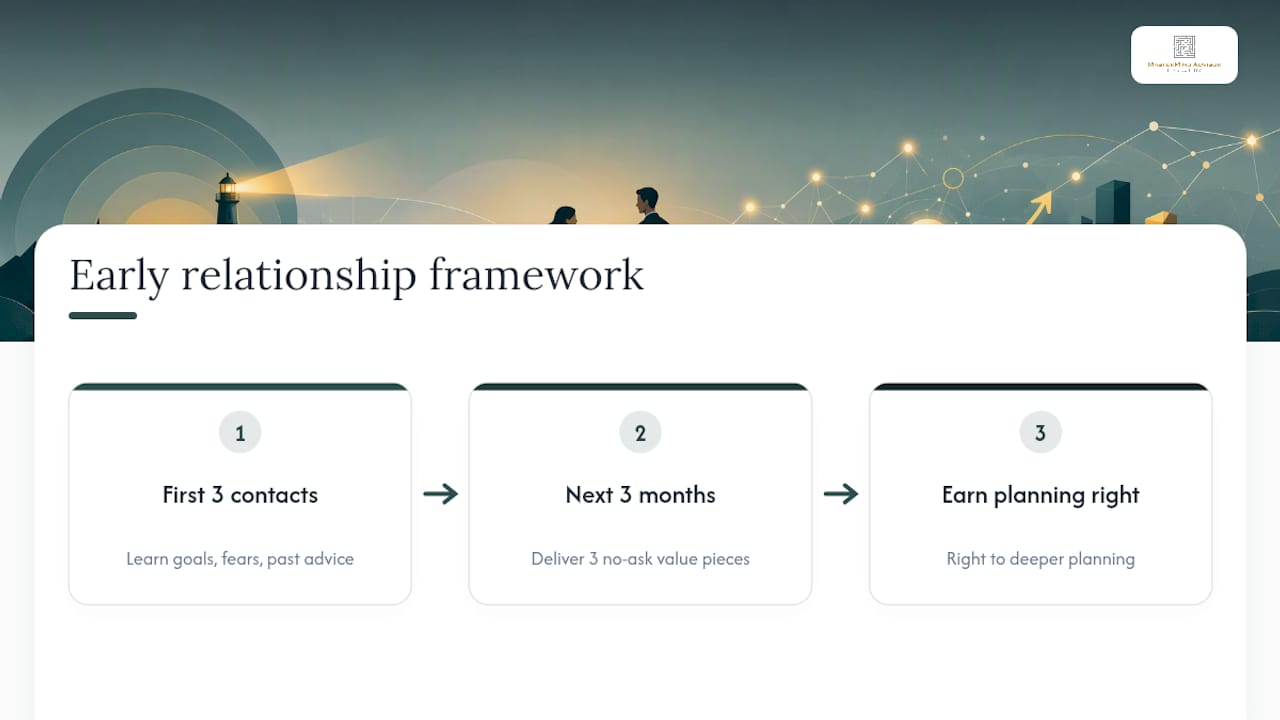
A practical framework for early-stage relationships: in the first three contacts, focus entirely on learning about the prospect (goals, fears, past advisor experiences). Over the first three months, deliver three pieces of genuine value with no ask attached, such as a relevant article, a tax-deadline reminder, or a brief market note tied to something they mentioned. By the end of that period, you have earned the right to a deeper planning conversation.
Four levels of relationship marketing for advisors
The Revenue Grid wealth management relationship model offers a useful three-layer taxonomy that maps cleanly to four practical levels:
- Parasocial: One-way familiarity built through content. A client watches your webinar, reads your newsletter, follows your LinkedIn posts. They feel they know you before you have spoken. Scale this layer aggressively.
- Social medium: Two-way digital interaction. Comments, replies, direct messages. These signal interest and warm a prospect before a formal meeting.
- Service relationship: The direct advisor-client engagement. Annual reviews, planning calls, life-event conversations. This layer cannot be automated without destroying its value.
- Ecosystem relationship: The advisor as the hub of a client's professional network, connecting them to estate attorneys, CPAs, and insurance specialists. This is where the deepest loyalty forms.
Academic evidence from the Journal of Marketing Theory & Practice supports treating all four levels as relevant regardless of how a client initially presents. Clients who look transactional on the surface often hold relational perceptions underneath, making them far more receptive to RBM than their behavior suggests.
How to implement RBM inside your advisory practice
Step 1: Clarify your capacity and target segments
Before building any system, decide how many deep relationships your firm can realistically manage. A solo advisor with 150 clients cannot give all 150 the same level of personalized attention. Segment your book into three tiers based on revenue, growth potential, and referral history. Tier 1 gets proactive, high-touch service. Tier 2 gets structured check-ins. Tier 3 gets automated but personalized digital touchpoints.
Step 2: Build your CRM for relationships, not just transactions
A CRM designed for RBM captures more than account balances. Key fields to add: referral source, life-event triggers (upcoming retirement, college funding window, business sale), relationship depth score, last meaningful contact date, and documented client preferences (communication channel, meeting format, topics of concern). These tags enable automated but deeply personal outreach that feels hand-crafted even at scale.
Step 3: Design your content and communication cadence
A workable email cadence for Tier 1 clients: one personalized check-in per month, one educational piece per quarter, one life-event-triggered note when the CRM flags a milestone. For Tier 2: one educational email per month, one personal touch per quarter. For Tier 3: monthly automated newsletter with a personalized subject line.
Webinars and seminars serve the parasocial layer. A 45-minute webinar on Social Security timing, Roth conversion windows, or estate planning basics positions you as an educator and generates warm leads who already trust your thinking before the first call. Digital marketing strategy for financial advisors covers email cadence and educational content frameworks in detail.
Conversation starters that work:
- Discovery: "What's the one financial concern keeping you up at night that we haven't fully addressed yet?"
- Annual review opener: "Since we last spoke, what's changed in your life that might affect your plan?"
- Referral conversation: "Is there anyone in your network going through a major transition right now who might benefit from a second opinion?"
Step 4: Run client appreciation events and referral programs
Client events serve two functions: they deepen existing relationships and they create natural referral moments. A dinner for your top 20 clients, a financial planning workshop for their adult children, or a virtual Q&A on year-end tax moves all generate goodwill and word-of-mouth. Referral program mechanics for advisors explains how to structure these programs so they generate consistent introductions rather than one-off mentions.
90-day RBM launch checklist
- Segment your client book into three tiers using revenue, growth potential, and referral history
- Add five RBM-specific fields to your CRM (referral source, life-event trigger, depth score, last meaningful contact, preferences)
- Draft a 12-month communication calendar with touchpoint types per tier
- Record or outline one educational webinar topic relevant to your niche
- Schedule your first client appreciation event or virtual workshop
- Write three conversation-starter scripts for discovery, review, and referral situations
- Set up one automated email sequence for Tier 3 clients using your CRM's drip function
- Document every marketing touch in a compliance-ready format
Pro Tip: Keep a simple compliance log in your CRM or a shared folder: date, touchpoint type, content used, and whether it was pre-approved by your compliance officer. For RIAs, this audit trail is not optional. The ADV marketing compliance guide covers what documentation regulators expect from advisor marketing materials.
How do you measure RBM success in an advisory practice?
Results compound slowly, then suddenly. Here are the KPIs that matter and when to expect movement.
| KPI | Why it matters | How to measure it |
|---|---|---|
| Client retention rate | Core indicator of relationship health | (Clients at year-end ÷ clients at year-start) × 100 |
| Referral rate | Shows whether clients trust you enough to introduce others | New clients from referrals ÷ total active clients |
| Client lifetime value (CLV) | Captures long-term revenue impact of retention | Average annual revenue per client × average relationship length |
| Engagement rate | Signals whether content and outreach are landing | Email opens, event attendance, reply rates per segment |
| Meetings per client per year | Measures relationship depth and proactive service | Total client meetings ÷ total active clients |
| Net Promoter Score (NPS) | Quantifies likelihood to refer and overall satisfaction | Standard NPS survey, run annually |
A simple ROI illustration: An advisor managing 100 clients at an average of $5,000 annual revenue each has a $500,000 book. At $5,000 each, that is $25,000 in preserved revenue annually, before counting the referrals those retained clients generate. Add two referrals per year from improved relationship activity, and the revenue impact grows further.
3/6/12-month milestones:
- Month 3: Email engagement rates improve; clients respond to check-in calls more readily
- Month 6: First referral lift becomes visible; NPS scores begin to move
- Month 12: Retention rate improvement measurable; CLV calculations show compounding effect
Common mistakes advisors make with RBM
Most RBM programs fail not because the strategy is wrong but because execution drifts. Watch for these patterns.
- Treating RBM as casual networking. Showing up at a chamber event once a quarter is not a relationship strategy. RBM requires a documented system, not good intentions.
- Over-automating the human moments. Automated birthday emails are fine. An automated condolence message when a client's spouse passes away is not. Map which touchpoints must remain human and protect them.
- Failing to segment. Sending the same communication to a 35-year-old accumulator and a 72-year-old in distribution erodes trust faster than silence. Segmentation is not optional.
- Inconsistent follow-up. The most common complaint clients have about advisors is not hearing from them unless they reach out first. A CRM without follow-up triggers is just an expensive address book.
- Ignoring compliance. Marketing materials, email campaigns, and seminar content must meet SEC or FINRA standards depending on your registration. Undocumented outreach creates regulatory exposure.
Red flags that your RBM efforts are stalling:
- Email open rates declining after three months of a new cadence (content is not resonating; test new topics)
- No referral lift after six to twelve months (relationship depth is insufficient; increase Tier 1 touchpoint frequency)
- Clients not attending events (wrong format or wrong topic; survey them directly)
- Compliance gaps discovered during an audit (rebuild your documentation process before scaling)
Building trust online offers practical remediation approaches for advisors whose digital presence is undermining the trust they are building in person.
Real-world RBM plays in advisory practices
Vignette 1: Boutique advisor using seminars and content
A solo RIA in the Pacific Northwest serving pre-retirees launched a quarterly in-person workshop series on Social Security and Medicare timing. Each workshop attracted 15 to 20 attendees, mostly referrals from existing clients. The advisor followed each event with a three-email sequence: a recap, a relevant planning checklist, and a personal invitation to a complimentary review call. Within twelve months, the practice added eight new clients directly from workshop attendees and saw referral introductions from existing clients increase noticeably, driven by clients sharing workshop invitations with friends.
Vignette 2: RIA using CRM automation and personalized outreach
A mid-size RIA with 200 clients implemented life-event triggers in their CRM. When a client's record showed a child turning 17, the system flagged it for a college funding conversation. When a client's business anniversary hit, the advisor sent a handwritten note. The firm also launched a monthly educational email segmented by client life stage. Over 18 months, the practice's NPS score improved, and the percentage of new clients arriving via referral climbed. The ABA Banking Journal's analysis of life-event targeting and analytics-driven personalization supports exactly this kind of trigger-based approach.

Both vignettes reflect the same underlying principle: customer loyalty strategies built on consistent, relevant, personalized contact outperform broad-reach campaigns for advisory practices with long client relationships.
How Mastermindadvisormarketing operationalizes RBM for advisors
A turnkey system removes the execution gap between knowing what RBM requires and actually doing it. Here is how the components of a system like Mastermindadvisormarketing map to the RBM operating model.
| System component | Primary KPI it moves | RBM layer served |
|---|---|---|
| Customized lead-generation webinars | Lead quality, parasocial familiarity | Parasocial |
| Fully produced in-person and virtual seminars | New client conversion, referral rate | Social medium to service |
| Compliance-friendly content library | Engagement rate, trust signals | Parasocial |
| Automated email drip campaigns | Engagement rate, follow-up consistency | Social medium |
| Scheduled social media content | Brand visibility, know-like-trust progression | Parasocial |
| Custom CRM with lifecycle and life-event fields | Retention rate, meeting frequency | Service |
| High-converting advisor website | Lead capture, first impression trust | Parasocial |
The compliance-ready templates and documented approval workflows address the audit-trail requirement directly, which matters for RIAs and hybrid practices operating under SEC oversight. Advisors using the system get pre-built content that has already been reviewed for regulatory language, reducing the compliance burden on their internal team.
The advisor dashboard gives practices a single view of campaign performance, client engagement metrics, and follow-up queues, making it possible to track the KPIs in the measurement section above without building a custom reporting stack.
For advisors evaluating any vendor in this space, the checklist should include: CRM integration depth, compliance documentation workflow, reporting on engagement KPIs, content customization options, and whether the system supports both digital and in-person event production. Mastermindadvisormarketing covers all five.
The case for prioritizing RBM right now
Most advisors know they should be doing more to deepen client relationships. Few have a system that makes it repeatable. That gap is where practices lose clients they should have kept and miss referrals they should have received.
The advisors I see pulling ahead are not the ones with the biggest marketing budgets. They are the ones who picked a segment, built a consistent communication rhythm, and showed up reliably for their clients through market volatility and life transitions. That is the whole game. RBM is not a tactic you add to your existing approach. It is the operating model you build your practice around.
Three things to do this week:
- Run a 90-day pilot. Pick your top 20 Tier 1 clients and commit to one additional meaningful touchpoint per month for three months. Track referral conversations and retention signals.
- Rebuild your CRM tags. Add life-event triggers and relationship depth scores to your top 50 client records. This single change will surface more opportunities than any new campaign.
- Book one event. A workshop, a webinar, or a client dinner. The format matters less than the consistency. One event per quarter, run well, compounds into a referral engine over 12 to 18 months.
A system like Mastermindadvisormarketing makes all three faster to execute, with the compliance documentation built in.
Mastermindadvisormarketing gives advisors a faster path to RBM results
Independent advisors who understand RBM often hit the same wall: the strategy makes sense, but building the content, the CRM workflows, the seminar production, and the compliance documentation from scratch takes months and pulls focus from client work.
Mastermindadvisormarketing was built to close that gap. The system delivers customized lead-generation webinars, fully produced in-person and virtual seminars, a compliance-friendly content library, automated email drip campaigns, scheduled social media content, and CRM integration with lifecycle and life-event fields, all configured for the regulatory environment independent advisors operate in. You get a complete RBM infrastructure without hiring a marketing team or managing five separate vendors.
Advisors who want to evaluate whether the system fits their practice should look for four things: CRM integration depth, compliance documentation workflow, content customization for their niche, and reporting on the KPIs that actually matter. Mastermindadvisormarketing covers all four. Explore the full service offering or visit the advisor dashboard to see how the reporting layer tracks your RBM metrics. Ready to see it in action? Mastermindadvisor and find out how quickly a turnkey system can replace the patchwork.
Sources
- 3 Marketing Approaches To Maximize Firm Growth
- The value of keeping the right customers
- Marketing for wealth management | ABA Banking Journal
- Integrating Transactional and Relational Marketing Exchange: A Pluralistic Perspective