

Independence is the single most persuasive positioning an advisory firm can hold with high-net-worth prospects. It signals open-architecture investing, disclosed fees, and a coordinated, family-office-style experience that wealthy clients cannot get from a wirehouse or bank platform. Your immediate next step: run a proof-point audit of your website and client materials to confirm you are showing open-architecture capabilities and transparent fees before your next prospect conversation.
Here is what that positioning rests on:
- Open architecture means access to direct indexing, alternatives, and bespoke estate vehicles, not a proprietary product shelf.
- Fiduciary alignment under the SEC fiduciary standard legally obligates you to act in the client's interest, a standard brokers operating under Reg BI do not meet.
- Transparent fees remove the ambiguity about incentives that HNW clients find non-negotiable.
- Coordinated service means proactive collaboration with the client's CPA and estate attorney, not siloed departments.
Pro Tip: Before your next prospect meeting, pull up your own website as a stranger would. If "open architecture," a fee schedule, and a case study are not visible within 60 seconds, you have a positioning gap to close this week.
Table of Contents
- Why independence attracts high net worth clients: the four core drivers
- What independence actually looks like in the client experience
- How to position and market independence so it converts HNW prospects
- Realistic timeline, marketing investment, and KPIs to win HNW clients
- Evidence that independence wins affluent clients
- A practical checklist to demonstrate independence credibly
- Key Takeaways
- The part most advisors get wrong about marketing independence
- Mastermindadvisormarketing helps you turn independence into a lead-generation engine
- Useful sources
Why independence attracts high net worth clients: the four core drivers
HNW prospects do not choose an independent advisor because they read a brochure. They choose one because the model solves specific frustrations they have already experienced at larger institutions.
Driver 1: Access and customization. Open-architecture platforms let you curate portfolios that include alternatives, tax-efficient direct indexing, and bespoke estate vehicles. For a client managing a concentrated stock position or navigating a business-sale capital gain, that flexibility is not a nice feature. It is the reason they call you.
Driver 2: Holistic, white-glove service. HNW families increasingly move to independent RIAs for multi-generational transfers, tax planning, philanthropy, and family governance. They want the family-office experience without the family-office price tag.

Driver 3: Fee transparency. Fee-only advisors disclose fees clearly, removing the ambiguity about incentives that HNW clients find critical. A client with $5 million under management who suspects hidden revenue-sharing arrangements will not stay long.
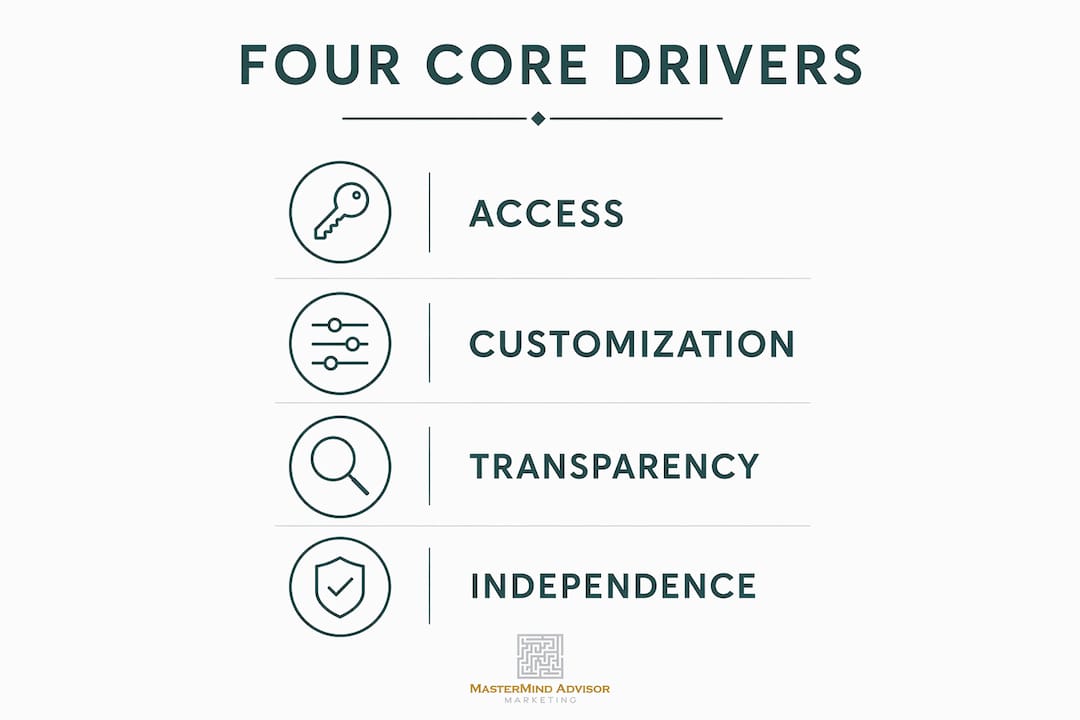
Driver 4: Independence as an advice model. HNW clients view independence as a chosen model because it signals the advisor's economic incentives are aligned with the client's long-term success, not a parent company's quarterly targets. The emotional drivers are control, respect, and relationship depth.
What independence actually looks like in the client experience
Drivers matter only when you can show them. Here is how they translate into concrete client-facing examples.
- Direct-indexing overlay. A taxable account managed as a direct-indexed sleeve harvests losses at the individual-security level, reducing the client's annual tax drag without sacrificing market exposure.
- Alternative investment sleeve. A separately managed allocation to private credit or real assets, selected from an open platform rather than an in-house product list.
- Estate-structure coordination. You review the client's trust documents alongside their estate attorney before any portfolio rebalancing that could trigger a taxable event.
- Multi-generation strategy sessions. An annual meeting that includes adult children, covering inheritance expectations, charitable vehicles, and family governance principles.
- Philanthropic vehicle design. Donor-advised fund structuring or charitable remainder trust analysis coordinated with the client's CPA for maximum tax efficiency.
- Consolidated reporting. A single dashboard pulling data across all custodians so the client sees their complete picture, not a fragmented account-by-account view. HNW clients perceive bank-affiliated arrangements as fragmented and opaque; consolidated reporting directly addresses that frustration.
- Fee audit for the client. You review the client's existing accounts for embedded fund expenses and revenue-sharing arrangements, then document what they are actually paying. Few gestures build trust faster.
Successful boutiques act as an architect, assembling a trusted ecosystem of external CPAs and attorneys rather than trying to be the sole provider for every service. That is the model to build toward.
Pro Tip: Use institutional custodial partners like Schwab Advisor Services or Fidelity Institutional for operational infrastructure. Your advisory relationship stays independent; your back-office does not need to be built from scratch.
How to position and market independence so it converts HNW prospects
Messaging that resonates with wealthy prospects maps directly to the four drivers above. Your four core pillars are: open architecture, fiduciary alignment, family-office-style coordination, and transparent fees. Every channel you use should reinforce at least one of them.
High-impact channels:
- Invitation-only seminars and webinars. Exclusive events signal the caliber of your practice. A dinner seminar on tax-efficient wealth transfer, limited to 12 guests, positions you differently than a public webinar. Mastermindadvisormarketing builds fully produced seminar and webinar programs specifically for this audience.
- CPA and attorney referral partnerships. Professional referral networks with tax and legal professionals are the highest-conversion channel for HNW prospects. These clients already trust their CPA; a warm introduction from that CPA carries more weight than any paid ad.
- Gated case studies and white papers. A downloadable case study showing how you coordinated a business-sale exit with a client's M&A attorney and CPA is a proof point that a generic "we put clients first" headline cannot match.
- Targeted content marketing. Tax-optimization explainers, direct-indexing primers, and estate-planning guides attract prospects who are already thinking about complexity. Advisor positioning strategy guides can help you frame these assets around your specific niche.
Conversion checklist for your website and proposals:
- Published fee schedule (AUM tiers or flat-fee structure, clearly stated)
- "Open-architecture" disclosure with a one-line explanation of what that means for the client
- Representative case study (anonymized) showing a coordinated outcome
- Sample engagement terms or a one-page service summary
- Third-party partner list naming your CPA and attorney relationships
- A discovery-call script focused on coordination and outcomes, not products
For consistent branding across these assets, every touchpoint should reinforce the same visual and verbal identity so prospects recognize your firm before they ever speak to you.
Realistic timeline, marketing investment, and KPIs to win HNW clients
HNW client acquisition is not a 30-day sprint. The buying cycle is long, the trust threshold is high, and the payoff is substantial.
| Phase | Timeframe | Primary Activity | Expected Outcome |
|---|---|---|---|
| Audit and positioning | 0–4 weeks | Fee audit, website proof-point review, messaging alignment | Clear positioning statement and gap list |
| Proof-material creation | 4–12 weeks | Case study drafting, fee schedule publishing, website updates | Credible, conversion-ready digital presence |
| Outreach and seeded events | 3–6 months | Seminars, CPA introductions, content distribution | First qualified meetings with HNW prospects |
| Nurturing to close | 6–18 months | Email sequences, follow-up events, proposal delivery | Signed engagements and referral pipeline |
Investment ranges (qualitative): A DIY approach with focused events runs lean but demands significant advisor time. A retainer with a specialized marketing firm adds content production and automation. Bespoke seminar programs with custom case study production represent the premium tier, and they tend to pay back fastest because the events themselves generate referrals.
Metrics to track:
- Qualified meeting rate (meetings with prospects above your AUM minimum)
- Conversion from meeting to signed engagement
- Marketing cost per qualified lead
- Client acquisition payback period
Vanguard's Advisor's Alpha framework estimates that disciplined advisory adds approximately 3% in net returns through tax-efficient investing, behavioral coaching, and asset location. Conflicted advice can compound to a material dollar loss over time on a multi-million-dollar portfolio. That context makes your marketing investment look very different when you frame it against the lifetime value of a single HNW client.
Evidence that independence wins affluent clients
RIA relationships with clients holding over $10 million in assets grew approximately 13% annually versus 8% for wirehouses and private banks over the same period. The migration is real, and it is accelerating in the UHNW segment.
Anonymized case structures that resonate with HNW prospects follow a consistent pattern:
- Problem: Client held a concentrated tech position and was paying embedded fees in a bank-managed account without knowing it.
- Independent strategy applied: Fee audit revealed 0.6% in hidden costs; direct-indexing overlay harvested losses against the concentrated position; estate attorney coordinated a gifting strategy.
- Client outcome: Measurable tax savings in year one, simplified reporting across three custodians, and a documented multi-generational transfer plan.
For guidance on building and presenting these assets compliantly, independent advisor case studies offer real-world growth examples you can adapt.
When anonymizing client data, strip identifying details (industry, geography, specific dollar amounts) and replace with ranges. A disclosed fee schedule or sample engagement letter attached to the case study adds a layer of credibility that a testimonial alone cannot provide.
A practical checklist to demonstrate independence credibly
Use this list across your website, proposals, and pitch decks.
- Published fee schedule. Post it publicly. Prospects who find it before calling you arrive pre-qualified.
- Open-architecture disclosure. One sentence: "We are not affiliated with any product manufacturer and receive no compensation from fund companies."
- Representative case study. Anonymized, outcome-focused, with a disclosed fee summary attached.
- Sample engagement terms. A one-page summary of what the client gets, how you are paid, and what the exit terms are.
- Third-party partner list. Name your CPA and attorney relationships. It signals ecosystem depth.
- Consolidated reporting sample. A redacted screenshot of a multi-custodian dashboard shows operational capability without a word of explanation.
Micro-template for your website headline: "Independent, fee-first advice — access to direct indexing and select alternative sleeves. See example case study."
Place the fee schedule and open-architecture disclosure on public pages. Gate the case study and sample engagement terms for high-intent prospects who have already submitted a contact form. That sequence filters for serious inquiries and gives you a reason to follow up.
- Public pages: fee schedule, open-architecture disclosure, service overview
- Gated content: case study, sample engagement terms, white papers
Key Takeaways
Independence converts HNW prospects because it signals open architecture, fiduciary alignment, fee transparency, and coordinated service — and advisors who document those proof points in marketing materials close more qualified meetings.
| Point | Details |
|---|---|
| Proof points close deals | Publish your fee schedule, open-architecture disclosure, and a case study before your next prospect event. |
| Ecosystem beats solo | Coordinating with external CPAs and attorneys signals capacity and builds the trust HNW families require. |
| Long buying cycle | Expect 6–18 months from first contact to signed engagement; nurture sequences and follow-up events are not optional. |
| Advisor's Alpha framing | Disciplined advisory adds approximately 3% in net returns — use that figure to contextualize your fee in every proposal. |
| Mastermindadvisormarketing | Provides a turnkey marketing system (webinars, seminars, CRM, email automation) built for independent advisors pursuing HNW growth. |
Pro Tip: Start this week by publishing your fee schedule and adding one anonymized case study to your website. Those two changes alone move you ahead of most independent advisors in your market.
The part most advisors get wrong about marketing independence
The conventional wisdom says: "Just tell prospects you're independent and fiduciary, and they'll come." That is wrong, and it costs advisors real revenue.
Independence is not a differentiator on its own anymore. Every RIA in your market claims it. What actually moves a wealthy prospect is evidence of independence in action: a fee schedule they can read before they call, a case study showing coordinated outcomes, a partner list naming the CPA and attorney you work with. The claim without the proof is noise.
The second mistake is overselling independence without the infrastructure to back it. Promising family-office-style coordination and then routing a client's estate question to a generic referral list is worse than not promising it at all. Capacity management matters. The most successful boutiques intentionally limit client count and build a genuine ecosystem rather than scaling past their ability to deliver.
The third mistake is treating marketing as a one-time project. HNW client acquisition runs on a 6–18 month cycle. Advisors who run one seminar, get no immediate signings, and conclude "events don't work" are measuring the wrong thing at the wrong time. The seminar plants the seed; the nurture sequence and the follow-up event close the engagement.
Mastermindadvisormarketing helps you turn independence into a lead-generation engine
Independent advisors who can articulate their model clearly and back it with proof materials consistently out-acquire those who rely on referrals alone. The gap is not the model. It is the marketing execution.
Mastermindadvisormarketing is built specifically for this problem. The turnkey system includes compliance-friendly content libraries, customized lead-generation webinars, fully produced in-person and virtual seminars, automated email drip campaigns, scheduled social media content, high-converting advisor websites, and CRM integration. Advisors using the system have increased qualified lead flow and strengthened their practices through consistent, compliant outreach that matches the long buying cycle of HNW prospects.
The Mastermind Advisor platform handles the production and automation so you stay focused on client relationships. Schedule a marketing audit to see exactly which proof points your current materials are missing and where your pipeline is leaking qualified prospects.
Useful sources
- AdvisorHub: Why High-Net-Worth Clients Prefer Advisors Who Are Independent, but Supported — Covers open-architecture platforms and the supported-independence model; primary source for Drivers 1 and 4.
- InvestmentNews: Trust over returns — Why affluent families are fleeing big firms — Documents the trusted-ecosystem model and the migration from large institutions to independent RIAs.
- TDWealth: Fee-Based Fiduciary Protects High-Net-Worth Families — Source for fee transparency as a primary driver and the Advisor's Alpha approximately 3% net-return estimate.
- McKinsey: US Wealth Management amid Market Turbulence — Provides the 13% vs. 8% annual growth comparison for RIA versus wirehouse UHNW relationships.
- TFOCO: Independent Financial Advisor and UHNWI Wealth Management — Supports consolidated reporting and fee-audit capabilities as trust signals for ultra-high-net-worth clients.
- Mastermind Advisor Case Studies: Real-World Growth Examples — Anonymized growth examples from independent advisors using tailored marketing strategies; primary source for proof-point templates.