
Define your niche, write a one-line unique value proposition (UVP), and publish a complete advisor profile this week. That single sequence is the fastest way to build a solo advisor personal brand that attracts qualified clients rather than just traffic.
Start today with these five tasks:
- Pick one specific niche (e.g., physicians in their 40s, business owners planning an exit, or near-retirees with pension decisions)
- Write a one-sentence UVP: "I help [audience] achieve [outcome] without [common frustration]"
- Update your LinkedIn headline to reflect that niche and UVP
- Create a one-page advisor bio with a professional photo, credentials, and a clear call to action
- Schedule your first webinar or client story post within the next two weeks
Your measurable goal for the next 90 days: book three discovery calls from targeted content and a refreshed online profile.
Key Takeaways
A focused niche, a clear UVP, and a consistent content cadence are the three variables that determine whether a solo advisor's personal brand generates discovery calls or just impressions.
| Point | Details |
|---|---|
| Niche first, everything else second | Define your ideal client and UVP before touching design, content, or channels. |
| Trust signals drive prospect decisions | Website design, credentials, and testimonials influence hiring decisions after a referral. |
| Compliance is infrastructure, not an afterthought | Build your approval and archiving workflow before you publish a single post. |
| Measure discovery calls, not likes | Track calls booked, website submissions, and conversion rate as your primary KPIs. |
| Mastermindadvisormarketing as the execution path | The turnkey system handles webinar production, CRM, compliance-ready content, and email automation for solo advisors. |
Table of Contents
- Why personal branding matters more for solo advisors than you think
- How to define your niche, ideal client, and UVP
- How to craft your brand voice, bio, and elevator pitch
- Which channels should you focus on as a solo advisor?
- How to build trust and authority quickly
- Your 90-day launch plan with milestones and costs
- What to measure and how to iterate
- Common mistakes solo advisors make when building a personal brand
- Your 10-point action checklist for the next 30, 60, and 90 days
- Legal and compliance considerations for advisor personal branding
- What most solo advisors get wrong about personal branding
- How Mastermindadvisormarketing helps solo advisors execute faster
- Sources
Why personal branding matters more for solo advisors than you think
When a prospect gets a referral to you, they almost never call right away. They search your name. Industry research confirms that most prospects research advisors online after receiving a referral, and website design plus trust signals heavily influence whether they reach out or quietly move on.
That dynamic hits solo advisors harder than it hits large firms. A wirehouse or RIA with 40 advisors carries institutional credibility by default. You do not. Your name, your story, and your positioning do the work that a brand logo does for a big firm.
Personal brand vs. firm brand: the key differences
- A firm brand signals stability and compliance infrastructure, while a personal brand signals expertise, personality, and fit.
- Firm brands protect against advisor departure. Personal brands protect against commoditization.
- For a solo practice, the two should reinforce each other: your firm name on the door, your face and voice in every client-facing channel.
The business case is direct. Advisors with a clear niche and visible personal brand tend to command higher fees, shorten the sales cycle, and generate referrals that arrive pre-qualified. Personal brand benefits for independent advisors are well-documented: stronger trust in prospect research, better content engagement, and a more defensible position when a competitor enters your market.
One succession note worth flagging: a practice built entirely on a personal brand with no firm identity creates transition risk. Pair-branding (your name plus a firm identity) is the safer long-term structure.
How to define your niche, ideal client, and UVP
The FPA's guide for financial planners treats niche definition as the foundation of every other branding decision. Get this wrong and no amount of LinkedIn posting fixes it.
Step-by-step prompts to define your ideal client:
- Demographics: age range, income, net worth, profession, family stage
- Life event: what just happened or is about to happen (divorce, sale of a business, retirement, inheritance)
- Values: what does this client care about beyond returns? (security, legacy, simplicity, impact)
- Behavior: where do they search for advice? Who do they trust?
A simple niche framework: Problem + Outcome + Audience. "I help [audience] solve [specific problem] so they can [desired outcome]."
Three UVP examples by niche:
| Niche | UVP Example |
|---|---|
| Physicians | "I help attending physicians build wealth outside their practice without spending hours managing it." |
| Business owners | "I help owners of $2M–$10M businesses turn an exit into a retirement plan, not just a transaction." |
| Near-retirees | "I help couples within five years of retirement replace their paycheck with a plan they can actually follow." |
Validation step: Pull five to ten existing clients who fit your target profile. Ask them: "What problem were you trying to solve when you hired me?" Their language, not yours, is your UVP. Practical techniques for identifying customer problems from entrepreneurship research apply directly here: interview before you assume.

Pro Tip: Strip your name from your current bio and website copy. Ask a colleague to read it and name the type of client you serve. If they cannot, your positioning needs work before your design does.
How to craft your brand voice, bio, and elevator pitch
Your brand voice is the personality behind every sentence you write or say. For most solo advisors, the right register sits between "trusted friend" and "credentialed expert." Formal enough to signal competence, warm enough to signal approachability.
Brand voice checklist:
- Tone: conversational but precise (avoid jargon unless your niche expects it)
- Formality: one step below a legal brief, one step above a text message
- Personality cues: pick two or three adjectives that describe how you want clients to feel after reading your content (e.g., calm, confident, clear)
- Compliance rule: describe outcomes in terms of process and approach, not guaranteed results
LinkedIn headline template: "[Credential] helping [niche audience] [specific outcome] | [Firm name]" Example: "CFP® helping physicians build wealth outside their practice | Clarity Financial"
Two-sentence bio template: "[Name] is a [credential] who works with [niche audience] navigating [specific life event or challenge]. [He/She/They] focuses on [core service approach] so clients can [desired outcome]."
30-second elevator pitch: "I work with [niche audience] who are [situation]. Most of them come to me because [common frustration]. What I do differently is [UVP differentiator]. The result is [outcome in plain language]."
For advisor brand identity to hold up across channels, every version of your bio, from your email signature to your website About page, should use the same core language. Inconsistency is the fastest way to erode trust with a prospect who finds you in three different places.
Pro Tip: *When sharing client stories for compliance-safe storytelling, describe the situation and the process, never the specific return or dollar outcome. "A physician client reduced her tax drag by restructuring her investment accounts" is compliant.
Which channels should you focus on as a solo advisor?
XYPN's research on social media for financial advisors makes a clear point: pick channels that match your niche, not channels that feel trendy. A focused niche plus a repeatable content cadence outperforms scattered posting across every platform.
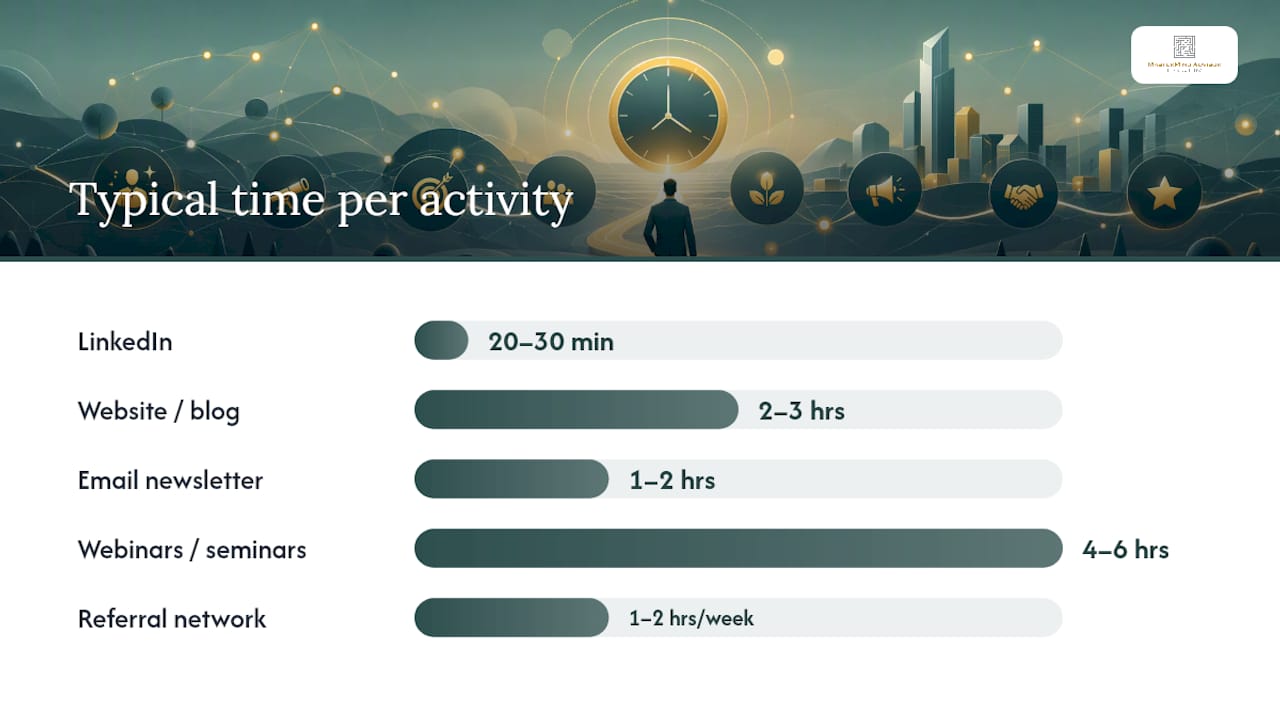
| Channel | Primary content type | Recommended cadence | Time per item |
|---|---|---|---|
| Short posts, articles, profile | 3x per week | 20–30 min | |
| Website/blog | Long-form articles, case studies | 2x per month | 2–3 hrs |
| Email newsletter | Curated insights, updates | 2x per month | 1–2 hrs |
| Webinars/seminars | Live education, Q&A | 1x per month | 4–6 hrs (with prep) |
| Referral network | Personal outreach, co-events | Ongoing | 1–2 hrs/week |

Repurposing rule: One webinar becomes three LinkedIn posts, one blog article, and two email newsletter segments. That single production effort covers two weeks of content across every channel. For detailed repurposing templates, the content marketing guide for advisors walks through the full workflow.
Compliance workflow: Before publishing, run every piece through your compliance review process. For RIAs, that typically means archiving social posts and email campaigns through a tool like Smarsh or Archiving by Global Relay, and getting written approval for any testimonial or performance reference. Build that step into your calendar, not as an afterthought.
For platform-specific tactics and posting cadences built for 2026, the independent advisor social media strategy guide covers LinkedIn, email, and webinar workflows in detail.
How to build trust and authority quickly
Credentials come first. If you hold a CFP®, CFA, or other recognized designation, it should appear on every public-facing profile within the first two lines. Prospects use credentials as a fast filter before they read anything else.
Trust signals to add this week, in priority order:
- CFP® or other designation prominently displayed on LinkedIn, website header, and email signature
- Three to five client testimonials (compliant with SEC Marketing Rule 2021 requirements — more on this in the compliance section below)
- A one-page case study on your website describing a client situation, your process, and the outcome
- Press mentions or podcast appearances, even local ones
- Public speaking: a local chamber event, a hospital grand rounds, or a virtual webinar counts
Testimonial request email script: "Hi [Client name], I'm refreshing my website and would love to include a short quote from a few clients I've enjoyed working with. Would you be willing to share a sentence or two about what working together has been like? No pressure at all — and I'll send you the final version before it goes live."
One-page case study skeleton:
- Situation: who the client was and what challenge they faced
- Approach: what you did and why
- Outcome: what changed (in process terms, not specific dollar returns)
- Quote: one sentence from the client (with permission)
Pro Tip: Turn one strong client win into five content assets: a written case study, a LinkedIn post, a webinar segment, a short video clip, and an email story. That single story, told five ways, does more for your brand than five separate generic posts.
For thought leadership examples that show how advisors structure authority content, those models are worth reviewing before you write your first case study.
Your 90-day launch plan with milestones and costs
Month 1: Foundation (Weeks 1–4)
- Finalize niche, ideal client profile, and UVP
- Update LinkedIn headline, summary, and featured section
- Commission or refresh a professional headshot
- Brief a designer on a simple visual identity (logo, color palette, one-page template)
- Outline your website About page and Services page
Month 2: Build (Weeks 5–8)
- Launch refreshed website with updated bio, services, and a lead-capture form
- Publish first blog post or case study
- Host first webinar or in-person seminar
- Set up CRM and email automation for new leads
- Send first email newsletter to existing contacts
Month 3: Amplify (Weeks 9–12)
- Collect three client testimonials
- Publish two LinkedIn articles and six posts
- Run one referral partner outreach campaign
- Review KPIs and adjust content topics based on engagement
- Schedule next quarter's webinar
Realistic cost ranges for common investments:
Go-live decision checklist:
- Niche and UVP finalized and reviewed by a trusted colleague
- Compliance review completed on all published content
- Lead-capture form tested and connected to CRM
- At least one piece of cornerstone content live (case study, bio, or webinar)
- Analytics tracking confirmed (Google Analytics or equivalent)
What to outsource vs. keep in-house: Keep niche definition, client relationships, and content ideas in-house. Outsource design, webinar production, CRM setup, and compliance-archiving workflows. When the production burden exceeds four to six hours per week, a turnkey provider typically pays for itself in recovered billable time.
What to measure and how to iterate
Your primary KPIs for the first 90 days are simple: discovery calls booked, website contact form submissions, and LinkedIn profile views. Secondary signals include email open rates and webinar registrations.
Monthly measurement checklist:
- Discovery calls booked (target: 3 by day 90)
- Website sessions and time on page (Google Analytics)
- LinkedIn profile views and connection requests from target niche
- Email open rate and click-through rate
- Webinar registrations and attendance rate
Web Tonic's wealth management branding research includes a practical differentiation test: strip brand names from your messaging and ask ten clients to match messages to advisors. If fewer than half match correctly, your positioning needs work before you invest more in design or paid promotion.
Experimentation playbook: Test one variable per month. Month one: try two different LinkedIn headline versions and compare profile views. Month two: test two email subject lines on the same newsletter. Month three: compare webinar attendance between a morning and an evening time slot. Small, single-variable tests give you clean data without requiring a marketing team.
For a deeper look at advisor content strategy and measurement, the cadence and KPI framework there complements the 90-day plan above.
Common mistakes solo advisors make when building a personal brand
The most expensive mistake: trying to appeal to everyone. "I help anyone with money" is not a brand. It is a commodity description. The advisors who attract the best clients are the ones who make a specific person feel like the content was written for them.
Other frequent errors and their fixes:
- Inconsistent identity across profiles: Your LinkedIn bio says "retirement planning specialist." Your website says "comprehensive wealth management." Pick one and align everything. A prospect who sees both reads confusion, not versatility.
- Ignoring compliance until it is a problem: Build compliance review into your content calendar from day one. Retroactively cleaning up non-compliant posts is far more disruptive than a two-day approval delay upfront.
- Overreliance on vanity metrics: Follower counts and post likes feel good but do not pay bills. Track discovery calls and conversion rates instead.
- No clear call to action: Every piece of content should tell the reader exactly what to do next. "Schedule a 20-minute call" beats "contact me" every time.
Red flags that signal a brand problem:
- Conflicting niche descriptions across your website, LinkedIn, and email signature
- No professional photo or an outdated one
- A website with no lead-capture mechanism
- Zero client testimonials or social proof
Pro Tip: Run the "strip test" on your own profiles before you invest in a redesign. Remove your name and photo from your LinkedIn summary and About page. If a stranger cannot identify your niche and ideal client within 10 seconds, rewrite the copy before touching the design.
Your 10-point action checklist for the next 30, 60, and 90 days
Days 1–30 (Foundation)
- Write your niche statement and UVP using the framework above (owner task, 2 hours)
- Update LinkedIn headline, summary, and featured section to reflect your niche (owner task, 1 hour)
- Commission a professional headshot if yours is more than two years old (vendor task, $150–$400)
- Draft your two-sentence bio and 30-second elevator pitch (owner task, 1 hour)
Days 31–60 (Build)
- Launch or refresh your website with updated bio, services page, and lead-capture form (vendor or DIY, 1–3 weeks)
- Publish your first cornerstone content piece: a case study, a webinar, or a long-form blog post (owner + vendor, 4–6 hours)
- Set up CRM and email automation for new leads captured via your website (vendor task, 1 week)
Days 61–90 (Amplify)
- Collect three client testimonials using the email script above (owner task, 1 week)
- Run one referral partner outreach campaign targeting two to three COIs (centers of influence) in your niche (owner task, ongoing)
- Review your KPIs: discovery calls booked, website sessions, LinkedIn profile views. Adjust content topics based on what generated the most engagement.
Minimal success metrics by window:
- Day 30: niche and UVP finalized, LinkedIn updated, headshot live
- Day 60: website live, first content published, CRM active
- Day 90: three discovery calls booked, three testimonials collected, first iteration of content strategy complete
Legal and compliance considerations for advisor personal branding
Personal branding for financial advisors operates inside a specific regulatory framework. Ignoring it does not just create legal risk; it can trigger FINRA or SEC enforcement actions that damage the brand you worked to build.
Key rules to know:
The SEC's Marketing Rule (Rule 206(4)-1, effective November 2022) governs how RIAs use testimonials and endorsements. You may now use client testimonials in marketing, but only with proper disclosures: whether the testimonial is from a current client, whether compensation was paid, and a statement that the testimonial may not be representative of all client experiences.
FINRA Rule 2210 governs broker-dealer communications, including social media posts, website content, and email. All retail communications require principal pre-approval before publication. Keep records of every post, email, and webinar script.
Practical compliance steps for your brand:
- Archive all social media posts and email campaigns using a compliant tool (Smarsh, Global Relay, or equivalent)
- Get written pre-approval for any content that references performance, outcomes, or client results
- Add required disclosures to testimonials: current/former client status, compensation, and representativeness caveat
- Never use superlatives like "best" or "top-rated" without substantiation
- Review your state's investment adviser regulations in addition to federal rules, as some states impose stricter standards
A note on AI-generated content: If you use AI tools to draft posts or emails, your compliance obligation is unchanged. You are responsible for reviewing, approving, and archiving that content exactly as you would anything written by hand.
This section is general information, not legal or compliance advice. Confirm current rules with your compliance officer, your broker-dealer's compliance department, or a qualified securities attorney.
What most solo advisors get wrong about personal branding
The conventional wisdom says: "Be authentic, post consistently, and the clients will come." That advice is not wrong, it is just incomplete in a way that wastes months.
Authenticity without positioning is just noise. Posting consistently about "financial planning tips" when your ideal client is a physician exiting a practice is like running a billboard in the wrong city. The content is fine. The audience is wrong.
The advisors who see traction fastest are not the ones who post the most. They are the ones who made one uncomfortable decision early: they said no to a client type. They picked a lane narrow enough that their ideal prospect reads their LinkedIn post and thinks, "This person is talking directly to me."
The second thing most advisors underestimate is the compliance drag on content velocity. Build your approval workflow before you build your content calendar, not after. An advisor who publishes three compliant posts a month consistently will outperform one who publishes ten posts and then goes dark for six weeks while cleaning up a compliance issue.
Personal branding for solo advisors is not a marketing project. It is a business infrastructure decision. The advisors who treat it that way, with a real timeline, a real budget, and a real measurement system, are the ones who look back at 90 days and have actual discovery calls to show for it.
How Mastermindadvisormarketing helps solo advisors execute faster
Solo advisors who try to build a brand while managing a full client load face one consistent problem: production. Writing content, setting up CRM workflows, producing webinars, and staying compliant all at once is a full-time job on top of a full-time job.
Mastermindadvisormarketing is built specifically for this constraint. The turnkey system covers customized lead-generation webinars, fully produced in-person and virtual seminars, a compliance-friendly content library, automated email drip campaigns, scheduled social media content, and a high-converting advisor website, all integrated with CRM and email automation tools designed for the regulatory realities of financial services.
Before signing with any marketing vendor, ask these three questions:
- Does your content library include compliance-ready disclosures, or do I handle that separately?
- Can you show me how webinar leads flow into my CRM and trigger follow-up sequences?
- What does your onboarding process look like for an advisor with no existing content infrastructure?
Mastermindadvisormarketing answers all three. Advisors who have gone through the system report stronger lead quality, faster time-to-first-call, and a content calendar that runs without requiring 10 hours a week of their own time.
Schedule a strategy call to see how the system maps to your niche and your 90-day launch plan.