
Marketing automation for an independent advisor means software that sends the right message to the right prospect or client at the right time, without you doing it by hand. For an RIA the hard part is not the software. It is building automation that stays inside the SEC Marketing Rule, fits long buying cycles and amplifies the referrals that already drive your growth. That is why a system built only for advisors, with compliance-friendly content and automation designed together, beats stitching generic tools together on your own.
TL;DR
- Marketing automation for advisors is a set of triggered workflows: lead capture, email nurture, event follow-up and client communication.
- Referrals still lead growth, so automation should support referral asks, reviews and regular client contact, not replace them.
- Firms with documented marketing plans, personas and value propositions attracted 67% more new clients and assets, according to Schwab's 2024 benchmarking study.
- Every automated send must be compliance-reviewed first, and every message must be retained under SEC recordkeeping rules.
- A turnkey system for advisors saves the time that makes up most of your client acquisition cost.
Table of Contents
- What marketing automation means for an advisory firm
- How common is it, and what are firms using?
- What actually grows an RIA: the evidence
- Workflows worth building first
- Compliance: where automation gets risky
- What it costs: time, mostly
- A setup plan you can follow
- Why a turnkey system fits advisors
- Put it to work
- FAQ
- Sources
What marketing automation means for an advisory firm
In a consumer business, automation can mean a cart-abandonment email. In an advisory practice it looks different. A prospect downloads a retirement guide, attends a webinar or fills out a contact form. Your CRM tags them, a short email series begins, and your team is alerted when they click on something meaningful. Months later the same person may still be in a nurture track, because advisory decisions take a long time.
The building blocks are the same across firms:
- Lead capture: website forms, webinar registration pages and seminar sign-ups that feed one CRM.
- Drip campaigns: pre-approved email sequences triggered by an action, such as a download or an event.
- Event follow-up: reminders before a webinar or seminar, and a thank-you and next-step sequence after it.
- Client communication: newsletters, review reminders, birthday or anniversary notes and referral requests.
- Social scheduling: approved posts queued ahead of time.
- Reporting: which source produced the meeting, and which meetings became clients.
How common is it, and what are firms using?
The 2023 Fidelity RIA Benchmarking Study of 245 firms found marketing automation in use at 48% of firms under $1 billion in assets and 65% of larger firms. Satisfaction averaged about 5 on a 7-point scale at both sizes. That is a useful reading: adoption is common, but most firms are only moderately happy with what they have. The gap is usually not the tool. It is the content, the compliance step and the strategy behind the sequences.
AI is spreading too. Dimensional's 2025 Global Advisor Study of 515 U.S. firms reported that 60% use AI, 45% of them for marketing content and 21% for automating client communications. Faster drafting makes the review step more important, not less.
What actually grows an RIA: the evidence
The 2024 Schwab RIA Benchmarking Study covered 1,304 firms. It found that referrals accounted for 67% of new clients and new client assets, and firms with a documented marketing plan, ideal client personas and a value proposition attracted 67% more new clients and assets. The same study found email campaigns and webinars were the top lead-generating digital tactics, and firms that tracked results reported a median 50% lead conversion rate in 2023.
Dimensional's study points the same way: referrals from existing clients were 49% of new clients, digital marketing 8%, and firms with documented workflows reported 18.6% median 2024 revenue growth versus 16.3% without.
Three practical conclusions follow:
- Write the plan first. Define who your ideal client is and what you promise them before building a single sequence.
- Use email and webinars as your core lead engines. They are where the data shows leads coming from.
- Automate the referral engine. Scheduled review reminders, thank-you notes and a timely referral ask put the largest source of growth on a routine.
Workflows worth building first
Webinar and seminar follow-up
A registration triggers a confirmation, two reminders and, afterward, separate tracks for attendees and no-shows. Attendees get a recap and an invitation to a discovery meeting. No-shows get the replay. Our financial advisor email campaign setup guide walks through the mechanics.
Lead nurture for long buying cycles
Someone approaching retirement may take a year to act. A six to ten message sequence spread across several months, each piece educational and approved in advance, keeps you present without pressure. Branch on behavior: a prospect who opens three retirement-income emails should see a different next message than one who never opens.
Client communication and referrals
Schedule annual-review invitations, market-commentary newsletters and a referral request tied to a positive moment, such as a completed plan. This is where automation protects the 67% referral engine rather than competing with it.
Measurement
Tag every lead with its source in the CRM. A pilot approach to tracking marketing ROI for an advisory firm lets you test one channel for a quarter before widening it. If your goal is client nurturing rather than lead generation, ROI is harder to attribute; asking clients for feedback on your communications is one way to gauge the effect, as USA Financial's Kim Weber suggests.
Compliance: where automation gets risky
Automation multiplies whatever you put into it, including mistakes. These are the rules that matter most to a U.S. advisor.
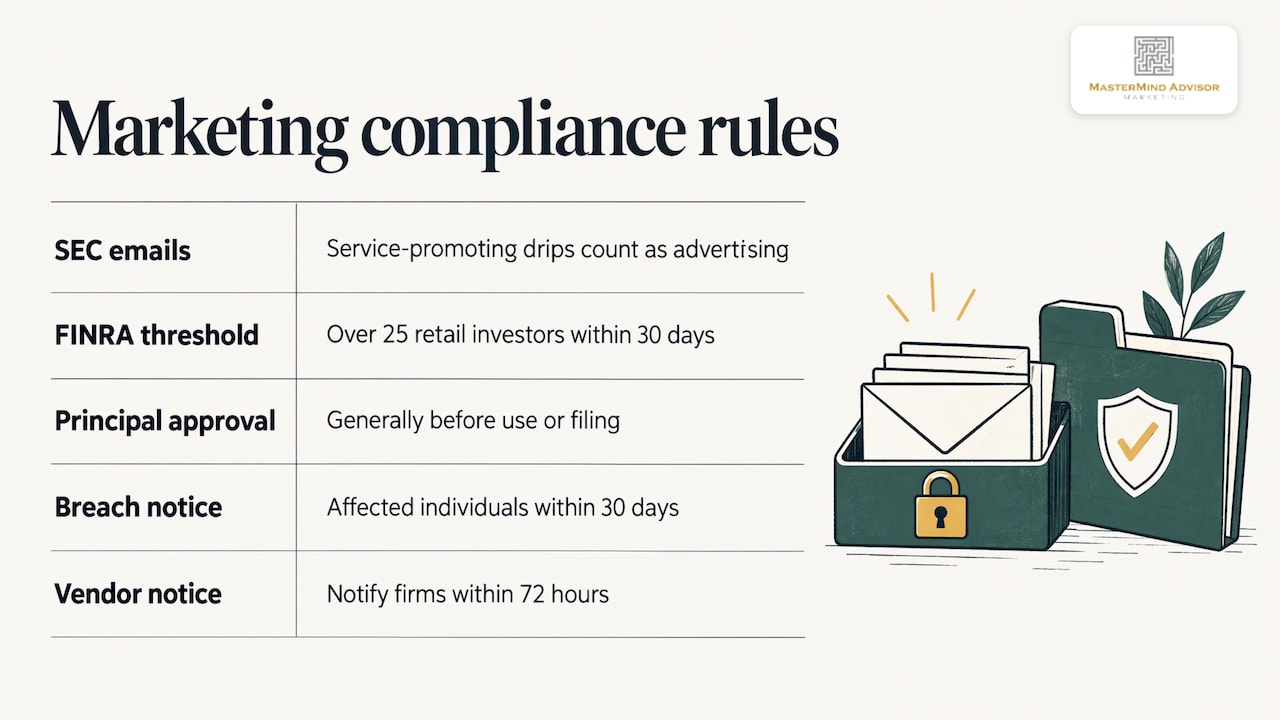
The SEC Marketing Rule. The SEC merged the old advertising and cash-solicitation rules into a single Investment Adviser Marketing Rule, effective May 4, 2021, with matching amendments to the books-and-records rule. Testimonials and endorsements are allowed under conditions; see our breakdown of the three conditions RIAs must meet to use testimonials. Your automated drip emails are advertising if they promote your services, so the rule applies to them.
FINRA Rule 2210 for dually registered or broker-dealer-affiliated advisors. A retail communication is written material distributed to more than 25 retail investors within 30 days, and a qualified registered principal generally must approve it before use or filing. Correspondence to 25 or fewer retail investors is subject to supervision and review. Bulk automated sends fall on the stricter side of that line.
State rules. NASAA amended its model rule on May 4, 2026 to give states a framework for testimonials, endorsements and performance advertising. State rules change only when a state adopts the amendments, so check your state regulator.
Privacy and vendors. Under the 2024 Regulation S-P amendments, firms need a written incident-response program, must notify affected individuals within 30 days of a covered breach, and service providers such as email and CRM vendors must notify firms within 72 hours. Choose vendors with that in mind.
A practical pre-send routine: no sequence goes live until each message is marked approved; templates are locked so edits trigger re-review; and every sent message is archived. Our guide to audit-ready pre-send email controls covers this in detail.
What it costs: time, mostly
Software is the smaller part of the bill. Kitces Research found the average total client acquisition cost was $3,119 per client, of which $519 was hard-dollar marketing spend and $2,600, or 83%, was the advisor's own time (published in 2020). Strategy-level costs ranged from $338 to over $25,000 per client. Kitces also argues that with client retention of 95% to 97% a year, many firms underspend on marketing relative to lifetime client value.
That is the real case for automation: it targets the 83%. A tool subscription you must configure, write for, get approved and maintain yourself still consumes your hours. The same hours go to a workflow that someone else builds and runs.
A setup plan you can follow
- Document your plan. Ideal client, value proposition, three or four core topics.
- Pick one CRM as the source of truth. Forms, webinars and email should all write to it.
- Build the first three sequences: new-lead welcome, webinar follow-up and client referral.
- Route every message through compliance before activation, and archive sends.
- Track source to meeting to client for 90 days, then adjust.
- Expand to social scheduling, seminars and website conversion once the first sequences perform.
For general automation planning concepts, this marketing automation checklist is a handy outline to adapt to an advisory firm.
Why a turnkey system fits advisors
Generic agencies and general-purpose tools leave the advisor-specific work to you: drafting compliant content, mapping long buying cycles, wiring the CRM. Our overview of why advisors need marketing automation in 2026 explains the broader shift.
Our view
We are practicing advisors who have grown real advisory practices, and we built our marketing around the same constraints you face. Automation only works in this field when content, compliance and follow-up are designed as one system. A drip sequence nobody has the time to write is not automation, and a polished campaign that ignores the Marketing Rule is a liability.
That is why our playbook, a $25M-a-year approach, pairs a compliance-friendly content library with automated email, webinars, seminars and a CRM that records where every lead came from. We focus on being the first call for your best prospects, not on vanity metrics.
Josh
Put it to work
Mastermind Advisor Marketing offers a turnkey system for independent advisors: customized lead-generation webinars, fully produced in-person and virtual seminars, a compliance-friendly content library, email drip campaigns, scheduled social content, advisor websites and custom CRM integration. See the full webinar, seminar and content services, or start with growth strategy.
Because we are built for independent advisors, the work starts from your regulatory needs and your buyers' long decision cycle.
FAQ
What is marketing automation for financial advisors?
It is software-driven workflows that capture leads, send approved emails on triggers and track which sources produce clients. For an advisor, each message also has to pass compliance review and be archived.
Can RIAs automate marketing emails under the SEC Marketing Rule?
Yes. Automated emails that promote your services are advertisements, so they must meet the Marketing Rule, and your firm must keep the required records. Review each template before activation and again whenever it changes.
What should I automate first?
Start with webinar or lead-magnet follow-up and a client referral sequence. Email and webinars were the top lead-generating digital tactics in Schwab's 2024 study, and referrals were 67% of new clients and assets.
How do I know whether automation is working?
Tag each lead's source, then track source to meeting to signed client over at least a quarter. For client-nurture campaigns, add client feedback on your communications, since direct attribution is harder.
Sources
- The 2023 Fidelity RIA Benchmarking Study
- Insights from the 2024 Schwab RIA Benchmarking Study
- Dimensional 2025 Global Advisor Study, FPA of Michigan presentation
- Kitces Research: client acquisition costs
- Federal Register: Investment Adviser Marketing
- FINRA Regulatory Notice 12-29 attachment
- Marketing automation FAQs for financial advisors
- Email marketing compliance for financial advisors
- Communications, recordkeeping and privacy
- Marketing automation checklist