

The lead magnets that actually work for financial advisors are interactive: retirement calculators, risk quizzes, and niche-specific diagnostic tools that hand a prospect a real number or score in exchange for their email. They convert at 40 to 50 percent because they pre-sell the advisor before the first call happens. Niche webinars with segmented registration come next. Generic PDFs and market outlooks rank last. Advisors who want this built and connected to a CRM without doing it themselves typically turn to a turnkey marketing system designed for financial advisors.
TL;DR:
- Interactive tools like retirement calculators and risk quizzes convert at 40 to 50 percent, significantly higher than static PDFs, because they deliver immediate, personalized results.
- Narrowing the target niche precisely ensures the lead magnet feels tailored, filtering out unqualified prospects and increasing the likelihood they see the value in booking a call.
- Designing the tool with minimal inputs, immediate specific outputs, and seamless CRM integration enhances conversion and enables effective lead scoring and routing.
- Placement of lead magnets on service pages and relevant blog posts, with clear, above-the-fold messaging, maximizes engagement from high-intent visitors.
- Using a turnkey system to handle creation, CRM connection, and follow-up automates lead qualification and nurtures prospects without overburdening the advisor’s busy schedule.
Table of Contents
- Why most advisor lead magnets fail the bridge test
- What makes an advisor lead magnet high-converting
- Top 10 lead magnet ideas advisors can implement now
- Where to place each magnet and how to promote it
- How to measure and prioritize the leads coming in
- Personalizing lead magnets so they don't feel generic
- Follow-up sequences that turn a completed magnet into a booked call
- Making sure your lead magnet actually works on a phone
- An advisor marketing specialist's take on where to start
- Mastermind Advisor: a turnkey path to lead magnets that actually convert
- Sources
- FAQ
Why most advisor lead magnets fail the bridge test
A gated PDF titled "5 Retirement Mistakes to Avoid" feels productive to build and does almost nothing for your pipeline. It attracts people who want free information, not people who want to talk to you. The email address you collect belongs to a list-builder, not a prospect.
The real problem shows up in what happens right after someone says "this was helpful." Andrew Murdoch calls this the 90-second bridge: the short window between a prospect finishing your content and deciding whether to act. A static PDF has no bridge. The reader closes the tab and moves on. A calculator or assessment has a built-in bridge, because the tool itself asks for the next step.
What separates a magnet that books meetings from one that just harvests emails comes down to a few things:
- It produces an immediate, personal result, not general advice.
- It hands the prospect a number, a score, or a ranked list of next steps.
- It creates enough curiosity or urgency that scheduling a call feels like the logical next move, not a sales pitch.
The gap is large. Magnetly reports that interactive calculators and diagnostic tools convert at 40 to 50 percent, compared with under 1 percent for gated guides. That's not a small optimization. It's the difference between a lead magnet that fills your calendar and one that fills a spreadsheet nobody looks at.
What makes an advisor lead magnet high-converting
Before you build anything, get specific about who the tool is for. "Financial planning help" is not a niche. "Retirement planning for small business owners selling their practice in the next five years" is. Naming the audience this precisely does two things: it filters out people you can't serve well, and it makes the people you can serve feel like the tool was built specifically for them, because it was.
From there, the design principles that separate a converting magnet from a forgettable one:
- Limit inputs to what actually changes the output. Magnetly recommends three to six questions for interactive tools. More than that and completion rates drop fast.
- Show a real result immediately. A dollar figure, a percentile score, or a ranked list of gaps to fix. Vague encouragement ("You're on the right track!") is worse than no result at all.
- Gate the details, not the headline. Reveal enough of the result to feel real and specific, then ask for an email to unlock the full breakdown or a personalized action plan.
- Map every output field to a CRM field. If the tool asks about asset range, timeline to retirement, and primary financial goal, those three answers should land directly in your CRM as searchable, filterable data.
- Build a scoring rule before you launch. Decide in advance what combination of answers makes someone a "hot" lead who gets a same-day calendar invite versus a "nurture" lead who enters a drip sequence.
Pro Tip: Build your scoring rubric on paper before you build the tool. If you can't describe in one sentence what separates a high-value lead's answers from a low-value lead's answers, your calculator won't be able to tell the difference either.
This is the shift ProperExpression describes as moving from list-building to conversion engineering. Every input is a piece of segmentation data, not just a form field.
Top 10 lead magnet ideas advisors can implement now
Some of these take an afternoon to set up. Others take a quarter and a developer. Pick one that matches your bandwidth and your niche, not the one that sounds most impressive.
1. Retirement readiness calculator. Ask for current age, target retirement age, savings balance, and monthly contribution. Output a projected retirement income and a gap score against their stated goal. Leads with lower readiness scores get flagged as higher priority for outreach, since urgency is built into the result.
2. Four-part financial health scorecard. Score savings rate, debt load, insurance coverage, and investment diversification on a simple 1 to 10 scale each. This works well as a broad top-of-funnel tool because it doesn't require deep financial literacy to complete, and low scores in any one category become a natural talking point for your first call.
3. Niche-segmented ebook. Something like "Retirement Planning for Business Owners Selling in the Next Five Years" beats a generic guide because it filters for exactly the reader you want. Don Connelly's research on lead generation mistakes points to overly broad content as one of the most common reasons advisors attract low-quality leads. Gate it behind an email and follow with a three-email nurture sequence specific to that audience's exit timeline.
4. Live webinar with segmented registration. Ask registrants two or three qualifying questions at signup ("What's your biggest concern heading into retirement?"). Webinars structured this way compress the sales cycle because registration, attendance, and engagement all generate behavioral data you can score automatically.
5. One-page financial snapshot. After a short intake (five or six fields), generate a single visual page summarizing net worth trajectory, savings rate, and one recommended action. Advisors Ascend lists this as one of the highest perceived-value formats because it feels like a mini consultation, not a marketing asset.
6. Micro-commitment consultation with a defined agenda. Instead of "book a free call," offer "book a 15-minute portfolio stress test" with a pre-qualification form. The specificity of the offer does the filtering for you. Vague offers attract vague interest.
7. Portfolio risk quiz. Ten questions about time horizon, loss tolerance, and current allocation, ending in a risk score and one concrete recommendation ("Your portfolio carries more downside risk than your stated tolerance suggests"). The concrete recommendation at the end is what turns a quiz into a lead magnet instead of a distraction.
8. Dividend or income blueprint mini-course. A five-email series aimed specifically at income-focused investors nearing or in retirement. This works because it nurtures over days instead of asking for a decision in one sitting, which suits a more risk-averse, income-focused audience.
9. Private community or study group invite. An ongoing group, virtual or in-person, focused on a specific topic like tax-efficient withdrawal strategies. Slower to build trust than a calculator, but the ongoing engagement produces stronger relationship signals over time.
10. Embedded calculators on service pages. Instead of one flagship tool, place small content upgrades directly on relevant service pages, like a Social Security timing estimator on your retirement planning page. This captures intent right where it's highest, since someone reading about retirement planning is already halfway convinced.
Where to place each magnet and how to promote it
Placement matters as much as the magnet itself. A brilliant calculator buried on page four of your blog will underperform a mediocre one linked from your homepage hero.
The placement hierarchy that tends to work best, in order of intent strength:
- Service pages first. Someone reading your retirement planning page is closer to a decision than someone on your blog.
- Related blog posts second. A post about Social Security timing should link directly to your Social Security calculator, not to a generic contact form.
- Homepage hero third. Good for volume, weaker for qualification, since visitors here haven't shown specific intent yet.
- Paid ads and LinkedIn last in the funnel but first in outreach. Use niche-specific ad copy ("Selling your business in the next 5 years? See your retirement gap in 90 seconds") rather than broad brand messaging.
On the landing page itself, keep the promise singular and visible above the fold, use one call to action rather than three competing ones, and show a glimpse of the output before asking for an email. A short privacy line ("We never sell your information") next to the submit button measurably reduces hesitation on financial tools, since money topics carry more trust friction than most other categories. For the mechanics of registration segmentation specifically, a structured webinar funnel gives you a template to adapt.
How to measure and prioritize the leads coming in
Not every completed calculator deserves a phone call today. The goal is routing, not just collecting.
Four numbers to track weekly once a magnet is live:
- Magnet conversion rate. Visitors who start the tool versus those who complete it and submit an email.
- Qualified consultation rate. Completed magnets that result in a booked call within seven days.
- Booked-meeting conversion. Booked calls that convert to an engagement or ongoing relationship.
- Asset-range capture rate. The percentage of leads where you actually know their approximate investable assets, since this single field often predicts consult value better than any other.
Build a simple scoring rubric using three CRM fields: asset range, timeline to the financial event in question, and stated primary goal. A prospect with $500,000-plus in assets, a two-year timeline, and a specific goal like "sell my business" should trigger an immediate calendar invite. Someone with a vague goal and no stated timeline goes into an educational drip sequence instead, structured through your CRM automation. Test one variable at a time: CTA wording, the exact point where you gate the result, and how much detail you reveal before asking for an email. Changing three things at once tells you nothing about what actually moved the number.
Personalizing lead magnets so they don't feel generic
The fastest way to kill conversion on an otherwise good tool is making it feel like it was built for anyone. A retirement calculator that just spits out "you're on track" or "you have a gap" reads as generic even if the math behind it is sound.
Personalization starts with language, not just logic. If your niche is small business owners, the calculator's copy should say "business sale proceeds," not "investment portfolio." If you serve physicians, reference loan forgiveness timelines and 1099 versus W2 income directly in the questions. The vocabulary alone signals to the prospect that you understand their situation before they've spoken to you.
The output matters even more than the input language. Instead of a flat score, break the result into two or three specific findings tied to their actual answers: "Your savings rate is strong, but your current allocation carries more risk than your 5-year timeline supports." Specificity here does the selling that a sales page never could, because it feels observed rather than templated.
Where you have the data, layer in follow-up personalization too. If someone's quiz result flags a high-risk portfolio, the confirmation email and any follow-up call script should reference that finding directly rather than repeating a generic "thanks for your interest" message. Small touches like inserting the prospect's stated goal into a follow-up email subject line measurably increase open rates on financial content, since it breaks the pattern of obviously automated outreach.
Follow-up sequences that turn a completed magnet into a booked call
The moment someone submits a lead magnet is the highest-intent moment you'll get from them without a phone call. Waste it with a generic "thanks, here's your PDF" email and you've thrown away most of the value of the tool you built.
The first email should arrive within minutes, not hours, and should do three things: deliver the promised result, restate one specific finding from their answers, and offer a single clear next step, usually a calendar link. Delay this and interest cools fast, especially with younger or higher-net-worth prospects who expect an immediate digital experience.
From there, the sequence should branch based on the lead score discussed earlier. High-score leads get a short two-email sequence focused entirely on scheduling, not more education. They already know enough. Mid-score leads benefit from a longer sequence, five to seven emails over two or three weeks, that builds trust with case-relevant content before pushing toward a call. Low-score leads go into a slower monthly nurture that keeps you visible without demanding action they're not ready for.
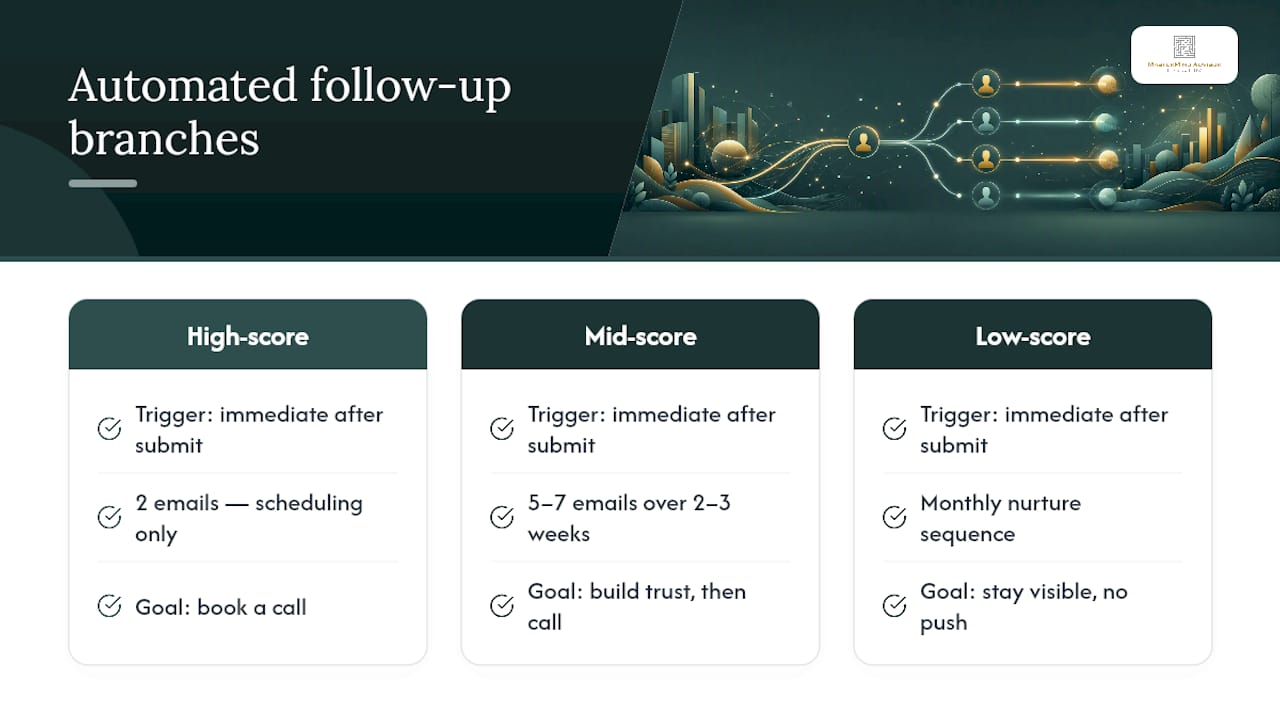
Automating this branching is where most advisors fall behind, since manually tracking which sequence each lead belongs in becomes unmanageable past a handful of leads per week. A well-configured email automation setup handles the branching logic automatically once the scoring rules are defined, and tools built specifically for automated follow-up nudges can help keep sequences timely without becoming another daily task on your plate.
Making sure your lead magnet actually works on a phone
More than half of the traffic hitting your landing page will arrive on a phone, often from a LinkedIn post or an email click during a commute. If your calculator requires pinching and zooming to read the input fields, you've lost a large share of your best prospects before they've answered a single question.
Mobile-friendly design for a financial tool means large tap targets, one question per screen rather than a long scrolling form, and a progress indicator so the user knows how much is left. Number inputs should trigger the numeric keyboard automatically rather than the full alphabet keyboard, a small detail that makes a real difference in completion rates on financial data entry.

Results screens need the same attention. A dense table of numbers that looked fine on a desktop monitor often becomes unreadable on a five-inch screen. Favor a single headline number or score with one or two supporting data points, and save the full detailed breakdown for the email you send after they convert, or for a desktop-optimized PDF attachment. This also reinforces the gating strategy discussed earlier: mobile users are even less patient with friction, so the preview-then-unlock pattern needs to feel effortless on a small screen, not just functional.
Test your own tool on an actual phone, not just a resized browser window, before launch. The gap between "looks fine in responsive preview" and "actually usable with a thumb" is where a lot of otherwise good magnets quietly lose completions.
An advisor marketing specialist's take on where to start
Most advisors overbuild their first lead magnet. They want the perfect ebook, the polished five-module course, the flagship tool that impresses everyone who sees it. That instinct is backwards. The advisors who see results fastest pick one interactive tool, one niche, and one scoring rule, then run it for 60 to 90 days before touching anything else.
Build the calculator. Connect it to your CRM. Watch the numbers. Only scale once you know what's actually working. If bandwidth is the real constraint, and it usually is for a busy practice, that's exactly when a turnkey partner earns its cost. DIY works when you have the time to iterate. It doesn't work when your calendar is already full of client meetings and the calculator sits half finished for three months.
— Josh
Mastermind Advisor: a turnkey path to lead magnets that actually convert
Building a calculator or scoring rubric from scratch takes real development time most advisory practices don't have lying around between client meetings and compliance work. Some turnkey marketing services remove that bottleneck by building calculators, webinars, and diagnostic tools and wiring them directly into a custom CRM, so a completed quiz doesn't sit in a spreadsheet, it triggers the right follow-up automatically.
Some systems cover the full loop: customized lead-generation webinars with registration segmentation, a compliance-friendly content library for niche-specific magnets, automated email drips scored by lead quality, and advisor websites built to house all of it without a separate tech stack to manage. They fit advisors who know their niche but don't have the internal team to build and maintain interactive tools, CRM logic, and nurture sequences at the same time.
If you're ready to see what a done-for-you calculator, webinar, and follow-up system looks like for your specific niche, get started with Mastermind Advisor and request a walkthrough of how the pieces connect.
Sources
The conversion figures and design guidance in this article draw on a handful of sources worth bookmarking if you're building your own tools. Magnetly's breakdown of the best lead magnet formats is the source for the 40 to 50 percent conversion benchmark on interactive tools. ProperExpression's optimization guide covers the shift from list-building to CRM-integrated conversion assets. Andrew Murdoch's piece on the 90-second bridge explains why static content underperforms interactive tools. Don Connelly's analysis of common lead generation mistakes and Advisors Ascend's list of top-converting formats round out the design and niche-targeting guidance throughout.
- The Best Lead Magnet for Financial Advisors (2026)
- How to Optimize Lead Magnets for Financial Advisors - ProperExpression
- The Lead Magnet That Actually Builds Your Pipeline (And Three That Don’t)
- Common Lead Generation Mistakes Financial Advisors Make
FAQ
What are some good lead magnet ideas for financial advisors?
Interactive tools work best: retirement readiness calculators, financial health scorecards, portfolio risk quizzes, and niche-specific webinars with segmented registration all outperform static guides because they deliver a personal result the prospect can act on immediately.
What is a red flag for a financial advisor's lead generation strategy?
Casting too wide a net and relying on generic, over-educational content is a common warning sign, since it attracts unqualified leads and wastes advisor time on calls that never convert into engagements.
What is the best lead source for financial advisors?
Interactive calculators and diagnostic assessments tend to produce the highest-quality leads because they qualify prospects through their own answers before an advisor ever picks up the phone, converting at 40 to 50 percent compared with under 1 percent for gated PDFs.
How do I promote my lead magnet effectively?
Place it on the service page most related to its topic first, link to it from relevant blog posts second, and use niche-specific LinkedIn posts or ads that speak to one clear problem rather than broad brand messaging.
Should I build a lead magnet myself or use a done-for-you system?
Build it yourself if you have the time to design, test, and connect the tool to your CRM over a full quarter; consider a turnkey system like Mastermind Advisor if your calendar is already full of client work and you need the calculators, webinars, and CRM integration handled for you.