

Your role as a strategic partnerships advisor inside your own RIA is to design, operate, and protect a predictable, compliant referral engine by treating center-of-influence (COI) relationships as structured, long-term partnership programs rather than informal coffee chats. Start by building a tiered partner program with a three-meeting vetting framework and plan for a 12–24 month ramp before referrals flow consistently. The SEC Marketing Rule governs how you document and disclose any compensated referral activity, so compliance is baked in from day one, not retrofitted later.
The single most important shift: stop treating COI outreach as networking and start treating it as a channel with its own pipeline, SLAs, and KPIs.
Table of Contents
- What do strategic partnerships actually deliver for an RIA?
- Which COI categories should you prioritize?
- What responsibilities does the advisor own inside a partnership?
- How long before partnerships produce steady referral flow?
- How do you build and run the partnership operationally?
- How do you know a partnership is actually working?
- What mistakes kill partnership ROI?
- How do digital tools and social media amplify your partnerships?
- How do you tailor your value proposition to each partner category?
- How do you handle conflict and competitive overlap in partnerships?
- Key Takeaways
- What most advisors get wrong about COI partnerships
- Mastermindadvisormarketing gives you the infrastructure to activate partnerships faster
- Authoritative sources and resources for your partnership program
What do strategic partnerships actually deliver for an RIA?
COI-sourced introductions convert at a meaningfully higher rate than paid leads and tend to produce clients with longer retention and higher lifetime value. The reason is straightforward: a CPA or estate attorney who refers a client has already pre-sold your credibility. That endorsement compresses the trust-building phase that normally takes months of nurturing.
The benefits of strategic partnerships compound in ways paid acquisition cannot match:
- Higher conversion rates. A warm introduction from a trusted professional removes the skepticism that cold outreach never fully overcomes.
- Lower client acquisition cost. No ad spend, no event venue fees. Your primary investment is time and reciprocal value.
- Access to complex cases. CPAs and M&A advisors surface clients mid-transaction, exactly when financial planning decisions carry the most weight.
- Reputation amplification. Each referral partner becomes a credible third-party endorser in their own professional network.
- Network effects over time. A partner who refers one client and sees a great outcome refers three more. Those three tell colleagues. The compounding is slow at first, then nonlinear.
The non-monetary delivery matters too. Co-case collaboration with an estate attorney sharpens your own technical depth. Mutual education sessions with a CPA build the kind of fluency that makes you the first call when a client's tax situation intersects with their investment plan.
Which COI categories should you prioritize?

Diversifying across multiple professional categories is the single best protection against channel concentration risk. Advisors who rely exclusively on one or two CPAs are one relationship change away from a dry pipeline.
Here is a ranked starting list, with category fit tied to common RIA niches:
- CPAs and tax professionals. The highest-volume COI category for most practices. Tax season creates natural referral moments.
- Estate attorneys. Ideal for advisors serving high-net-worth families or clients approaching wealth transfer.
- Business brokers and M&A advisors. Essential if your niche includes business owners planning exits. These partners surface clients with sudden liquidity events.
- Mortgage and real estate professionals. Useful for advisors serving younger accumulators or clients buying investment properties.
- Divorce attorneys and mediators. Underused. Divorce creates immediate, complex financial planning needs on both sides.
- Business coaches and fractional CFOs. Growing category. They work with business owners who need personal financial planning alongside business strategy.
- Specialty niches. Philanthropy directors, private bankers, and niche service providers (elder law attorneys, immigration attorneys for international clients) unlock referral pools most advisors never touch.
Practical starter set: pick three categories that match your ideal-client profile. A business-owner specialist should lead with M&A advisors, business coaches, and CPAs. A family wealth advisor should lead with estate attorneys, CPAs, and mortgage professionals.
What responsibilities does the advisor own inside a partnership?
The advisor's operational responsibilities are more demanding than most practitioners expect. Showing up to a quarterly lunch is not a partnership program. Here is what the role actually requires:
- Structured outreach. Identify five to ten prospects per category, initiate contact with a clear value proposition, and run them through the three-meeting vetting framework.
- Partner onboarding. Share your ideal-client profile, explain your referral submission process, set response-time SLAs (48 hours is a reasonable standard), and agree on a reporting cadence.
- Mutual education sessions. Quarterly meetings where you and a partner walk through a real client scenario or a regulatory change that affects both practices. High-trust partnerships are built on knowledge exchange, not transactional asks.
- Timely follow-up. When a partner sends a referral, respond within 24 hours and send the partner a brief update within seven days. Silence after a referral is the fastest way to stop getting them.
- Referral tracking and feedback loops. Log every introduction in your CRM with source, date, and status. When a referred client onboards, ask them to share a brief note with the referrer confirming their experience.
- Reciprocity. Send referrals back. If you cannot send clients, send knowledge: a relevant article, a heads-up about a regulatory change, or a warm introduction to another professional.
Pro Tip: After a referred client signs, send the referring partner a brief, compliant summary of the outcome (no confidential details). This closes the loop, reduces the referrer's professional risk, and is the single most underused tactic for generating a second referral from the same partner.
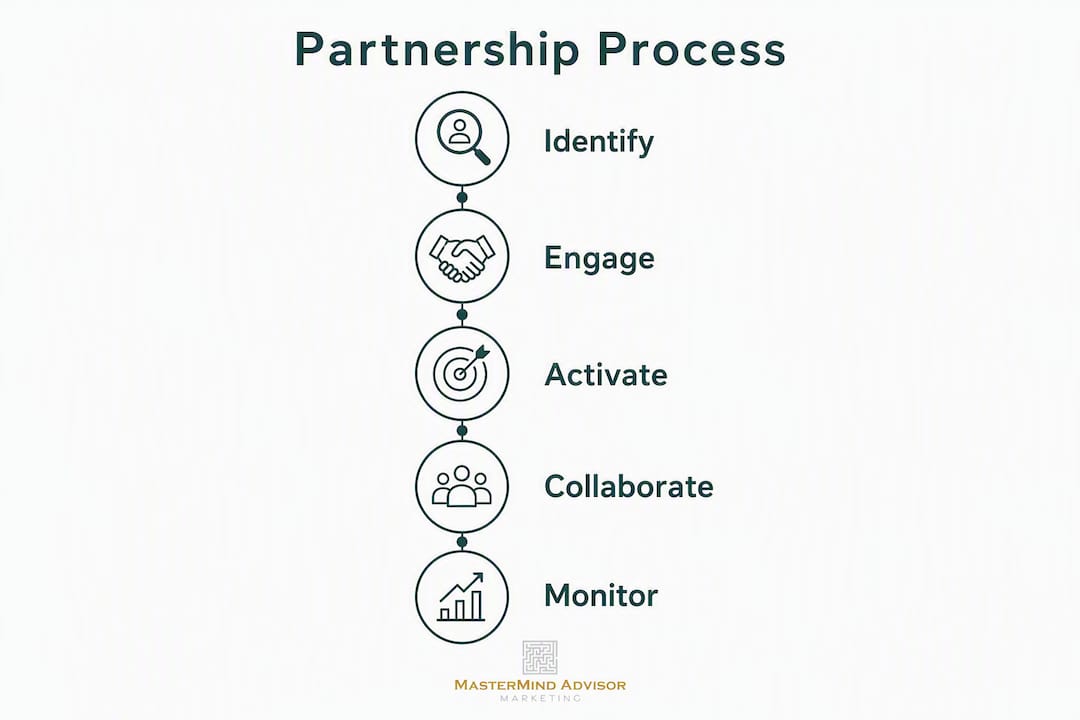
The Financial Planning Association's framework supports tiered structures with transparent benefit thresholds. Bronze partners get quarterly check-ins; silver partners get co-marketing opportunities; gold partners get co-hosted events and deeper integration. Tiers give partners a visible path to greater collaboration and give you a rational basis for allocating time.
How long before partnerships produce steady referral flow?
Plan for a ramp-up period of about one to two years before any single partner sends referrals with real consistency. Kitces research frames this correctly: COI relationships are long-term relationship capital, not a lead source you can activate in a quarter.
| Phase | Months | Key Activities | Expected Output |
|---|---|---|---|
| Pipeline building | — | Identify prospects, run 3-meeting vetting, onboard 1–2 partners | First introductions; no conversions yet |
| Activation | 4–12 | Joint events, co-branded content, mutual education sessions | Sporadic referrals; uneven cadence |
| Steadying | 12–24 | Distribution partnerships, service integrations, tier upgrades | Predictable referral flow from top partners |
| Integration | 24+ | Deep service integrations, co-case workflows | Highest referral volume and quality |
Most partnerships stall at the activation phase because advisors stop investing time once early referrals slow down. The FPA's activation model shows that Level 4 service integrations produce the highest and most predictable referral flow, but they require consistent investment through Levels 1–3 first.
Solo advisors should budget roughly two to four hours per week across their active partner set. Multi-advisor firms can assign a dedicated relationship manager once the program reaches five or more active partners.
How do you build and run the partnership operationally?
Outreach sequence:
- Connect on LinkedIn or via a mutual introduction; reference a specific shared client type or recent article.
- First meeting: rapport, practice overview, and a genuine question about their client challenges.
- Second meeting: deeper service alignment; share your ideal-client profile and ask for theirs.
- Third meeting: formalize collaboration, agree on referral process, and sign any required documentation.
Partner onboarding checklist:
- Exchange written ideal-client profiles
- Agree on referral submission method (email, CRM form, or phone)
- Set response-time SLAs
- Confirm disclosure and documentation requirements under the SEC Marketing Rule
- Schedule first quarterly check-in
Compliance essentials. Under the SEC Marketing Rule, compensated referrals and many non-cash incentives are treated as endorsements and require written agreements, documentation, and timely disclosure. Even reciprocal non-cash arrangements (co-hosting a seminar, sharing leads) can trigger promoter-activity rules if they function like compensation. Store all agreements, track both cash and non-cash incentives, and review your ADV disclosures with compliance counsel before formalizing any arrangement. Your compliance marketing checklist should include a line item for each active partner.
CRM and attribution: tag every lead with source, partner name, and introduction date. Track three numbers: introductions per partner per quarter, lead-to-client conversion rate, and days from introduction to signed paperwork.
Joint activities: co-hosted webinars, educational workshops for each other's clients, and co-branded content bundles all build conversion mechanisms into the relationship. A marketing calendar with two to four joint events per year per top-tier partner is a realistic and productive cadence.
How do you know a partnership is actually working?
Three numbers tell you most of what you need to know, per Jump's referral program guidance: introductions generated, conversion share, and cycle length from introduction to signed paperwork.
| KPI | What to measure | Benchmark signal |
|---|---|---|
| Referrals per partner per quarter | Raw introduction count | Less than 1 per quarter after month 12 signals a stalled relationship |
| Lead-to-client conversion rate | COI-sourced vs. all other sources | COI-sourced leads typically convert at a higher rate than cold channels |
| Time to close | Days from introduction to signed agreement | Shorter than your average cold-lead cycle confirms the trust transfer is working |
| Referred client LTV | Revenue over 5 years vs. non-referred clients | Higher LTV justifies deeper time investment per partner |
| Cost/time per partner | Hours invested vs. AUM generated | Guides tier decisions and partner pruning |
Sample ROI frame: if a gold-tier partner generates four introductions per year, two convert, and each referred client brings $8,000 in annual revenue, that is $16,000 in year-one revenue against roughly 40–50 hours of relationship investment. At year three, with referrals compounding, the same partner relationship may generate $40,000+ annually with no incremental acquisition cost.
What mistakes kill partnership ROI?
- Over-reliance on one partner. A single CPA who retires, changes firms, or shifts priorities can wipe out your referral pipeline overnight.
- Passive networking without follow-up. A coffee meeting with no next step is not a partnership; it is a pleasant hour that produces nothing.
- Not tracking referrals. If you cannot tell which partners are producing, you cannot allocate time rationally.
- Unclear expectations. Partners who do not know your ideal client will send the wrong ones, then stop sending altogether after a few mismatches.
- Ignoring partner risk. A partner with compliance issues, client complaints, or a reputation for aggressive sales tactics creates reputational exposure for your practice.
Compliance red flags: undisclosed compensation arrangements, verbal promises that function like referral fees, inconsistent disclosure language across clients, and partners using your brand name or credentials in their own marketing without your review. Under the SEC Marketing Rule, these are exam-ready issues.
When to end a partnership: set clear thresholds. Zero introductions in 12 months after full activation, repeated SLA breaches, or any regulatory exposure are sufficient grounds to pause or terminate. Exit cleanly: a brief, professional conversation explaining that you are refocusing your partnership program, with no bridges burned.
How do digital tools and social media amplify your partnerships?
LinkedIn is the most productive platform for COI relationship maintenance. Commenting on a partner's posts, sharing their content with a brief endorsement, and tagging them in relevant articles keeps you visible between in-person meetings without requiring a calendar invite. Establishing authority through consistent digital content signals to potential partners that you are a credible, active practitioner worth associating with.
Practically, a CRM with referral-source tagging, automated partner-update emails, and a shared referral intake form removes friction from the referral process for both sides. A co-branded landing page for a joint webinar gives both partners a trackable conversion mechanism and a shared asset to promote. Email automation can handle partner nurture sequences: a quarterly newsletter with planning insights, a post-event follow-up, and a birthday or milestone note all maintain warmth without manual effort.
Social proof matters here too. A short LinkedIn post thanking a partner for a successful co-hosted event, or sharing a client success story (with appropriate compliance review), reinforces the partnership publicly and signals to other potential COIs that you are an active collaborator.
How do you tailor your value proposition to each partner category?
A CPA does not care about the same things a divorce attorney does. Generic pitches fail because they do not address the specific professional risk and client-service gap each partner is trying to solve.
CPAs: your value proposition is tax-efficient investment management and proactive planning that reduces their client's year-end surprises. Lead with your tax-overlay capabilities and your willingness to collaborate on client scenarios before year-end.
Estate attorneys: you solve the funding and beneficiary coordination problem they see constantly. Offer to review beneficiary designations and titling on referred clients as a complimentary service. That is a concrete, immediate value add.
Business brokers and M&A advisors: your value is post-transaction planning. A business owner who just received $3 million needs a plan for that liquidity within weeks. Position yourself as the advisor who specializes in exactly that transition.
Divorce attorneys: financial complexity is their client's biggest stressor. A CDFA credential or demonstrated experience with QDRO analysis and asset division makes you the obvious referral for their most complicated cases.
Business coaches and fractional CFOs: they see the personal financial blind spots their clients ignore. Your value is the personal planning layer their engagement does not cover. Offer a complimentary financial clarity session for their clients as a low-friction entry point.
The underlying principle: relationship marketing built on genuine mutual value outlasts transactional arrangements. Every value proposition should answer the partner's implicit question: "What does my client get that they cannot get from me?"
How do you handle conflict and competitive overlap in partnerships?
Competitive overlap is inevitable. A CPA who also offers investment management, or a financial planner at a bank who refers clients to you selectively, creates tension that needs a direct conversation, not avoidance.
Address scope early. In the third vetting meeting, clarify which client situations you handle and which you do not. A written scope-of-collaboration note (not a formal contract, just a shared document) prevents the ambiguity that breeds resentment.
When a partner poaches a client: treat it as a data point, not a betrayal. One incident may be a misunderstanding; a pattern is a structural problem. Have a direct conversation, reset expectations, and if the behavior continues, downgrade the partner's tier or exit the relationship.
When you compete for the same client: disclose it immediately. Tell both the client and the partner that you have identified an overlap and that the client's interests come first. Advisors who handle this transparently earn more trust than they lose.
Referral reciprocity disputes: if a partner feels the referral flow is one-sided, they are usually right. Review your CRM data, acknowledge the imbalance, and either send more referrals or have an honest conversation about whether the partnership is the right fit.
Key Takeaways
The advisor's role in strategic partnerships is to run a structured, compliant COI program with tiered partners, a three-meeting vetting process, and consistent tracking, expecting 12–24 months before referrals flow predictably.
| Point | Details |
|---|---|
| Start with three categories | Pick CPAs, estate attorneys, and one niche category that matches your ideal-client profile. |
| Use the three-meeting framework | Rapport, alignment, and formalization meetings before any referral agreement is signed. |
| Plan for 12–24 months | Steady referral flow from COI partners typically takes up to two years to develop. |
| Track three core numbers | Introductions per partner, lead-to-client conversion rate, and days to close tell you what is working. |
| Mastermindadvisormarketing accelerates activation | Turnkey webinars, CRM automation, and compliance-friendly content compress the timeline from outreach to first joint event. |
What most advisors get wrong about COI partnerships
The conventional wisdom says to "add value first" and "be patient." Both are true, but they miss the structural problem. Most advisors treat COI relationships as social capital they accumulate passively, then wonder why referrals never materialize.
The advisors who build genuinely productive COI programs do something different: they run their partnership channel the way they run their investment process. There is a defined universe (partner categories), a screening process (three-meeting vetting), a monitoring framework (quarterly KPI reviews), and a rebalancing mechanism (tier adjustments and partner pruning). The relationship warmth is real, but it sits on top of a system, not instead of one.
The tactic that consistently produces outsized results is the quarterly co-case review. Invite one or two partners to a 60-minute working session where you walk through a real (anonymized) client scenario together. The CPA sees how you think about tax-efficient withdrawal sequencing; you see how they approach entity structure for a business owner. That shared intellectual work builds the kind of trust that no number of lunches replicates. Partners who have worked through a real problem with you refer with confidence because they have seen your process firsthand.
The other underrated move: close the feedback loop after every referral. A brief, compliant note to the referring partner confirming that their client is being well served removes the professional risk the partner took by making the introduction. That one habit, done consistently, is what separates advisors who get a second and third referral from the same partner from those who get one and wait.
Mastermindadvisormarketing gives you the infrastructure to activate partnerships faster
Building a COI program from scratch means producing webinars, writing co-branded content, setting up CRM tagging, and staying compliant, all while running your practice. That is where most advisors stall: the operational lift is real, and it compounds when you are managing five or more active partners.
Mastermindadvisormarketing is built specifically for this problem. The platform gives independent RIAs and fee-only practices a turnkey system that includes done-for-you webinar production, fully produced in-person and virtual seminars, a compliance-friendly content library, automated email drip campaigns, and CRM integration with referral-source tagging. Every piece is designed for the regulatory constraints and long buying cycles of financial services, so you are not adapting generic marketing tools to a fiduciary context.
For partnership activation specifically, the co-branded materials, joint event production, and automated follow-up sequences compress the timeline from first partner meeting to first joint event. You spend your time on the relationship; the system handles the execution.
Visit Mastermindadvisor.com to see how the platform supports your COI program and book a walkthrough of the referral-tracking and automation features.
This article is general information for educational purposes. Consult a qualified compliance professional or your RIA's legal counsel to confirm that your specific referral arrangements meet current SEC Marketing Rule requirements.
Authoritative sources and resources for your partnership program
- Building a Systematic Referral Partnership Program: Why Structure Beats Hope — Financial Planning Association framework for tiered partner programs and activation levels.
- Getting a Flow of New Clients From Centers of Influence — Kitces deep-dive on COI ramp timelines, mutual education tactics, and feedback loops.
- 3-Meeting Framework to Vet and Establish COI Relationships — Kitces step-by-step vetting process for formalizing partner relationships.
- Centers of Influence Referrals Must Go Beyond the CPA — Financial Planning on diversifying COI categories beyond the traditional CPA relationship.
- How to Create a Financial Advisor Referral Program — Jump's guide to CRM tagging, KPI tracking, and SEC Marketing Rule compliance for referral programs.
- Why Client Referrals Matter for Advisors' Growth — Mastermindadvisormarketing's breakdown of referral program design and ROI.
- Professional Networks for Independent Advisors: 2026 Guide — Guidance on building a diverse professional network across COI categories.
- Independent Advisor Compliance Marketing Checklist — Compliance checklist covering referral disclosures, written agreements, and SEC Marketing Rule documentation.