

Client referrals are the single most effective client acquisition channel for independent financial advisors, consistently outperforming every other lead source on conversion rate, asset value, and client loyalty. The industry term for this is "referral marketing," and understanding why client referrals matter for advisors is the first step toward building a practice that grows on its own momentum. Client referrals drive 45–67% of new clients and assets for RIA firms. Yet most advisors treat referrals as a happy accident rather than a repeatable system. That gap between referral potential and referral reality is where practices stall.
Why do client referrals matter for advisors more than any other lead source?
Referrals work because trust travels with them. When a satisfied client introduces you to a friend or colleague, that introduction carries the weight of a personal endorsement. No cold email or paid ad replicates that.
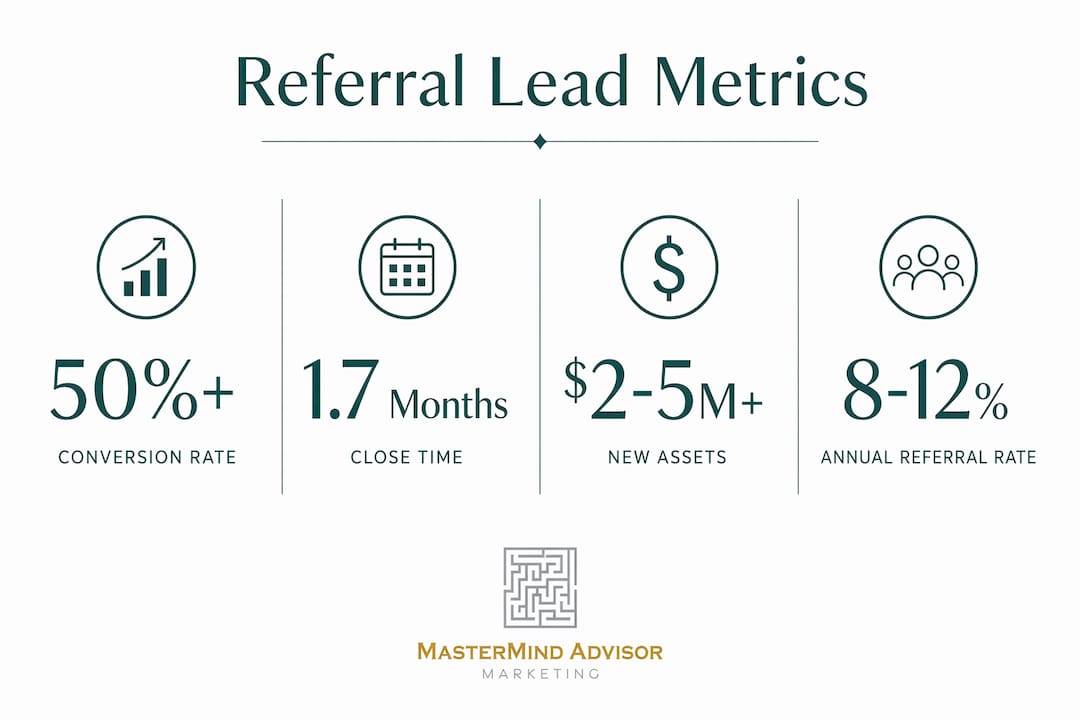
The numbers confirm the advantage. Referral leads convert in 1.7 months on average, compared to 3.6 months for marketing-sourced leads. That faster cycle means less time spent nurturing and more time serving. Conversion rates for referral leads exceed 50%, while seminar leads convert at 15–25% and purchased third-party leads convert at just 2–8%.

The financial impact goes beyond conversion speed. Referral programs yield $2–5M+ in new assets per successful referral. Referred clients also tend to stay longer, complain less, and refer others at higher rates than clients acquired through advertising. They arrive pre-sold on your credibility.
Comparing lead sources by key performance metrics
| Lead source | Avg. conversion rate | Avg. time to convert | Typical asset quality |
|---|---|---|---|
| Client referrals | Above 50% | 1.7 months | High |
| Seminar leads | 15–25% | 2–4 months | Moderate |
| Purchased leads | 2–8% | 3.6+ months | Variable |
| Digital marketing leads | Varies widely | 3–6 months | Moderate |
The table above makes the case plainly. No other channel comes close to referrals on all three dimensions simultaneously. That is why 48% of financial professionals rank networking and referrals as their highest return-on-investment channel.
Pro Tip: Track the source of every new client meeting in your CRM. After 12 months, you will almost certainly find that referrals produce more revenue per hour of effort than any other channel you run.
Why do many advisors underutilize referrals despite the clear benefits?
The gap is not a motivation problem. Most advisors know referrals matter. The problem is execution. 93% of advisors include referrals in their growth strategy, yet fewer than 5% receive consistent referrals from their client base. That disconnect points to a structural failure, not a relationship failure.
Several specific barriers explain the underperformance:
- No formal program. 52% of advisors have no structured referral system. Without a repeatable process, referral asks happen randomly or not at all.
- Poor timing. Advisors often ask for referrals during routine check-ins rather than after meaningful client wins. The ask feels transactional because the context is neutral.
- Vague language. Asking a client to "send anyone my way" gives them nothing to act on. Clients need a specific person in mind and a clear, low-effort way to make the introduction.
- Fear of awkwardness. Many advisors worry that asking will damage the relationship. This fear is largely unfounded, but it keeps advisors silent at exactly the right moments.
- No follow-up system. Even when a client agrees to refer, there is no automated reminder or tool to help them follow through.
Only 3–5% of clients who are willing to refer actually produce a meeting, despite 25–35% expressing willingness. The gap between willingness and action is a process problem. Advisors who solve it with systems, not charm, win.
Pro Tip: After your next quarterly review, send a one-sentence follow-up email thanking the client for their time. Then add a second sentence: "If you know anyone going through a similar situation, I'd be glad to help." That simple, low-pressure message outperforms any formal referral script.
What systematic strategies increase client referrals for advisors?
Building a predictable referral pipeline requires treating referrals the same way you treat any other business process: with defined steps, clear timing, and tools that keep it consistent. Here is how top-performing advisors do it.
-
Map referral moments into your client calendar. The most impactful referral asks happen after meaningful client milestones, such as delivering a completed financial plan, reaching a savings target, or resolving a tax concern. Build these moments into your annual client touchpoint schedule so the ask is never an afterthought.
-
Use CRM automation to prompt and track referral activity. AI-driven CRM systems create predictable referral pipelines by flagging the right clients at the right time and automating follow-up sequences. Without this infrastructure, referral programs depend entirely on memory, which is unreliable at scale.
-
Replace the word "referral" with service-oriented language. Top referral-performing advisors avoid the word "referral" entirely. Instead, they frame the ask around helping someone the client cares about. "Is there anyone in your life who could benefit from having a clear financial plan?" lands differently than "Do you have any referrals for me?"
-
Reduce client effort with ready-to-use tools. Provide clients with a forwardable email, a calendar link, or a short introduction they can send directly. The easier you make it, the more likely they act. Clients want to help. They just need the path of least resistance.
-
Build relationships with Centers of Influence. CPAs, estate attorneys, and mortgage brokers serve the same clients you do. A formal referral partnership with even two or three Centers of Influence can produce a steady stream of pre-qualified introductions every quarter.
Advisors with systematic referral processes achieve 30–46% higher gross production and referral rates of 8–12% annually from their client base. That is not luck. That is process. You can read more about the mechanics behind referral program benefits and how structured systems change the outcome.
How should referrals fit into a broader advisor growth strategy?
Referrals are the foundation of advisor growth, but they cannot be the entire structure. Firms that rely solely on referrals hit a growth ceiling. Referral networks are personal and non-transferable. When you retire or sell your practice, those relationships do not automatically transfer to a buyer.
Buyers discount practices that lack repeatable, documented client acquisition systems. A practice built entirely on personal referrals is worth less on paper than one with a multi-channel acquisition engine. That is a financial reality advisors rarely consider until it is too late.
The solution is to treat referrals as the highest-performing channel in a portfolio of channels, not the only channel. Digital marketing, content marketing, and advisor marketing automation each play a supporting role. They generate leads when referrals are slow, build brand visibility that makes referrals more credible, and create documented acquisition data that supports firm valuation.
Combining referrals with digital lead generation also protects against referral network fatigue. A client base of 100 households can only refer so many people before the network is tapped. Digital channels continuously expand the top of your funnel. The advisors who grow fastest treat referrals and digital marketing as partners, not competitors. You can explore how financial services digital marketing fits into this picture for a practical 2026 framework.
Automation workflows that systematize referral follow-ups and client engagement give advisors the consistency that manual processes cannot sustain. The goal is a growth engine where referrals feed the top of the funnel and digital channels fill the gaps.
Key Takeaways
Client referrals are the highest-converting, fastest-closing lead source available to independent financial advisors, but only when backed by a consistent, documented process rather than ad-hoc asks.
| Point | Details |
|---|---|
| Referrals outperform all other channels | Referral leads convert above 50% in 1.7 months, far ahead of any other lead source. |
| Most advisors lack a formal system | 52% of advisors have no structured referral program, leaving significant growth on the table. |
| Timing and language determine success | Ask after meaningful client milestones and use service-oriented language instead of the word "referral." |
| Systematic processes multiply results | Advisors with formal referral systems achieve 30–46% higher gross production annually. |
| Referrals alone limit firm value | A multi-channel approach protects growth scalability and supports practice valuation at exit. |
The consistency problem is the only problem worth solving
Every advisor I talk to knows referrals matter. They have seen it firsthand. A long-time client mentions them to a colleague, that colleague books a call, and within six weeks there is a new household with $800,000 in assets. The advisor thinks, "I need more of that." Then nothing changes.
The reason nothing changes is not a lack of desire. It is a lack of infrastructure. Referral asks get pushed to "when the moment feels right," and that moment never comes on a schedule. The consistency problem is real, and it is the only referral problem worth solving. Everything else, the language, the timing, the Centers of Influence relationships, only works if you show up consistently.
What I have seen work is treating referral asks the same way you treat compliance deadlines. They go on the calendar. They get automated reminders. They have a defined script that gets refined over time. The advisors who do this stop thinking about referrals as a relationship skill and start thinking about them as a business system. That mental shift is worth more than any single tactic.
Client testimonials also play a supporting role here. When referred prospects research you before the first call, what they find either confirms or undercuts the referral. Strong client testimonials close that gap and make the referral stickier. Build both sides of the equation.
— Josh
How Mastermindadvisormarketing helps advisors build a referral growth engine
Independent financial advisors who want referrals to become a reliable growth channel need more than good intentions. They need a system.

Mastermindadvisormarketing is built specifically for independent advisors who are ready to stop leaving referrals to chance. The platform combines custom CRM tools, automated email follow-up sequences, and content marketing strategies that keep you visible to clients between meetings, so referral asks land in the right context at the right time. Advisors who use Mastermindadvisormarketing report stronger client engagement and more consistent lead flow. If you are ready to put your referral growth on a repeatable track, explore Mastermind Advisor's services and see what a purpose-built system looks like for your practice.
FAQ
Why are client referrals the top growth channel for advisors?
Referral leads convert above 50% and close in 1.7 months on average, faster and at higher rates than any other lead source. They also arrive with built-in trust, which shortens the sales cycle and increases long-term client retention.
How many advisors have a formal referral program?
Only 48% of advisors have any structured referral system in place. That means more than half rely on ad-hoc asks, which produce inconsistent and unpredictable results.
When is the best time to ask a client for a referral?
The best time is immediately after a meaningful client win, such as delivering a completed financial plan or resolving a financial concern. Referral asks timed after positive experiences yield significantly higher results than asks made during routine check-ins.
Should advisors use the word "referral" when asking clients?
No. Top-performing advisors avoid the word "referral" and instead use service-oriented language focused on helping someone the client knows. This framing reduces the transactional feel and increases the likelihood the client acts.
Can an advisor grow a practice on referrals alone?
Referrals are the most effective channel, but relying on them exclusively limits firm valuation and long-term scalability. Buyers discount practices without documented, repeatable acquisition systems, making a multi-channel approach both a growth strategy and a business protection strategy.