

Search engine optimization (SEO) is the process of structuring your online presence so that prospects searching for financial guidance find your practice first, trust what they see, and take action. The role of SEO for financial advisors goes beyond rankings. It determines whether a potential client discovers you or your competitor when they type "retirement planner near me" into Google. 81% of consumers start their search on Google, yet only 22% of financial advisors actively use SEO in their marketing. That gap is the opportunity. Google classifies financial content under its Your Money or Your Life (YMYL) standards, which means your site must demonstrate Experience, Expertise, Authority, and Trust (E-E-A-T) to rank at all.
How does SEO help financial advisors attract more clients?
SEO produces the lowest client acquisition cost of any digital channel available to financial advisors. Paid ads stop generating leads the moment you stop paying. SEO compounds over time, building what amounts to a permanent digital asset for your practice.
The timeline requires patience. SEO delivers results after 6–12 months of consistent work, which is why advisors who start early gain a durable advantage over those who wait. The advisors who treat SEO as a long-term infrastructure investment, rather than a short-term campaign, consistently outperform those who cycle through paid tactics.

The data on structured marketing is striking. Firms with a marketing plan that includes SEO generate 168% more monthly leads and onboard 50% more clients annually than firms without one. That is not a marginal edge. It is the difference between a practice that grows predictably and one that depends entirely on referrals.
Key lead generation benefits SEO delivers for advisors:
- Organic compounding: Each published page accumulates authority and traffic over time without additional ad spend.
- High-intent traffic: Prospects searching "fee-only financial advisor in Denver" are already in decision mode.
- Lower cost per lead: Organic leads cost a fraction of what paid search or seminar marketing costs per acquisition.
- 24/7 visibility: Your website works as a lead funnel around the clock, even when you are with clients.
Pro Tip: Build your SEO around service pages first, not just blog posts. A well-optimized "Retirement Planning in [City]" page will generate qualified leads far faster than a general article about retirement.
What are the key SEO best practices for financial services?
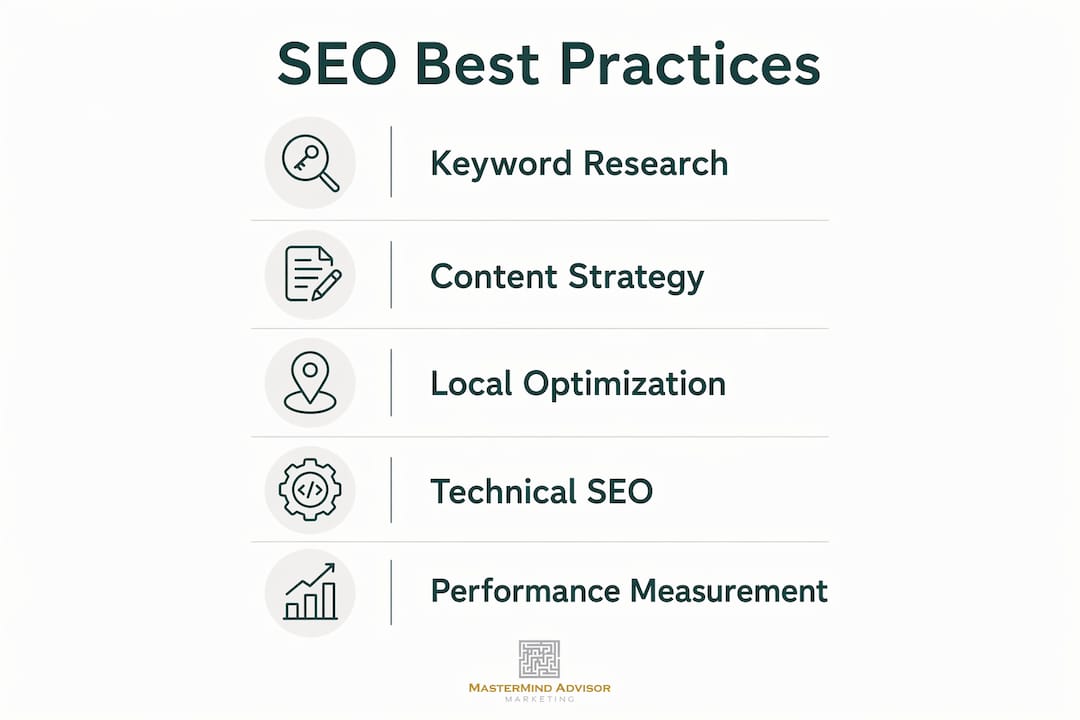
SEO success in financial services requires combining technical optimization, strategic content, local focus, and compliance awareness. Each pillar supports the others. Skipping one weakens the entire structure.
E-E-A-T: the foundation of financial SEO
Google's YMYL classification means your site faces a higher bar than a recipe blog. You need author bios with credentials, links to your regulatory registrations, client testimonials where compliant, and content that reflects genuine expertise. A page written by a CFP with 20 years of experience outranks a generic article every time, assuming the technical basics are in place.
Local SEO for high-intent searches
Local SEO captures high-intent searches through location-specific keywords, a fully optimized Google Business Profile, and a steady stream of client reviews. Most advisors serve a defined geographic area, which makes local SEO one of the highest-return tactics available. Claiming and maintaining your Google Business Profile costs nothing and directly influences whether you appear in the local map pack.
Technical SEO fundamentals
Your site must load fast, display correctly on mobile devices, use HTTPS, and include structured data markup. These are not optional extras. Google uses page experience signals as ranking factors, and a slow or broken site signals low trust to both search engines and prospective clients.
Content structured around real client questions
Write pages and posts that answer the exact questions your prospects type into search engines. "How much do I need to retire at 60?" is a real query with real search volume. Answering it clearly and completely, with your credentials attached, builds both rankings and trust. Avoid keyword stuffing. Integrate terms naturally into titles, meta descriptions, H2 headings, and the first paragraph of each page.
Pro Tip: Use Google's "People Also Ask" box to find the exact questions your prospects are asking. Build one page per question, answer it in the first two sentences, then expand with detail.
How is Answer Engine Optimization changing SEO for advisors?
Answer Engine Optimization (AEO) builds on traditional SEO by structuring your content so AI tools like ChatGPT, Perplexity, and Google's AI Overviews can extract and present your expertise directly in their responses. SEO gets your site indexed and ranked. AEO ensures your content gets quoted when someone asks an AI assistant for a financial recommendation.
The distinction matters because AI-powered search is now a primary discovery channel for high-net-worth clients who research extensively before contacting an advisor. If your content does not appear in those AI-generated answers, you are invisible to a growing segment of your best prospects.
Here is how to build an SEO and AEO content stack that works in 2026:
- Write in question-and-answer format. Open each section with a direct question as a heading, then answer it in the first two sentences. AI models parse this structure easily.
- Use clear, factual summaries. Structured, question-based content with concise answers improves both indexing and AI answer inclusion.
- Add structured data markup. FAQ schema and Article schema tell search engines and AI models exactly what your content covers.
- Keep paragraphs short. AI models favor content with clear, scannable structure over dense walls of text.
- Cite your credentials inline. Mention your designations and experience within the content itself, not just in a bio. AI models use this to assess source authority.
Pro Tip: Think of AEO as writing for two audiences simultaneously: the human reader and the AI model that may summarize your page. Both reward clarity and directness.
A multichannel SEO approach that stacks traditional search rankings with AEO visibility creates stronger inbound lead generation than either tactic alone. The advisors who adopt this combined approach now will hold a significant advantage as AI search continues to grow.
What practical steps integrate SEO into your marketing strategy?
SEO works best when it connects to your broader financial advisor marketing strategies rather than running as a separate project. Here is a structured approach to building that integration.
Keyword research first. Use Google Keyword Planner to identify local and niche queries your ideal clients actually search. Focus on terms with clear intent: "estate planning attorney vs. financial advisor," "how to choose a fee-only advisor," or "best financial planner in [city]." These terms signal a prospect who is close to making a decision.
Build a content calendar around client questions. Map one page or post to each keyword cluster. Prioritize decision-level content, such as service pages and comparison guides, before publishing broad educational articles. Every piece of content must meet compliance standards before publication.
Earn backlinks from reputable sources. Building backlinks from relevant, reputable sources directly raises your domain authority and improves rankings. Target local business associations, financial media outlets, and professional directories. Guest posts on recognized financial planning sites carry significant weight.
Measure performance and adjust. Advisors who integrate SEO with their marketing system and measure performance see more sustainable lead generation over time. Track organic traffic, keyword rankings, and lead form submissions monthly. Drop content that does not convert. Double down on pages that do.
Connect SEO to your lead funnels. Organic traffic only converts when it lands on a page designed to capture a lead. Pair your SEO content with optimized landing pages that include a clear call to action, a calendar booking tool, or a lead magnet like a retirement readiness checklist.
Consider specialized SEO support. Financial services SEO requires compliance awareness that general SEO agencies lack. A specialist understands FINRA and SEC content guidelines and builds your strategy within those boundaries.
Key Takeaways
SEO is the single highest-return digital marketing investment a financial advisor can make, provided it is built on E-E-A-T principles, local optimization, and structured content that serves both search engines and AI answer tools.
| Point | Details |
|---|---|
| SEO compounds over time | Organic rankings build lasting visibility, unlike paid ads that stop when the budget runs out. |
| Structured marketing multiplies results | Firms with SEO in their marketing plan generate 168% more monthly leads than those without. |
| Local SEO captures decision-ready prospects | Optimizing your Google Business Profile and location keywords targets clients already searching nearby. |
| AEO extends your reach into AI search | Structuring content for AI answer engines ensures your expertise appears in ChatGPT and Perplexity responses. |
| Measurement drives sustainable growth | Tracking organic traffic, rankings, and lead conversions monthly lets you refine what works and cut what does not. |
Why most advisors are still leaving SEO on the table
The 22% adoption rate among advisors is not surprising to me. Most advisors built their practices on referrals, and referrals feel reliable in a way that SEO does not. You cannot see SEO working the way you can see a client introduction happen in real time.
What I have observed, though, is that high-growth practices use SEO as a layer that reinforces referrals rather than replacing them. When a referred prospect receives your name, the first thing they do is Google you. If your site looks outdated, loads slowly, or has no substantive content, you lose credibility before the first conversation. SEO is not competing with your referral network. It is protecting it.
The advisors I see struggle most with SEO make one of three mistakes. They publish content without a keyword strategy, so it never ranks. They ignore local SEO entirely, missing the highest-intent searches in their own market. Or they treat SEO as a one-time project rather than an ongoing practice. The future of search now includes AI-powered answer engines, and advisors who do not adapt their content for AEO will lose visibility to those who do. The advisors who commit to continuous adaptation, not just a one-time site refresh, are the ones who build practices that grow without constant paid ad spend.
— Josh
How Mastermindadvisormarketing supports your SEO and digital growth
Financial advisors who want to grow their practice through organic search need more than a checklist. They need a system built specifically for how advisors market and how clients choose advisors.

Mastermindadvisormarketing is a turnkey marketing platform designed exclusively for independent financial advisors. It combines SEO strategy support, content marketing, custom CRMs, and automated lead follow-up into one integrated system. Advisors using the platform have increased their lead volume and built stronger client pipelines without managing multiple disconnected tools. If you are ready to build digital leads for your practice through a system that handles both SEO and the full lead funnel, Mastermind Advisor is built for exactly that.
FAQ
What is the role of SEO for financial advisors?
SEO helps financial advisors rank in organic search results so prospects searching for financial guidance can find, evaluate, and contact their practice. It builds long-term visibility and client trust without ongoing ad spend.
How long does SEO take to generate leads for advisors?
SEO typically requires 6–12 months of consistent effort before generating meaningful leads. The results compound over time, making early investment more valuable than delayed action.
Why does local SEO matter for financial advisors?
Most advisors serve a specific geographic area, and local SEO targets prospects who are actively searching for advisors nearby. Optimizing your Google Business Profile and using location-based keywords captures high-intent, decision-ready clients.
What is AEO and how does it differ from traditional SEO?
Answer Engine Optimization (AEO) structures your content so AI tools like ChatGPT and Perplexity can extract and present your expertise in their responses. Traditional SEO focuses on search engine rankings, while AEO targets visibility inside AI-generated answers.
How do financial advisors measure SEO success?
Track organic traffic, keyword rankings, and lead form submissions monthly using tools like Google Analytics and Google Search Console. Advisors who measure and adjust their SEO consistently see more sustainable lead generation than those who set it and forget it.