
A service menu for financial advisors is a client-facing catalog of packages, deliverables, access levels, and fees that helps prospects understand what they're buying and helps the firm deliver it profitably. The person who builds, prices, and maintains that catalog is functionally acting as a service menu advisor, whether that's the firm's own practice manager or an outside consultant brought in to design the structure.
Three things happen when a firm gets this right:
- Clients gain clarity. They know exactly what's included, what costs extra, and how often they'll hear from you.
- The firm gains guardrails. Standardized workflows and a documented service calendar keep delivery consistent with what's promised on paper.
- The business gains a growth path. Well-priced tiers create room to scale service without scaling advisor burnout.
Key Takeaways
A service menu works when every tier's fee is priced against real advisor hours and every deliverable on paper matches a standardized workflow the firm can actually deliver.
| Point | Details |
|---|---|
| Define tiers by complexity, not AUM | Segment clients using time logs, revenue per client, and life-stage complexity rather than assets alone. |
| Map every deliverable to cost | Use fully loaded hourly cost times estimated hours plus margin to price each tier before publishing it. |
| Pilot before firm-wide rollout | Test with 10 to 15 clients for 30 to 60 days and track out-of-scope requests before locking the structure. |
| Match paper to delivery | Get compliance signoff and keep a service log so client-facing language never outruns what actually happens. |
| Track KPIs by tier, not firm-wide | Monitor CSAT, utilization, advisor hours, margin, and upgrade rate quarterly to catch underperforming tiers early. |
For firms ready to turn a finished service menu into an active lead-generation asset, Mastermind Advisor builds the webinars, seminars, and compliance-friendly content that put your new pricing structure in front of qualified prospects instead of leaving it buried on a static page.
Where to Find Templates and Deeper Pricing Detail
- The AdvicePay blog lists productizable services for building your first menu draft.
- Kitces covers pricing formulas in depth.
- Mastermindadvisormarketing's fee structure guide expands on billing-frequency tradeoffs.
Table of Contents
- What Is a Service Menu Advisor and Why Does the Role Matter?
- What Should a Financial Advisor's Service Menu Include?
- How Do You Build a Service Menu Advisors Can Actually Use?
- How Do You Price Menu Items So Every Tier Stays Profitable?
- How Do You Keep a Service Menu Compliant and Communicate It Well?
- What Should a Launch Timeline and KPI Dashboard Look Like?
- Frequently Asked Questions
- Sources
What Is a Service Menu Advisor and Why Does the Role Matter?
A service menu advisor is anyone responsible for designing, pricing, and maintaining the service catalog that a firm presents to prospects and clients. Sometimes that's an internal role inside a growing RIA. Sometimes it's a fee-for-service consultant or practice-management specialist brought in specifically to fix a broken pricing structure. Either way, the job matters because most advisory firms don't fail at this by accident. They drift into it.
Here's the business case in plain terms: a tiered menu turns vague sales conversations into structured ones, and it gives every prospect a concrete reason to say yes or no early, instead of dragging out a fit conversation for weeks.
Watch for these symptoms if you're not sure whether your firm needs one:
- Clients seem confused about what's included in their fee versus what costs extra.
- Advisors are burning out because scope keeps expanding without a matching fee increase.
- New prospects are dropping off during the sales process because pricing feels opaque or negotiated case by case.
- Delivery doesn't match what was promised in the engagement letter, which creates compliance exposure over time.
Tiered service models solve for capacity stress specifically. They reduce the inefficient allocation of advisor hours and stop scope creep from quietly eating margin one client request at a time.
What Should a Financial Advisor's Service Menu Include?
Every credible menu needs six components, and skipping any one of them is usually what causes trouble six months later.
- Named tiers, not letter grades. "Foundation," "Growth," and "Legacy" tell a prospect something. "Tier A" and "Tier B" tell them nothing.
- Deliverables mapped to cadence. Each tier should list what happens and how often, not just a vague promise of "ongoing support."
- Access levels. Spell out whether a client gets the lead advisor, an associate, or a self-service digital portal, and when.
- Exclusions and scope limits. State what's not included as clearly as what is.
- Explicit fees and billing cadence. Monthly, quarterly, or annual, stated in dollars, not "starting at."
- Upgrade paths. A documented route from one tier to the next, so migration feels like progress, not a renegotiation.
A single menu row might read like this: Quarterly Portfolio Review, delivered by lead advisor, 45 minutes, owned by advisor with para-planner prep support, $125/month billed monthly. That level of detail is what separates a sellable menu from a marketing brochure.
The client service model behind the menu should assign ownership, cadence, and hour estimates internally so the public-facing document never overpromises. Only put a service on the menu once the firm has a repeatable workflow to deliver it.

Pro Tip: Avoid phrases like "access as needed" without a boundary attached. Compliance reviewers and skeptical prospects both read that as a blank check, and it invites exactly the scope creep you're trying to prevent.
How Do You Build a Service Menu Advisors Can Actually Use?
Building a durable menu comes down to three sequential steps. Skip the order and you'll end up redesigning it within a year.
- Segment your client base by revenue, complexity, and time demand, not AUM alone. A client with $2 million in assets who calls monthly costs more to serve than one with $3 million who checks in twice a year. Pull data from time logs, revenue per client, and life-stage markers like approaching retirement or a business sale to group clients honestly.
- Design each tier by mapping deliverables to time and cost. For every service line, estimate the hours it takes, assign an owner, and set the meeting cadence. Then check the math: does the fee clear a profitability threshold once you account for the fully loaded cost of the advisor's time?
- Implement, then iterate. Train the team internally first. Update the CRM and workflow templates so delivery tracking matches the new tiers. Run a pilot group of 10 to 15 clients before rolling out firm-wide, and build a simple client communication plan that explains the change without implying anyone is losing service.
The segmentation step is the one firms most often shortcut, and it's also the one insight worth repeating: tiering is fundamentally arithmetic. You're summing the hours required per tier against the advisor hours actually available, and if the math doesn't work at the design stage, no amount of client goodwill fixes it later.
For the pilot phase specifically:
- Pick clients who represent the middle of each tier, not edge cases.
- Set a 30 to 60 day feedback window before locking the structure.
- Track how many pilot clients ask for something outside their tier's scope. That's your scope creep leading indicator.
Segmentation logic pairs well with a defined niche selection framework, since the clients you want to attract should drive which tiers you build in the first place.
How Do You Price Menu Items So Every Tier Stays Profitable?
Advisory firms typically choose from five fee structures: flat fee, tiered fee, subscription or retainer, one-time project fee, and hybrid models that layer a reduced AUM fee on top of a flat retainer. Kitces research on fee-for-service pricing shows most advisors blend a one-time fee for planning work with an ongoing fee for the relationship, rather than picking just one model.
The pricing math itself is simple once you have real time estimates:
- Calculate your fully loaded hourly cost (advisor salary, benefits, overhead, divided by billable hours available per year).
- Multiply that by the estimated hours per client per year for the tier.
- Add your target margin.
Billing frequency changes how that price feels to the client, even when the annual total is identical:
- Monthly billing feels like a subscription. Lower per-charge resistance, steadier cash flow for the firm.
- Quarterly billing works well for project-heavy tiers where deliverables cluster.
- Annual billing suits high-touch, high-trust relationships but creates lumpier cash flow.
A subscription-style fee-for-service model also opens the door to prospects who don't yet have investable assets for AUM, giving the firm a monthly cash-flow relationship it can later migrate into full asset management.
How Do You Keep a Service Menu Compliant and Communicate It Well?
Before any menu goes live, run it through a short compliance pass:
- Confirm every deliverable description matches what the engagement letter actually promises.
- Check that client-facing language is consistent across the website, proposal, and engagement letter, not three slightly different versions of the same tier.
- Verify required disclosures appear where they should.
- Get legal or compliance signoff before publishing, not after a client complaint.
The most common reason a service model breaks down isn't bad intent. It's that the document on paper stops matching what actually happens in client meetings, and nobody notices until a client asks why their "quarterly review" hasn't happened in nine months.
That gap between paper and delivery is worth building your entire compliance process around.
When you introduce tiers to existing clients, frame it as intentional design, not a downgrade: "We've restructured how we deliver planning so every client gets a service level matched to what they actually need, and here's exactly what's included at yours."
Prevent service creep with defined ownership per deliverable, a service log tied to each item on the menu, and a clear escalation path for out-of-scope requests instead of an advisor quietly absorbing the extra work.
Pro Tip: Log every out-of-scope request for 90 days after launch. That list becomes your evidence for the next tier redesign or the next fee increase conversation.
What Should a Launch Timeline and KPI Dashboard Look Like?
A realistic rollout runs in three stages:
- Pilot (30 to 60 days): Test the menu with a small client group and track friction points.
- Firm-wide rollout (90 days): Roll out to the full client base once pilot feedback is incorporated, with CRM and billing systems updated to match.
- First formal review (6 months): Compare actual delivery data against the assumptions you priced against.
Track these metrics by tier from day one:
- Client satisfaction (CSAT) per tier, not firm-wide, so you can spot which tier is underperforming.
- Service utilization rate, meaning how much of the promised service clients actually use.
- Advisor hours per client, checked against the estimate you priced against.
- Margin per segment, recalculated quarterly.
- Upgrade or migration rate, tracking how many clients move up a tier over time.
Building repeatable billing and CRM integration is what makes this dashboard sustainable rather than a manual spreadsheet exercise, and fee-for-service infrastructure guidance covers the systems side in more depth. Review results quarterly and revalidate the entire pricing model annually.
What Advisors Learn After Switching to a Menu Model
Firms that make the switch report fewer fee-pushback conversations, since the price is set before the sales call, not negotiated during it. Sales handoffs get cleaner too, because prospects self-select into a tier before the advisor ever quotes a number.
The recurring surprise: admin hours run higher than expected in month one, and pilot clients almost always ask for at least one add-on that wasn't on the original menu.
If there's one priority action worth taking before building anything else, it's this: log actual advisor hours per client for 30 days before you price a single tier. Guessing at time estimates is the single biggest reason tier pricing fails later.
Frequently Asked Questions
What is a service menu advisor, exactly? It's the role, internal or external, responsible for designing, pricing, and maintaining an advisory firm's client-facing catalog of service tiers, deliverables, and fees so it stays profitable and compliant.
How is a service menu different from a fee schedule? A fee schedule just lists prices. A service menu shows the full package: deliverables, cadence, access level, exclusions, and the fee, so a prospect can compare tiers and self-select.
How do I become a service menu advisor for my own firm? Start by logging advisor hours per client for 30 days, segment your client base by complexity rather than AUM, then price each tier using fully loaded hourly cost plus margin before you write a single word of client-facing copy.
What's the biggest mistake firms make when building one? Publishing a menu before the internal workflow exists to deliver it consistently. The written promise has to match what actually happens in client meetings, or attrition and compliance friction follow.
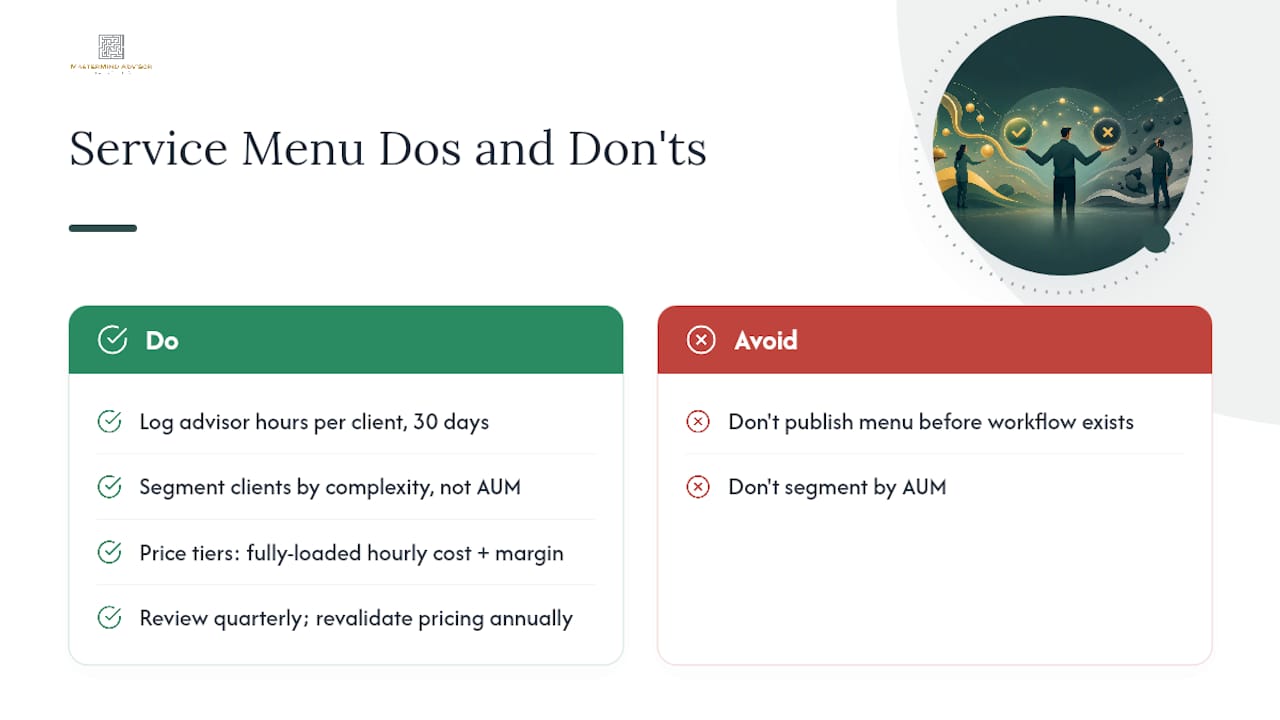
How often should a service menu be updated? Review it quarterly against actual delivery data and revalidate the full pricing structure annually, since advisor costs and client complexity both shift over time.
Sources
- How growing RIAs can build an effective tiered service model | Financial Planning
- The Client Service Model for Financial Advisors That Works | Jump
- How To Profitably Price Fee-For-Service Financial Planning | Kitces
- Fee-for-Service Financial Planning Guide | AdvicePay
- One-time and ongoing services to offer under the fee-for-service model | AdvicePay blog