

A call to action advisor is a marketing specialist who designs compliant, measurable conversion pathways — CTAs, offers, landing pages, and nurture sequences — that turn advisor content into booked consultations and qualified leads. The outcomes are concrete: more scheduled meetings, better-qualified prospects, and a clearer line from marketing spend to AUM growth. Three platforms define the space well: Mastermind Advisor Marketing (turnkey system for independent advisors), Select Advisors Institute (playbook for compliant conversion pathways), and CatchLight.ai (audience alignment and messaging guidance). The urgency is real: roughly 70% of advisor pages still lack an effective CTA, meaning most advisory websites generate traffic that never converts.
Key elements a call to action advisor owns:
- Offer design and value framing for each audience segment
- CTA copy, placement, and landing page structure
- Lead-capture flows, CRM integration, and automated nurture
- Compliance documentation and disclosure workflows
- A/B testing cadence and KPI reporting
Table of Contents
- Why do CTAs matter so much for financial advisors and RIAs?
- What does a call to action advisor actually do?
- How do you align CTAs to prospect awareness and buying cycles?
- What compliance rules apply to advisor CTAs and marketing funnels?
- How do you measure CTA performance and when do results show up?
- Step-by-step checklist for building your first CTA funnel
- Ready-to-use CTA examples and funnel templates
- When should you hire a CTA specialist or marketing partner?
- Key Takeaways
- Why diagnostic offers beat "contact us" every time
- Mastermind Advisor Marketing builds the funnel you've been putting off
Why do CTAs matter so much for financial advisors and RIAs?
CTAs are the mechanism that converts educational traffic into consultations and, ultimately, AUM growth. Without them, even a well-trafficked advisor blog is just a library — informative, but not profitable.
Direct-response principles make the case plainly: specific offers with a measurable next step outperform vague trust messaging every time. A page that says "We help families plan for retirement" gives a visitor nothing to do. A page that says "Download our 2026 Social Security timing checklist" gives them a reason to raise their hand. That distinction drives the entire business case for CTA-focused marketing.
The downstream effects compound quickly. Better CTAs mean better lead qualification, which shortens sales cycles. Shorter sales cycles mean lower cost-per-client. And when every lead enters through a documented funnel, attribution becomes straightforward — you know which channel, offer, and copy drove each booked meeting.

Pro Tip: Structure your first offer to be diagnostic or low-commitment — a checklist, a short risk quiz, or a 15-minute fit call — rather than asking for a full engagement up front. Prospects who self-select through a diagnostic offer arrive at the consultation already partially qualified.
Landing pages, offer design, and follow-up workflows are not optional add-ons. They are the infrastructure that makes CTA strategy pay off. A strong CTA without a focused landing page is like a great headline on a broken link.
What does a call to action advisor actually do?
The CTA advisor designs offers, funnels, landing pages, copy, measurement frameworks, and compliant workflows that move prospects from awareness to a booked consultation. Think of the role as part conversion strategist, part compliance-aware copywriter, and part funnel architect.
Core responsibilities:
- Design diagnostic offers and frame their value for specific audience segments
- Write short, benefit-led CTA copy (3–5 words) and determine placement inline, in headers, and on sidebars
- Build focused landing pages: one audience, one outcome, one CTA per page
- Set up lead-capture forms, CRM field mapping, and lead-scoring rules
- Create automated nurture sequences and segmentation logic
- Run A/B and multivariate tests on copy, offer framing, and button placement
- Produce reporting dashboards and optimization recommendations
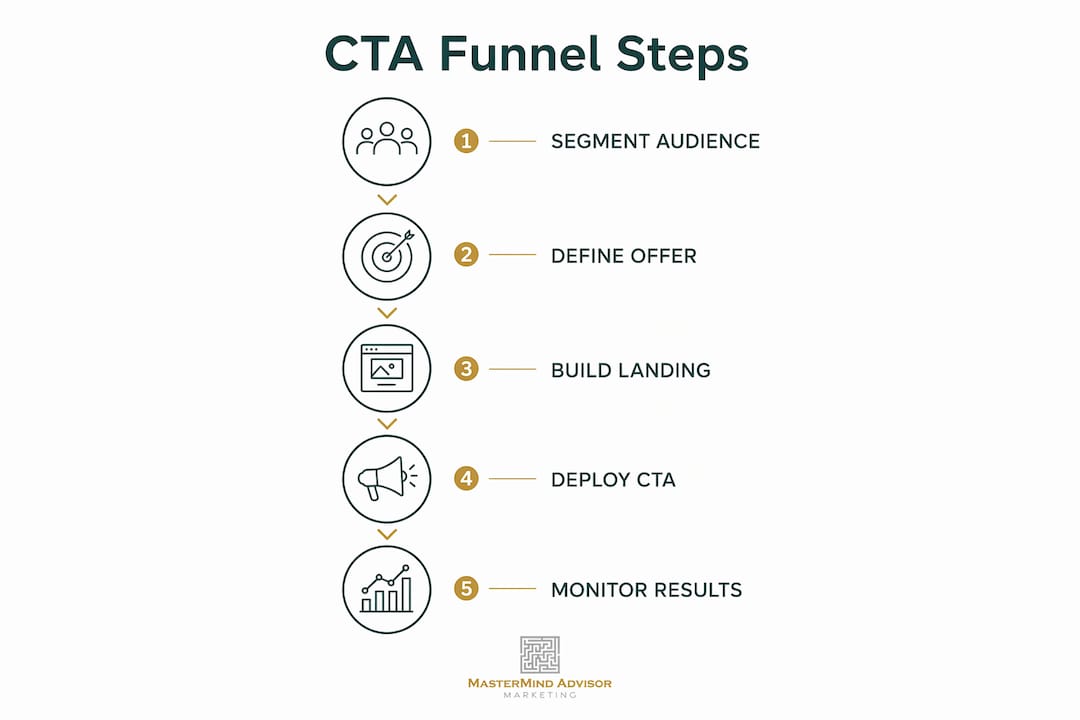
The process flows sequentially: segment audience → define the next-step offer → build the landing page and CTA → deploy via channel → capture the lead → trigger automated nurture → qualify and route to the advisor's calendar.
Operationally, the CTA advisor also documents compliance language, creates standardized follow-up sequences, and sets a testing cadence that generates statistically meaningful results without burning through the audience.
Pro Tip: Pair the CTA advisor role with a compliance reviewer from day one. Baking required disclosures and recordkeeping into the funnel design is far cheaper than retrofitting them after launch.
How do you align CTAs to prospect awareness and buying cycles?
Aligning the CTA to the prospect's awareness level is the single biggest driver of conversion lift. A cold prospect who has never heard of your firm needs education, not a calendar link. A warm prospect who has read three of your articles is ready to compare options. A hot prospect who attended your webinar wants to book.
| Awareness Stage | Prospect Mindset | Right CTA Type | Example CTA |
|---|---|---|---|
| Cold | Problem-unaware or curious | Low-commitment diagnostic lead magnet | "Take the retirement risk quiz" |
| Warm | Comparing options, building trust | Checklist, webinar, or score tool | "Download the tax planning checklist" |
| Hot | Ready to act, evaluating fit | Short fit call or portfolio review | "Book a 15-minute fit call" |
CatchLight.ai's messaging framework structures this as: Audience → Behavior (the CTA) → Content (what's in it for them) → Delivery channel → Evaluation KPIs. Skip any step and the funnel leaks.
A practical mini-funnel: a social post drives traffic to a diagnostic quiz lead magnet. The thank-you page segments respondents by score. A short survey refines the segment. The final step is a calendar booking page. Each stage has one job, and the CTA at each stage matches where the prospect actually is.
Select Advisors Institute reinforces this: without a structured conversion pathway from diagnostic offer to short fit call to nurture, even high-quality educational content rarely becomes booked consultations.
What compliance rules apply to advisor CTAs and marketing funnels?
CTA creative and funnels must include accurate claims, required disclosures, documented workflows, and retained marketing records to meet ADV and SEC expectations. FINRA-registered advisors face additional advertising rules under FINRA Rule 2210.
Compliance checklist for advisor CTAs:
- Verify all factual claims in CTA copy and landing page content are accurate and not misleading
- Include required disclaimers: registration status, that the content is for informational purposes, and any applicable advertising disclosures
- Store archived copies of every landing page version, email, and outreach piece
- Document an internal approval workflow before any CTA or offer goes live
- Maintain an audit trail for testimonials, including disclosures of any compensation or conflicts per SEC Marketing Rule requirements
- Track and document solicitation rules for events, webinars, and referral-based CTAs
Mastermind Advisor Marketing's compliance-friendly content library and templates are built with these requirements in mind, which reduces the compliance burden for independent advisors who lack in-house legal review.
Pro Tip: Keep one authoritative, versioned copy of each landing page — use archived snapshots or versioned URLs — so you can produce the exact creative that ran on any given date during an audit.
How do you measure CTA performance and when do results show up?
Measure from impression to funded household, not just clicks. Booked meetings and qualified leads are the primary KPIs; CTR is a diagnostic metric, not a success metric.
Core KPIs to track:
- Impressions and CTR (diagnostic)
- Landing page conversion rate (lead capture percentage)
- Lead-to-booking rate
- Booking-to-proposal rate
- Time-to-book from first touch
- Cost-per-booked-meeting
- Eventual conversion to client and AUM added
For testing cadence, run A/B tests for 2–4 weeks or until you reach statistical significance on the key metric. Test one variable at a time: CTA phrasing, button color, headline, or offer framing. Use sequential testing across funnel stages rather than changing everything at once.
For attribution, use UTM parameters on every channel link and map them to CRM source fields. Track cohort performance from channel to offer to booking so you know which combination is actually working.
Pro Tip: A 10% lift in booking rate typically delivers far more AUM impact than a 50% lift in CTR. Optimize for the metric closest to revenue.
Step-by-step checklist for building your first CTA funnel
Implement in stages and validate each milestone before scaling. A pilot that works cleanly beats a full launch that leaks.
- Define one audience segment and one testable offer (diagnostic lead magnet or short fit call)
- Build a focused landing page: single headline, three benefit bullets, one CTA button
- Set up CRM capture: map lead fields, source tags, and scoring rules
- Create an automated thank-you email and a 3–5 email nurture sequence
- Add a short qualification survey (3–4 questions) on the thank-you page
- Connect a routable calendar booking flow with confirmation and reminder emails
- Build a pre-call nurture sequence (1–2 emails) to prepare the prospect
- Measure booked-meeting rate for 2–4 weeks before making changes
Operationally, a quick pilot runs in 4–6 weeks. A full launch with compliance review and content production typically takes 8–12 weeks. The advisor marketing funnel maps these stages in detail if you need a visual reference.
Pro Tip: Launch one funnel per audience segment. Mixing segments in a single funnel makes it impossible to know what worked.
Ready-to-use CTA examples and funnel templates
Use narrow, diagnostic offers and concise benefit-led CTAs to improve self-selection and booking rates. Short CTAs of 3–5 words placed inline with content, in headers, and on sidebars capture intent at multiple decision moments.
Sample CTAs by funnel stage:
- "Get my tax checklist" — mid-funnel, warm prospect who has read your content
- "Take the retirement risk quiz" — top-to-mid-funnel, cold or curious prospect
- "Book a 15-minute fit call" — bottom-funnel, prospect ready to evaluate fit
Short copy template for a webinar landing page:
Headline: "Is Your Retirement Plan Ready for a Market Correction?" Value statement: "Join our 45-minute live session and leave with a personalized risk score." Three benefits: Identify gaps in your current plan / Compare three withdrawal strategies / Get a free follow-up checklist CTA button: "Reserve my spot"
Mini funnel map: Blog post → inline CTA → landing page → thank-you page with a 3-question survey → calendar booking link.
Diagnostic lead magnets — tax checklists, retirement risk scores, business exit readiness assessments — consistently outperform generic guides because they accelerate self-selection. The prospect who completes a risk quiz already knows they have a problem worth solving.
A/B test one element at a time: CTA phrasing first, then button color, then offer framing. Large simultaneous changes make it impossible to isolate what moved the needle.
When should you hire a CTA specialist or marketing partner?
Hire a specialist when you need faster, repeatable bookings and lack internal bandwidth for compliant funnel-build and testing. Most advisory firms hit this threshold earlier than they expect.
Decision signals that it's time to bring in outside help:
- Booking rates are inconsistent or declining despite steady traffic
- No documented funnels exist — leads arrive but the path is unclear
- CRM is not integrated with marketing channels
- No testing capacity or no one owns optimization
Questions to ask any marketing partner:
- Can you show examples of compliant funnels built for RIAs or fee-only advisors?
- What are your documented booked-meeting and lead-to-client metrics from past engagements?
- How do you handle ADV and advertising review in your workflow?
- What does your CRM and automation integration process look like?
- How often do you optimize, and what does a reporting dashboard look like?
Red flags: vendors who promise quick client wins without documented testing, no compliance workflow, or no plan for CRM integration. Those gaps create regulatory exposure and make attribution impossible.
For advisors who want an integrated solution, Mastermind Advisor Marketing's turnkey system covers compliance-aware funnels, webinars, landing pages, CRM integration, and ongoing optimization — built specifically for independent advisors. When evaluating financial advisor marketing agencies, use the questions above as your baseline filter.
Key Takeaways
A call to action advisor turns advisor content into booked consultations by designing compliant, measurable funnels that align offers to prospect awareness, instrument the right KPIs, and iterate through structured testing.
| Point | Details |
|---|---|
| Start with a diagnostic offer | Low-commitment lead magnets (quizzes, checklists) qualify prospects faster and improve booking rates. |
| Measure booked meetings, not clicks | CTR is diagnostic; booked meetings and lead-to-client rate are the KPIs that connect to AUM. |
| Bake compliance in from day one | Every landing page needs accurate claims, required disclosures, and an archived version for audit purposes. |
| Run short, focused A/B tests | Test one variable over 2–4 weeks; simultaneous changes make it impossible to isolate what worked. |
| Mastermindadvisormarketing as your system | Mastermind Advisor Marketing provides a turnkey, compliance-aware funnel system tailored to independent advisors. |
Why diagnostic offers beat "contact us" every time
Most advisors underestimate how much the first offer shapes everything downstream. A "contact us" button asks a cold prospect to make a commitment before they trust you. A diagnostic quiz or checklist asks them to learn something about themselves. That's a fundamentally different psychological ask — and it's why diagnostic funnels consistently outperform generic contact forms, regardless of how polished the website looks.
The compliance angle is equally underrated. Advisors who build funnels without a compliance reviewer in the room end up retrofitting disclosures, pulling pages, or worse. The firms that treat compliance as a design constraint from the start — not an afterthought — build funnels that scale without regulatory friction. That's not a nice-to-have for an RIA; it's the difference between a marketing asset and a liability.
One advisory firm that shifted from a generic "schedule a call" CTA to a retirement risk quiz saw its booking rate improve meaningfully within the first month of testing. The leads that came through were better prepared, the conversations were shorter, and the close rate improved. The funnel didn't change the advisor's expertise — it just made that expertise visible at the right moment, to the right prospect, with the right ask.
Mastermind Advisor Marketing builds the funnel you've been putting off
Independent advisors consistently know what they need to do with their marketing. The gap is execution: building compliant landing pages, integrating a CRM, writing nurture sequences, and running tests while also serving clients.
Mastermind Advisor Marketing handles the entire system — customized lead-generation webinars, a compliance-friendly content library, high-converting landing pages, CRM and email automation integration, and ongoing optimization. Every component is built for the regulatory realities of independent advisory practices, so you're not adapting a generic marketing tool to fit your compliance requirements.
The next step is straightforward: visit Mastermind Advisor to request a pilot consultation. You'll scope the engagement, define your first audience segment and offer, and get a timeline for your first compliant funnel. If you want to see how client testimonials fit into the conversion system, that resource walks through compliant usage alongside CTAs.
This article is general marketing and business information, not legal or compliance advice. Confirm current SEC, FINRA, and ADV requirements with a qualified compliance professional for your specific practice.