
A registered advisor elevator pitch is a 10 to 30 second statement that tells a stranger exactly who you help, what problem you solve for them, and what happens next if they're interested. That's it. No résumé, no list of services, no mention of your custody platform.
The formula fits in one sentence: who you serve + the problem you solve + the outcome + a low-friction call to action. A 10 to 30 second pitch structured this way gives listeners enough to react to without asking them to sit through your entire practice history.
Here's the shape it usually takes:
- Who: "I work with tech employees three years from vesting their last RSU grant."
- Problem: "Most of them have no idea what their tax bill looks like until it's too late."
- Outcome: "I help them turn equity comp into a retirement number they can actually plan around."
- CTA: "Want me to run your numbers?"
Say the whole thing out loud. If it takes longer than 30 seconds, it's too long.
Key Takeaways
An effective registered advisor elevator pitch names one client type, one problem, and one outcome, then ends with a low-friction call to action.
| Point | Details |
|---|---|
| Keep it to 30 seconds | State who you help, the problem you solve, the outcome, and a CTA in one breath. |
| Skip the jargon | Use the client's own words for their problem instead of planning terminology. |
| Match the channel | Shorten for LinkedIn DMs and voicemail, expand slightly for networking and seminars. |
| Always get compliance sign-off | Replace promissory language with exploratory phrasing before using a pitch publicly. |
| Scale it into your marketing | Mastermind Advisor Marketing builds tested pitch language into seminars, webinars, and CRM-driven follow-ups. |
Table of Contents
- What Is a Registered Advisor Elevator Pitch Meant to Do?
- Why a Sharp Pitch Changes Your Client Pipeline
- Where and When to Use Different Versions of Your Pitch
- The Anatomy of an Advisor Elevator Pitch
- How to Write and Refine Your Elevator Pitch Step by Step
- Ready-to-Adapt Pitch Templates by Audience and Channel
- Common Pitch Mistakes and a Compliance Checklist
- How to Rehearse and Improve Your Pitch Over Time
- A Marketer's View on Making Your Pitch Do More Work
- How Mastermind Advisor Marketing Turns a Tested Pitch Into a Full Lead System
- Frequently Asked Questions
- Sources
What Is a Registered Advisor Elevator Pitch Meant to Do?
An elevator pitch isn't a shrunken version of your Form ADV or your LinkedIn "About" section. Those documents exist to inform. Your pitch exists to start a conversation.
A firm brochure lists services: financial planning, retirement income strategies, tax-efficient investing. A pitch does something narrower and harder: it names one person's problem and one outcome, in language that person already uses about their own life. A pitch built to spark curiosity gets the listener asking follow-up questions instead of nodding politely and changing the subject.
You're not trying to explain your entire practice in 20 seconds. You're trying to earn the next 20 seconds. The reactions you want are specific: "Wait, how does that work?" "Can you look at my situation?" "Do you have a card?" If your pitch produces a polite nod and silence, it's doing the job of a brochure instead of the job of an opener. That distinction changes everything about how you write it.
Why a Sharp Pitch Changes Your Client Pipeline
Financial services runs on long sales cycles and referral-driven trust, which means the first ten seconds of an interaction often decide whether there's a second one at all. A vague pitch gets a vague response. A sharp one gets specific.
Compare the reactions:
- Weak pitch: "I'm a financial advisor, I help people with their money." Response: silence, maybe a business card exchange nobody follows up on.
- Sharp pitch: "I help small business owners get their retirement plan out of their business's cash flow risk." Response: "Wait, I need to talk to you about that."
A pitch designed to spark interest and invite a follow-up conversation shortens your qualification process, because the people who lean in are already self-selecting as good fits. Referral partners repeat sharp pitches almost word for word when they introduce you to someone else. Vague pitches never get repeated at all.
Where and When to Use Different Versions of Your Pitch
The same pitch doesn't work everywhere. A networking event gives you 20 to 30 seconds and a live audience that expects some personality. A LinkedIn direct message gets read in silence, so it needs to work in 10 to 15 seconds of text with zero vocal tone to carry it.
Referral introductions run differently again. Someone else is vouching for you, so your job is to confirm what they already said, not repeat your whole pitch from scratch. A voicemail needs a single sentence and a clear reason to call back, since most people delete anything longer. Email openers can run slightly longer than a voicemail but should still front-load the outcome in the first line, before anyone scrolls.
Seminar and webinar intros get more room, closer to 30 to 45 seconds, because the audience already chose to be there. Match your tone to the setting: conversational and warm in person, tighter and more direct in writing, and slightly more formal when a CPA or attorney is making the introduction for you.
The Anatomy of an Advisor Elevator Pitch
Every effective registered advisor pitch breaks down into five parts, and skipping any one of them is usually why a pitch falls flat. A three-part value promise covering who you serve, how you work, and a call to action is the backbone most advisors build from, with two extra pieces layered in for clarity and credibility.
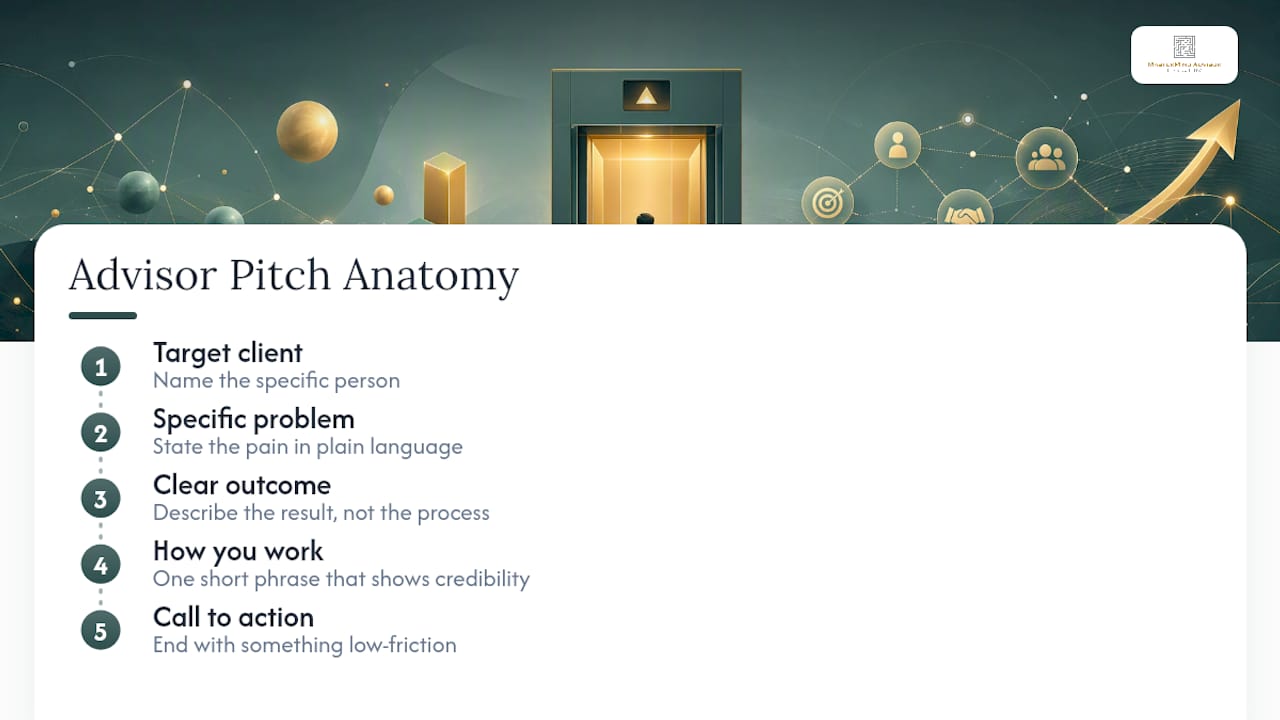
Target client. Name the specific person, not a demographic category. "Business owners" is weak. "Owners of manufacturing companies planning a sale in the next five years" is a pitch someone can react to.
Specific problem. State the pain in plain language, not planning jargon. "They've never modeled what happens to their income if the business sale falls through" beats "they need succession planning."
Clear outcome. Describe the result, not the process. "So they know exactly what their post-sale income looks like" is an outcome. "I run comprehensive financial plans" is not.
How you work or proof. One short phrase that shows credibility without a resume dump. "I've walked a dozen owners through exactly this" or "I specialize only in pre-liquidity event planning."
Call to action or question. End with something low-friction. A question works better than a statement because it invites a response instead of ending the exchange.
Stitched together, it sounds like this: "I work with manufacturing business owners who are three to five years from selling, so they know exactly what their income looks like after the deal closes. I've built this plan a dozen times. Want me to show you what yours could look like?"
How to Write and Refine Your Elevator Pitch Step by Step
Writing a good pitch is a process, not a flash of inspiration. Here's the method, start to finish.
1. Pick one niche and its single biggest problem. Resist the urge to write a pitch that works for every prospect. A pitch for "people who need retirement planning" fits nobody in particular. A pitch for "physicians in their first five years of practice carrying six figures in student debt" fits a real person you can picture. If you haven't nailed down your niche yet, working through advisor niche selection before you write a single sentence saves you from rewriting the pitch three months from now.

2. Write the outcome statement first, not last. Most advisors start by describing what they do. Flip it. Start with what changes for the client. "So they retire without wondering if they'll outlive their savings" is an outcome statement. Write three versions and read them aloud. The one that sounds like something a friend would say, not a brochure, is the one to keep.
3. Add a short proof phrase. This is one clause, not a paragraph. "I've done this for over 40 families in the last three years" or "I only work with tech employees on RSU and ISO planning." Skip credentials and letters after your name here; save that for your bio.
4. Close with a CTA or a question. The single most common failure point in advisor pitches is ending on a statement instead of an invitation. Advisors who anchor on a clear outcome and end with a specific next step see more of those pitches convert into actual meetings. A question like "Does that sound like something you're dealing with?" gets a response almost every time. A flat statement like "I'd love to help" gets nothing.
5. Say it out loud, then time it. Read your draft at a normal conversational pace, not rushed. If it's over 30 seconds, cut a clause. The proof phrase is usually the first thing to trim.
6. Test it on someone outside the industry. Read it to a spouse, a friend, anyone who isn't a financial professional. If they respond with a blank stare or "so, like, a financial planner?" your pitch is using too much industry language. People tune out financial jargon and category labels almost instantly, so a rewrite in plainer words usually fixes the problem faster than adding more detail.
7. A/B test it across two or three real settings. Use one version at a networking event, a shorter cut on LinkedIn, and see which gets more follow-up questions. Track it loosely; you don't need a spreadsheet, just a mental tally of which version people actually respond to.
8. Run the final copy by compliance before you use it anywhere public. Any phrase that implies a guaranteed result, a specific return, or a promise about outcomes needs review before it goes on your website, LinkedIn, or a printed card. This step isn't optional and it isn't slow if you build it into your process from the start rather than bolting it on at the end.
Ready-to-Adapt Pitch Templates by Audience and Channel
Swap in your own niche language, but keep the structure intact. Each of these follows the who, problem, outcome, CTA formula.
- Near-retirees, in-person networking: "I work with people five to seven years from retirement who aren't sure if their savings will actually last. I help them build an income plan that answers that question with numbers, not guesswork. Are you already tracking that, or still guessing?"
- Tech employees, LinkedIn DM: "I help tech employees turn RSU and ISO grants into an actual retirement number instead of a mystery. Worth a 15-minute call to see where you stand?"
- Small business owners, referral introduction: "[Name] mentioned you're thinking about an exit in the next few years. I specialize in helping owners like you know exactly what your income looks like after the sale closes."
- HNW families, seminar intro: "Most families with significant assets have a portfolio but no coordinated plan across estate, tax, and income. I build that coordination so nothing falls through the cracks between advisors. Happy to walk you through what that looks like after tonight's session."
- CPA or attorney referral partner: "I focus exclusively on physicians carrying six figures in student debt alongside a growing income. When your clients hit that stage, I can build the debt-versus-investing plan so you don't have to."
- Voicemail follow-up: "This is [Name] with [Firm]. I work with small business owners planning an exit and wanted to share a quick idea on protecting your retirement from a deal that falls through. Call me back at [number]."
- Cold approach at an event: "I help nonprofit executive directors figure out if their retirement plan can survive a smaller paycheck than they're used to. Does that question ever come up for you?"
- Email opener: "Quick note: I specialize in helping widows and widowers reorganize their finances in the first year after a loss, without the pressure of big decisions right away."
- Podcast or webinar intro: "I've spent the last decade helping teachers and public employees make sense of pension elections most people get wrong the first time."
If a phrase feels too bold for compliance, swap "I guarantee" or "you will" for softer, exploratory language: "I help clients explore whether X is realistic" reads very differently to a compliance reviewer than "I'll make sure X happens," while still landing the same idea for the listener.
Common Pitch Mistakes and a Compliance Checklist
Most weak pitches fail for the same handful of reasons, and every one of them is fixable in a single rewrite pass.
Avoid:
- Leading with your title instead of the client's problem ("I'm a financial advisor" tells a listener nothing they can react to).
- Listing every service you offer instead of naming one.
- Using words like "comprehensive," "holistic," or "customized" that describe nothing specific.
- Making promissory claims about returns, guarantees, or outcomes you can't verify.
Do:
- Anchor on one client type and one problem.
- Use the exact words that type of client uses about their own situation.
- End with a question, not a statement.
- Run every public-facing version through your firm's compliance review before it appears on a website, card, or LinkedIn profile, using something like an advisor compliance marketing checklist as a starting point.
Common risky phrase → compliant rewrite: "I'll guarantee your retirement is secure" becomes "I help clients build a plan designed around their retirement goals." "I'll maximize your returns" becomes "I help clients pursue their investment goals within their risk tolerance."
Pro Tip: Keep a swipe file of three pitch variations, one for networking, one for LinkedIn, one for referral intros, and get all three approved by compliance at once. It saves you from waiting on approval mid-conversation later.
How to Rehearse and Improve Your Pitch Over Time
A pitch you've never said out loud isn't finished; it's a draft. Record yourself delivering it on your phone, then listen back the way a stranger would hear it. Most advisors are surprised by how much filler language creeps in ("um," "so basically," "what I do is") that never shows up on paper.

Improv-style pair practice works better than solo rehearsal. Have a colleague play a skeptical prospect and react honestly, not politely. If they ask a genuine follow-up question, the pitch is working. If they nod and say "cool," it isn't yet.
Track a few simple signals over the next month: how many discovery meetings your pitch produces, whether referral partners repeat your language back to you unprompted, your reply rate on LinkedIn openers, and whether voicemails actually get callbacks. A specific, low-friction next step tends to convert into more booked meetings than a vague "let's connect sometime."
Once a version consistently earns good reactions, reuse it everywhere. The line that works at a networking event usually works as a website headline, a LinkedIn summary opener, or the first sentence of a seminar invitation. Consistency across channels means prospects hear the same clear message no matter where they first encounter you.
A Marketer's View on Making Your Pitch Do More Work
Most advisors treat their elevator pitch as something they say once at a networking event and forget. That's a mistake. The pitch you refine in conversation should become the verbal headline running through your entire lead generation system, not a line you retire after the handshake.
Think of it as raw material. The outcome statement that lands in person is the same line that should open your seminar invitation, anchor your webinar registration page, and show up as the first sentence of your follow-up email sequence. Advisors who treat their pitch as one-off small talk end up running three or four inconsistent messages across their marketing, and prospects notice the disconnect.
The fix is simple: once a pitch hook consistently earns good reactions in real conversations, lock it in and reuse it everywhere, always pointing back to the same discovery call offer.
How Mastermind Advisor Marketing Turns a Tested Pitch Into a Full Lead System
Writing a sharp pitch is the easy part. Getting it in front of the right prospects, consistently, across seminars, webinars, and email, without spending your evenings building funnels yourself, is where most independent advisors stall out. That's the gap Mastermind Advisor Marketing closes: a turnkey system that takes the pitch language you've already tested and builds it into seminar scripts, webinar funnels, and compliant email sequences, backed by CRM integration so no lead gets dropped.
Rather than hiring a generalist agency that treats your practice like any other small business, you get a system built specifically around long financial-services sales cycles and firm compliance requirements. Your tested outcome statement becomes the headline on your seminar invite, the hook in your webinar registration copy, and the opener in your automated follow-up emails, all pulling prospects toward one consistent next step. If you're ready to see what that looks like for your practice, start with Mastermind Advisor and map out your first campaign.
Frequently Asked Questions
What is a registered advisor elevator pitch, in one sentence? It's a 10 to 30 second statement naming who you help, the problem you solve, the outcome you create, and a next step, designed to start a conversation rather than describe your entire practice.
How long should an advisor elevator pitch actually be? Most effective pitches run 10 to 30 seconds. LinkedIn DMs and voicemails should sit at the shorter end; networking and seminar intros can stretch closer to 30 seconds.
Do I need a different pitch for every channel? Not a completely different pitch, but adjust length and tone. The same core outcome statement should carry across networking, LinkedIn, referral intros, and email, just trimmed or expanded to fit.
What's the biggest mistake advisors make in their pitch? Leading with their job title or a list of services instead of naming a specific client and problem. A pitch that could apply to any advisor rarely gets a reaction from anyone.
Does my elevator pitch need compliance approval? Yes, especially any version that will appear publicly on a website, LinkedIn profile, or printed material. Avoid promissory language and get final copy reviewed before wide use.
Sources
For a step-by-step breakdown of the 10 to 30 second structure, see 5 Steps to Writing Your Financial Advisor Elevator Pitch. For the compliance-minded angle on avoiding jargon and generic phrasing, read Why People Tune Out Financial Advisor Pitches. Advisors looking for more advanced introduction phrasing, especially for referral and advisor-to-advisor settings, should check Kitces on introducing yourself as a financial advisor. For turning a tested pitch into your firm's positioning across every channel, see Advisor Positioning Strategy.
- 5 Steps to Writing Your Financial Advisor Elevator Pitch
- How to Create a Valuable Elevator Pitch as a Financial Advisor
- Why People Tune Out Financial Advisor Pitches
- 3 Steps To Making The Perfect Elevator Pitch | Financial Planning
- Why Your Sales Pitch As A Financial Advisor Isn’t Getting Clients - B2B Inbound Marketers