
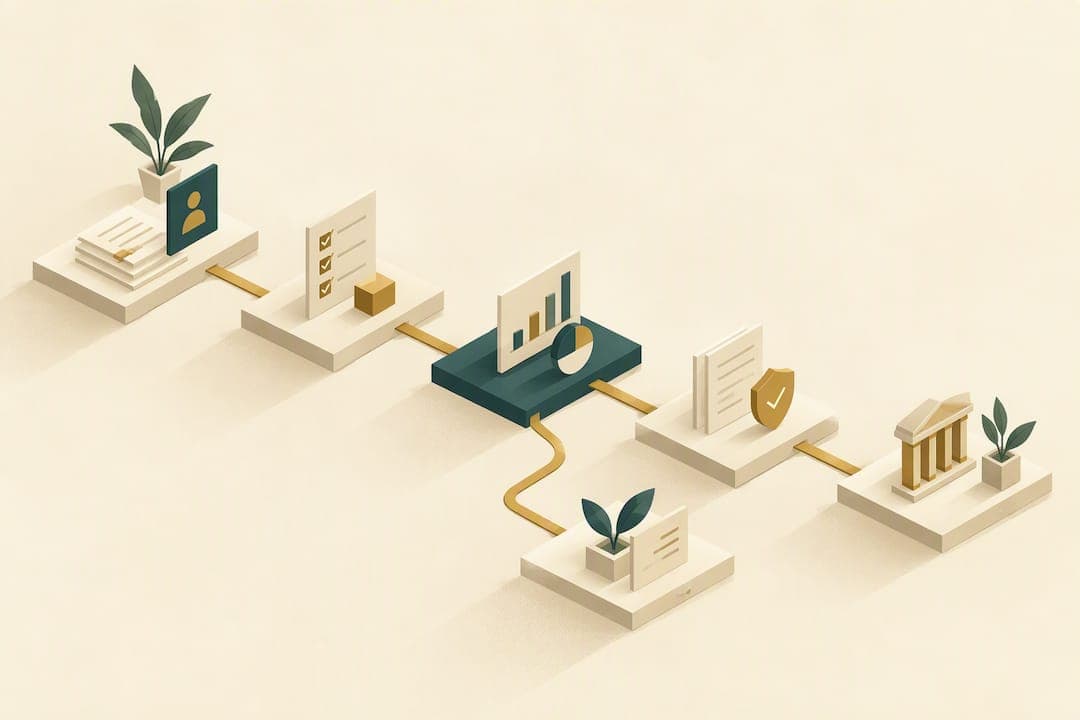
The pipeline model that works best for most advisory practices has several stages, each with written entry criteria that an associate or advisor applies the same way every time. Pair that with consistent CRM hygiene and you get forecasting you can trust and conversion data you can actually act on. This article lays out sample stage sets, CRM field templates, conversion benchmarks, weekly rituals, compliance notes tied to the SEC Marketing Rule, and a 90-day pilot you can run starting this quarter.
TL;DR:
- Choose four stages for a small team, five as a default, or seven when longer sales cycles and multiple handoffs require finer tracking.
- Require completed ideal client profile fields, including assets, service fit, client problem, and estimated first year revenue, before prospects advance.
- Make next step dates mandatory, flag records after 14 inactive days, and move prospects to nurture after 30 days without a scheduled action.
- Use at least 12 months of your own stage history for conversion rates, recalculate them quarterly, and test changes at the slowest stage.
- For testimonials and endorsements, retain promoter agreements unless the promoter is an affiliate or received $1,000 or less in the prior 12 months.
Table of Contents
- Why pipeline stages matter more than marketing metrics
- How your ideal client profile reshapes stage entry
- Copy-ready stage models for 4, 5, and 7 steps
- Setting up CRM fields, stage rules, and a hygiene checklist
- The lead-to-close math behind your revenue target
- Daily, weekly, and monthly rituals that keep data current
- KPIs, dashboards, and spotting where deals stall
- SEC marketing rule obligations tied to pipeline activity
- A 90-day pilot for rolling out new stages
- Why the simplest working pipeline beats the perfect one
- How Mastermind Advisor Marketing builds this for you
- FAQ
- Sources
Why pipeline stages matter more than marketing metrics
A marketing funnel measures how many people raised their hand. A sales pipeline measures what happens after that, and the two get confused more often than they should. Marketing generates the inquiry; sales treats that inquiry as the start of a separate process with its own stages, owners, and conversion metrics. When advisors collapse the two into one undifferentiated list, they lose the ability to tell whether a slow quarter is a lead problem or a closing problem.
Clear stages turn vague progress into measurable milestones. A prospect either met the criteria to move from "discovery scheduled" to "plan presented" or they did not. That binary judgment is what makes forecasting possible: if you know how many prospects sit in each stage and your historical conversion rate between stages, you can project closes for the quarter with real precision instead of a gut feeling.
Most practices get this wrong in three predictable ways.
- Vague stage names like "warm lead" or "in progress" that mean something different to every team member.
- No entry criteria, so prospects get moved forward based on optimism rather than a completed action.
- Inconsistent CRM updates, where stages reflect what someone remembers rather than what actually happened on a given date.
Fixing those three issues before you touch anything else will do more for your forecast accuracy than adding more stages or buying a new tool.
How your ideal client profile reshapes stage entry
Your ideal client profile (ICP) is not just a marketing filter. It is the gate that decides whether a prospect deserves to occupy space in your pipeline at all, and skipping this step is why so many advisors end up with a pipeline full of people who will never become clients.
Capture a short set of ICP fields at intake:
- Investable assets or household net worth, to flag whether the prospect clears your minimum.
- Service tier fit, whether they need comprehensive planning, investment management only, or a specialized service like equity compensation or business exit planning.
- Problem type, the specific trigger (retirement timing, inheritance, job change) that brought them to you.
- Fee potential, an estimate of first-year revenue based on assets and service tier.
Once those fields exist, build an automatic qualification flag in your CRM that only lets a prospect advance past the first stage when the ICP fields are filled in and meet your threshold. A solo advisor working a narrow niche might set a hard asset minimum and reject anything below it immediately. A growth-stage firm with a junior advisor track might keep a lower bar in the early stage, routing smaller prospects to a different service tier instead of turning them away outright. Lead-generation sources that consistently produce prospects who fail the ICP test are worth reconsidering, even if they generate volume.
Copy-ready stage models for 4, 5, and 7 steps

Pick the shortest model that still gives you useful data. More stages are not automatically better, they are only better when each one marks a distinct, observable decision point.
Four-stage model, best for solo advisors or small teams who want momentum over granularity. Practitioners who favor this approach argue that simplicity around four stages keeps a small team moving without getting lost in administrative overhead.
- New inquiry: prospect has reached out or been referred; entry requires a name, contact information, and lead source logged.
- Qualified: ICP fields are complete and the prospect clears your minimum; entry requires a completed intake form or discovery call booked.
- Proposal: a plan or recommendation has been presented; entry requires a scheduled or completed presentation meeting.
- Client or closed: prospect signed paperwork or explicitly declined; entry requires a signed agreement or a documented closed reason.
Five-stage model, the most common structure in the industry and a good default for most practices. Kitces describes a five-step structure built around an initial inquiry, a brief screening call, a discovery meeting, plan preparation, and a presentation meeting where recommendations and fees are reviewed.
- Inquiry: initial contact logged with source and date.
- Screening call: a short call confirms fit before investing planning time; entry requires the call to be scheduled.
- Discovery meeting: a deeper conversation on goals and finances; entry requires the screening call to be completed with a qualified outcome.
- Plan preparation: internal work on a tailored recommendation; entry requires discovery notes and data-gathering to be complete.
- Presentation and close: the plan is reviewed with the prospect, fees are quoted, and a decision is requested; entry requires a scheduled presentation meeting.
Seven-stage model, suited to firms with longer sales cycles, multiple service lines, or a dedicated business development role that needs finer-grained handoffs between marketing, a sales associate, and the lead advisor.
- Raw inquiry, qualified lead, discovery scheduled, discovery completed, plan in development, proposal delivered, and closed (won or lost), each with its own entry date and owner.
Add a nurture or revisit bucket outside the primary pipeline for prospects who are a fit but not ready now, rather than letting them die silently in an active stage. Label closed-lost reasons specifically ("fee objection," "chose another advisor," "not ready," "failed ICP") instead of a generic "lost," since that detail is what lets you spot a pattern worth fixing. Your choice of sales engagement style, whether you Do, Show, or Tell during the sales process, also affects how many stages make sense: a Do-heavy process that does real planning work before a prospect commits needs more stages to track that effort than a Tell-based single-meeting close.
Setting up CRM fields, stage rules, and a hygiene checklist
Stage names mean nothing if the CRM behind them is inconsistent. Kitces recommends tracking seven core data points for every prospect to make pipeline health and bottlenecks visible: inquiry date, lead source, qualification flags, each meeting date, close date, stage, and first-year revenue estimate.
- Inquiry date and source: the day the prospect entered your pipeline and where they came from, logged automatically whenever possible.
- ICP qualification flags: the fields described earlier, stored as structured data rather than free text so you can filter and report on them.
- Next-step date: a mandatory field so every open prospect has a scheduled action, never a blank "follow up later."
- Meeting dates: discovery, presentation, and any other meeting, each with its own date field.
- Revenue estimate and close date: an estimated first-year revenue figure entered at qualification, updated at proposal, and a close date recorded the moment a decision is made.
Paste-ready stage description for your CRM: "Discovery completed: prospect has finished a data-gathering meeting, provided account statements or equivalent documentation, and confirmed interest in receiving a formal recommendation. Entry requires the discovery meeting date and a completed notes field."
A few automations keep the data honest without adding manual work. Set an aging rule that flags any prospect with no activity in 14 days. Automatically move a prospect to the nurture bucket after 30 days with no scheduled next step rather than leaving them in an active stage. Require a closed-reason field before a record can be marked lost. These rules, along with similar CRM workflow templates built for a 90-day rollout, are the kind of automation that turns a pipeline from a static list into a self-correcting system.
Pro Tip: Run a monthly CRM audit where you pull every record with no activity in 30 days and either schedule a next step or move it to nurture; a clean pipeline is worth more than a full one.

The lead-to-close math behind your revenue target
Work backward from the revenue number you need to hit. Say you want $150,000 in new first-year revenue this year, and your average new client generates $5,000 in first-year revenue, an illustrative figure for this example only. That means you need 30 new clients.
That kind of backward math only works when your stage-to-stage conversion rates are built from your own data rather than borrowed from someone else's firm. Conversion rates vary widely by niche, fee structure, and sales method, and a firm running a Do-heavy planning process will see different numbers than one running a single-meeting close.
- Pull at least 12 months of stage history before trusting a conversion rate.
- Recalculate your stage-to-stage percentages every quarter, since seasonality and lead source mix shift the numbers.
- Treat any conversion benchmark you read elsewhere as a sanity check, never a target to force your own data to match.
Time-in-stage is one of the most actionable signals you have. Recording the date of every meeting and the close date lets you calculate average days-to-close and spot exactly which stage is holding deals longest, which is usually a more useful fix than chasing more top-of-funnel volume.
Daily, weekly, and monthly rituals that keep data current
A pipeline is only as good as the habits that maintain it. Three short rituals, consistently run, matter more than any dashboard.
- Daily (5 to 10 minutes): each advisor or associate scans their open prospects, confirms every record has a scheduled next step, and reschedules anything that slipped. This is a sanity check, not a review.
- Weekly: the team reviews stalled deals, meaning anything past its aging threshold with no movement, and either assigns a follow-up action or moves it to nurture. This is also when follow-up cadence and prospecting templates get audited for whether they are actually being used.
- Monthly: the team reviews stage-to-stage conversion rates against the prior quarter, updates the forecast, and checks capacity, whether the advisor team can handle the proposals currently in the pipeline without a backlog forming.
Assign explicit ownership to each ritual. A practice manager or senior associate usually owns the weekly stalled-deals review, while the lead advisor owns the monthly forecast and capacity conversation. Without a named owner, these rituals quietly stop happening within a few months, and the pipeline data decays back into guesswork.
KPIs, dashboards, and spotting where deals stall
A one-page dashboard beats a sprawling report that nobody opens. Four KPIs cover most of what a growing practice needs to watch.
- Pipeline opportunity value: the sum of estimated first-year revenue across all open prospects, a rough forecast ceiling.
- Average days in stage: calculated from your meeting and close-date fields, this is the clearest signal of where a deal gets stuck.
- Close rate: closed-won prospects divided by total prospects that reached the final stage in a given period.
- Conversion by source: close rate segmented by lead source, which tells you whether a webinar, seminar, or referral channel is actually producing clients, not just inquiries.
Build the dashboard around four widgets, one per KPI above, refreshed weekly for a quick snapshot and reviewed in depth once a month alongside the ritual described earlier. When a number moves, treat it as a signal to test something rather than a verdict. A practical approach from Kitces is to pick the single stage with the longest average days-in-stage, run a two-week experiment with a structured follow-up cadence and a named owner, and measure whether movement and close rates improve before rolling the tactic out more broadly. That kind of small, measured test beats a wholesale process overhaul almost every time.
SEC marketing rule obligations tied to pipeline activity
Pipeline-driven marketing often leans on testimonials, client success stories, or third-party ratings to move prospects through early stages, and that activity falls squarely under SEC oversight. The SEC's Marketing Rule compliance guide requires a written agreement with any promoter unless that promoter is an affiliate or received $1,000 or less in compensation over the prior 12 months. A 2025 Risk Alert from the SEC Division of Examinations flagged testimonials, endorsements, and third-party ratings as recurring areas of compliance deficiency, with disclosure, oversight, and recordkeeping named as the most common gaps.
Build this into your pipeline hygiene, not as a separate compliance project:
- Store every written promoter agreement in a single, auditable location tied to the campaign that used it.
- Prepare standard disclosure language in advance for any testimonial, endorsement, or third-party rating before it reaches a prospect.
- Log promotional compensation for every promoter relationship, even informal ones, so the $1,000 threshold is never a guess.
A closer look at the testimonial and endorsement conditions is worth reading before you add any client story to a webinar, seminar, or nurture email tied to your pipeline.
A 90-day pilot for rolling out new stages
Rolling out a new pipeline structure works better as a defined pilot than an open-ended change. Ninety days is long enough to see real conversion data and short enough to keep the team engaged.
- Weeks 1 to 2: finalize your stage model and entry criteria, write the paste-ready stage descriptions, and get sign-off from everyone who touches the CRM.
- Weeks 3 to 4: import or clean existing CRM records into the new stages, build the aging and nurture automations, and assign ritual ownership.
- Weeks 5 to 8: train the team on entry criteria and next-step logging, and launch or continue a lead source, such as a webinar or seminar funnel, to feed fresh inquiries into the new structure.
- Weeks 9 to 12: run the weekly and monthly rituals as designed, record KPIs at the 30, 60, and 90-day marks, and compare days-in-stage and close rate against your pre-pilot baseline.
Pro Tip: Freeze any other process changes during the 90 days so you can tell whether a conversion shift came from the new stages or from something else entirely.
A turnkey system that already bundles webinar funnels, compliant content, and CRM automations can compress this timeline considerably, since the lead source and the stage automations launch together instead of in sequence, improving lead gen and SEO performance. That is one way to run this pilot, not the only one, but it removes a lot of the setup work that otherwise eats the first month.
Why the simplest working pipeline beats the perfect one
The advisors who get the most out of a pipeline rebuild are not the ones who design the most elegant stage model, they are the ones who pick something good enough and actually use it every day. A seven-stage system that nobody updates is worse than a four-stage system logged consistently, because stale data produces a forecast that is worse than no forecast at all.
Build a simple version that captures key decisions at each stage, run it consistently over time, and then improve based on what the data reveals. Waiting to launch until the process feels finished is usually just a way of avoiding the harder work of getting the team to actually use it. Alignment matters more than architecture: a team that agrees on what "qualified" means will outperform a perfectly designed stage model that half the office ignores.
— Josh
How Mastermind Advisor Marketing builds this for you
Setting up stages, CRM rules, and a working lead source at the same time is the part most practices never get to, not because the plan is unclear but because nobody on the team has the hours. We offer a turnkey system that bundles webinar funnels, compliant content, and CRM automations configured together so the pipeline and the lead source launch on the same timeline instead of months apart.
A typical pilot engagement runs the same 90-day structure outlined above, with setup work handled directly:
- Stage definitions and CRM entry criteria built and configured in the system.
- Automated email follow-ups and a webinar or seminar funnel live as the first new lead source.
- A KPI baseline recorded at day 30, 60, and 90 to show the pilot's impact.
If you want a done-for-you version of the pilot above, see our services and request a pipeline implementation consultation.
FAQ
What are the five stages of a sales pipeline?
A common structure used in financial advisory sales is inquiry, screening call, discovery meeting, plan preparation, and a presentation and close meeting where fees are quoted. Kitces outlines this five-step structure as a widely used default, though firms with shorter or longer sales cycles sometimes use four or seven stages instead.
What are the five phases of a process pipeline?
Definitions vary by industry, but in a financial advisory context the phases typically mirror the sales pipeline stages: inquiry, qualification, discovery, proposal, and close. Each phase should have written entry criteria recorded in the CRM so a prospect only advances once a specific, observable action has happened.
Which CRM is best for pipeline management?
The right CRM depends on your firm's size, service model, and existing tech stack, and no single platform is correct for every practice. What matters more than the brand is whether the CRM supports the required fields, inquiry date, source, ICP flags, next-step date, and revenue estimate, and whether it can automate aging and nurture rules.
How do I calculate how many leads I need?
Start with your revenue target, divide it by your average first-year revenue per client to get the number of closes you need, then work backward through your historical conversion rates at each stage to find the required number of inquiries. Recalculate those conversion rates from your own CRM data every quarter rather than relying on industry averages.
What does the SEC require for testimonials in advisor marketing?
Advisors using testimonials or endorsements generally need a written agreement with the promoter unless that person is an affiliate or received $1,000 or less in compensation over the prior 12 months, per SEC marketing rule guidance. A 2025 SEC Risk Alert also flagged disclosure and recordkeeping around testimonials and third-party ratings as common compliance gaps.
Sources
- 5-Step Not-Cheesy Prospecting Process For Financial Advisors — Kitces
- Investment Adviser Marketing compliance guide — SEC